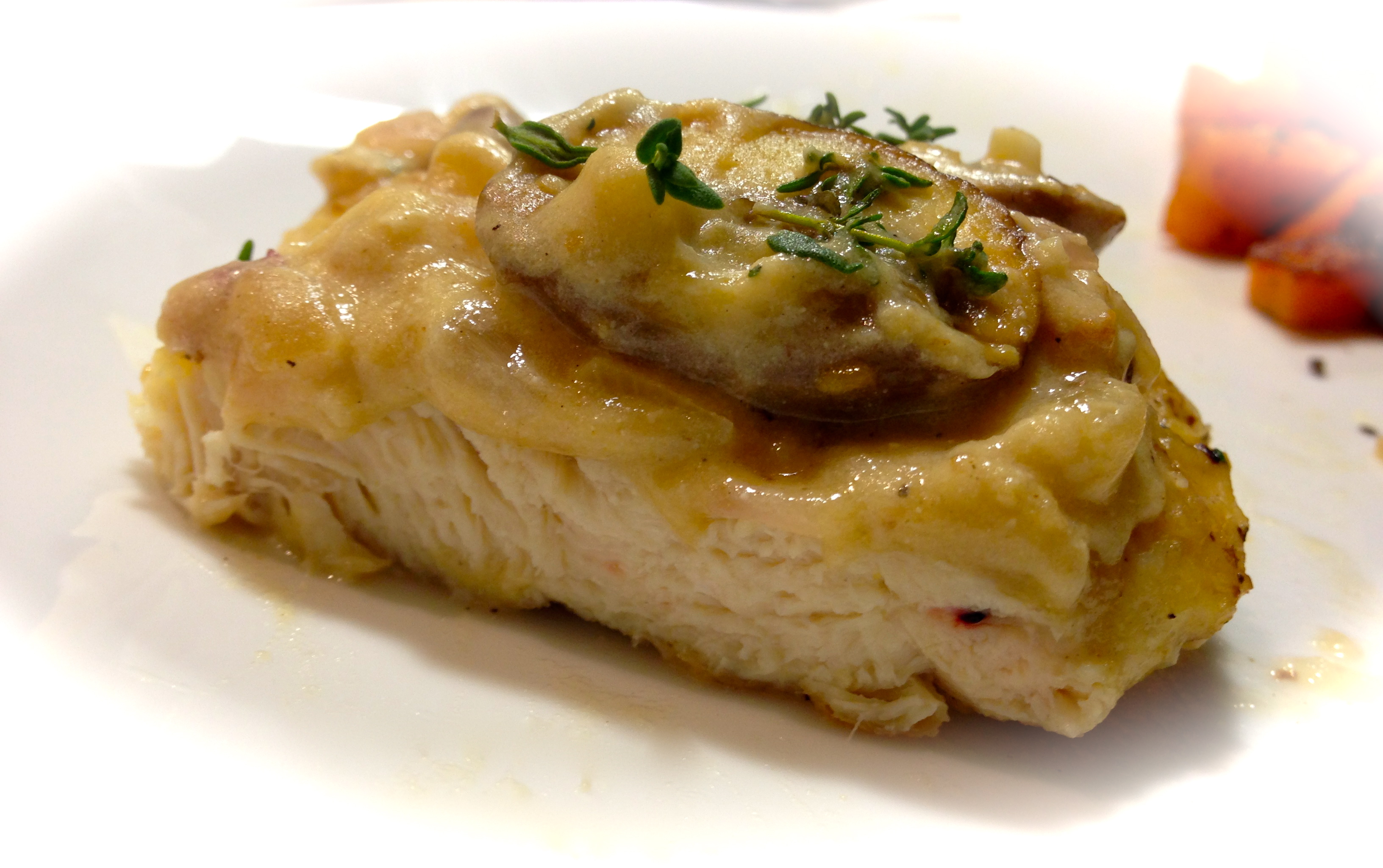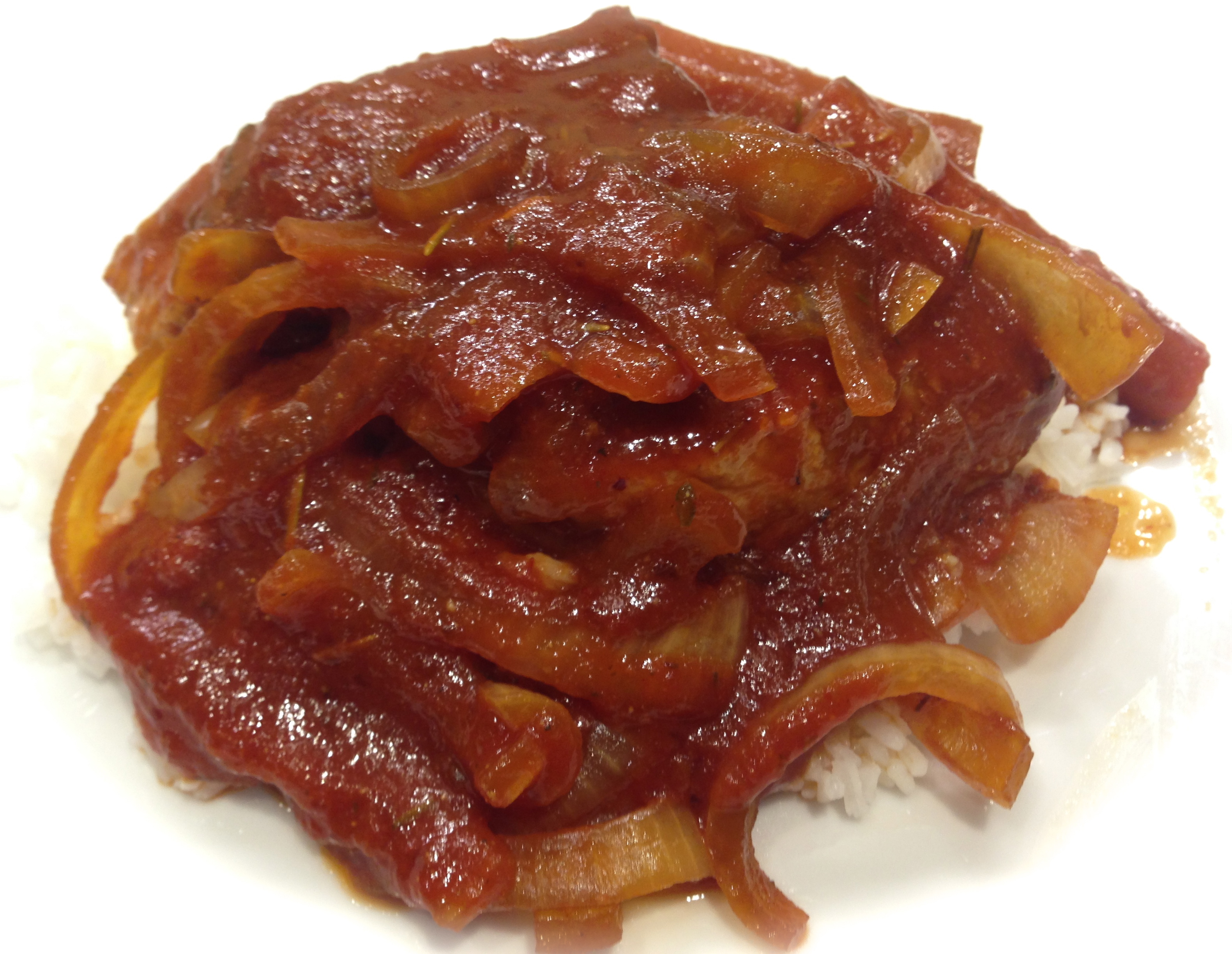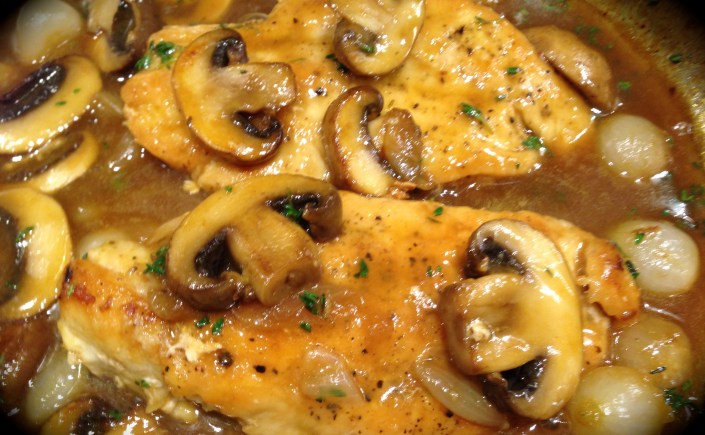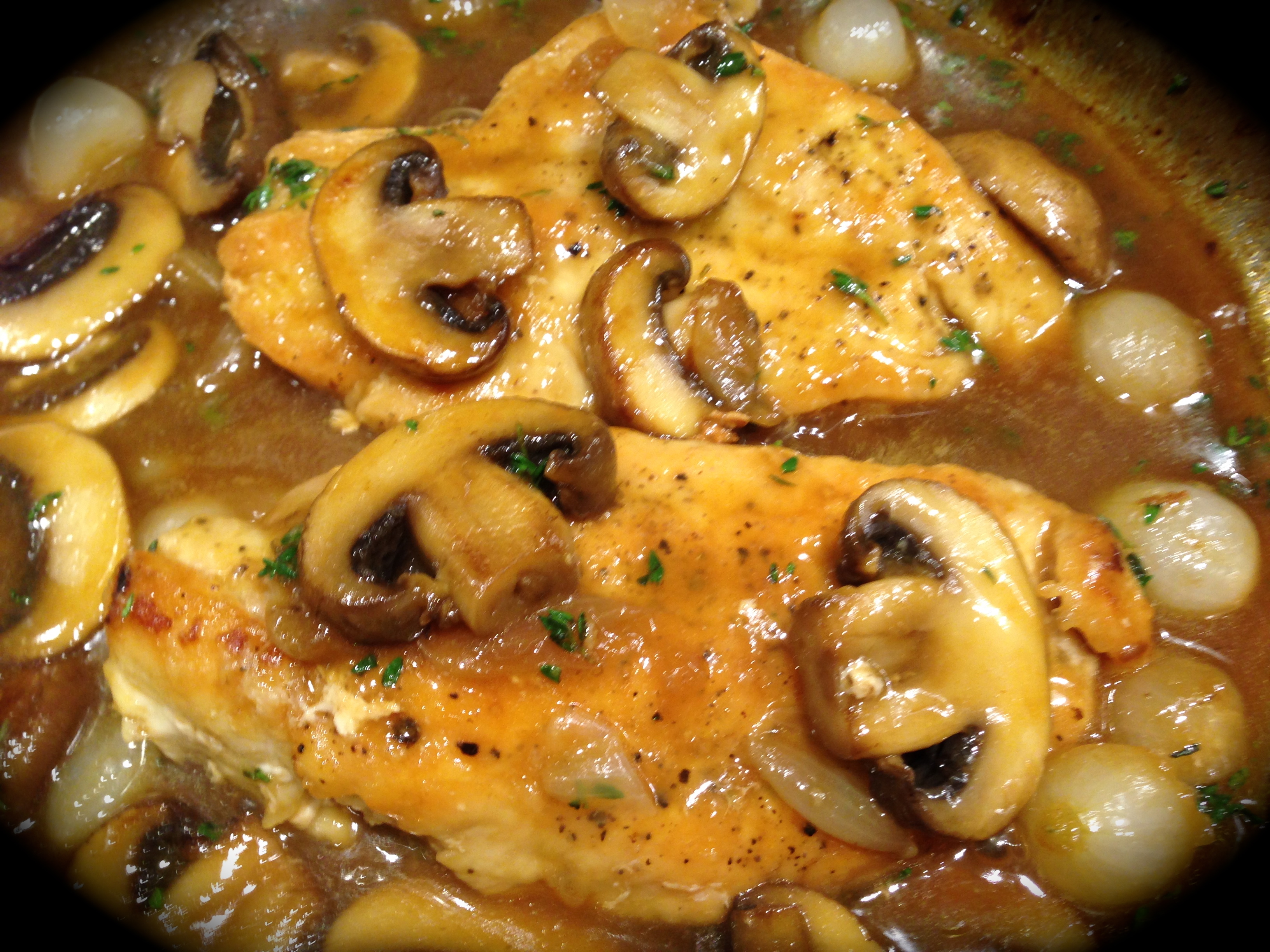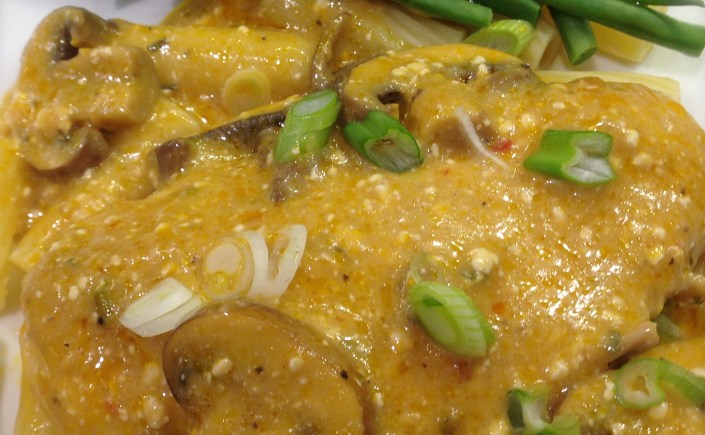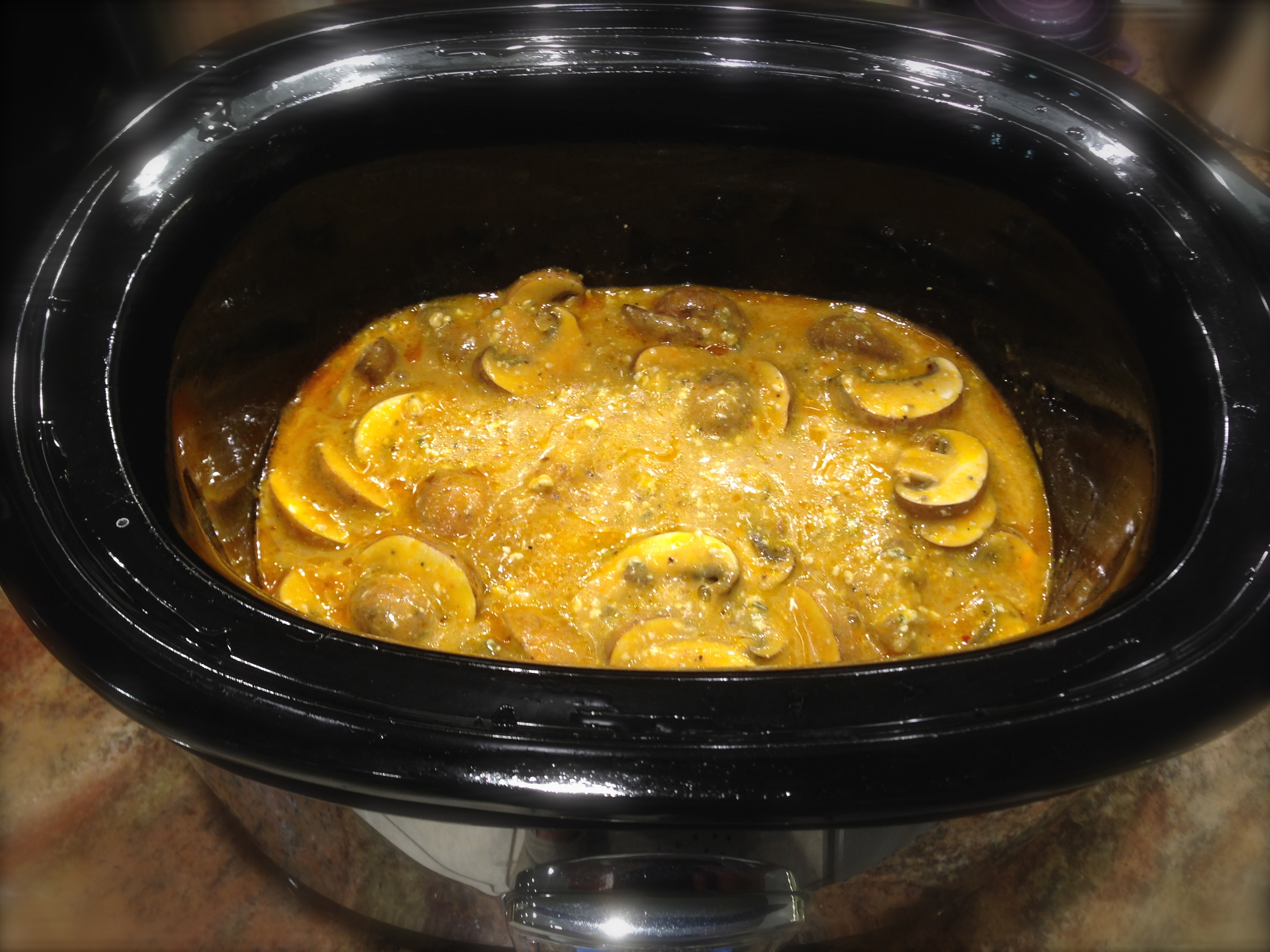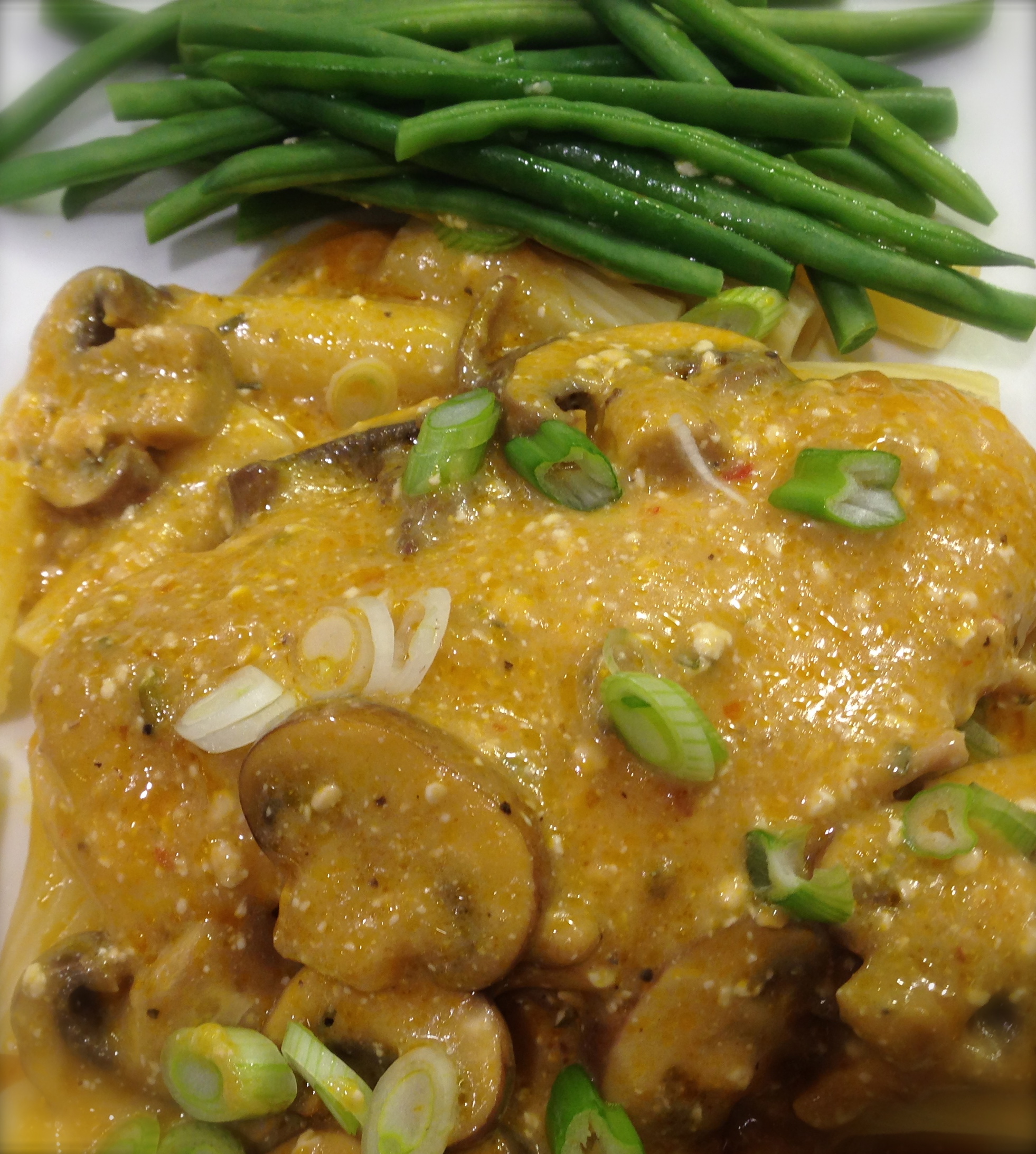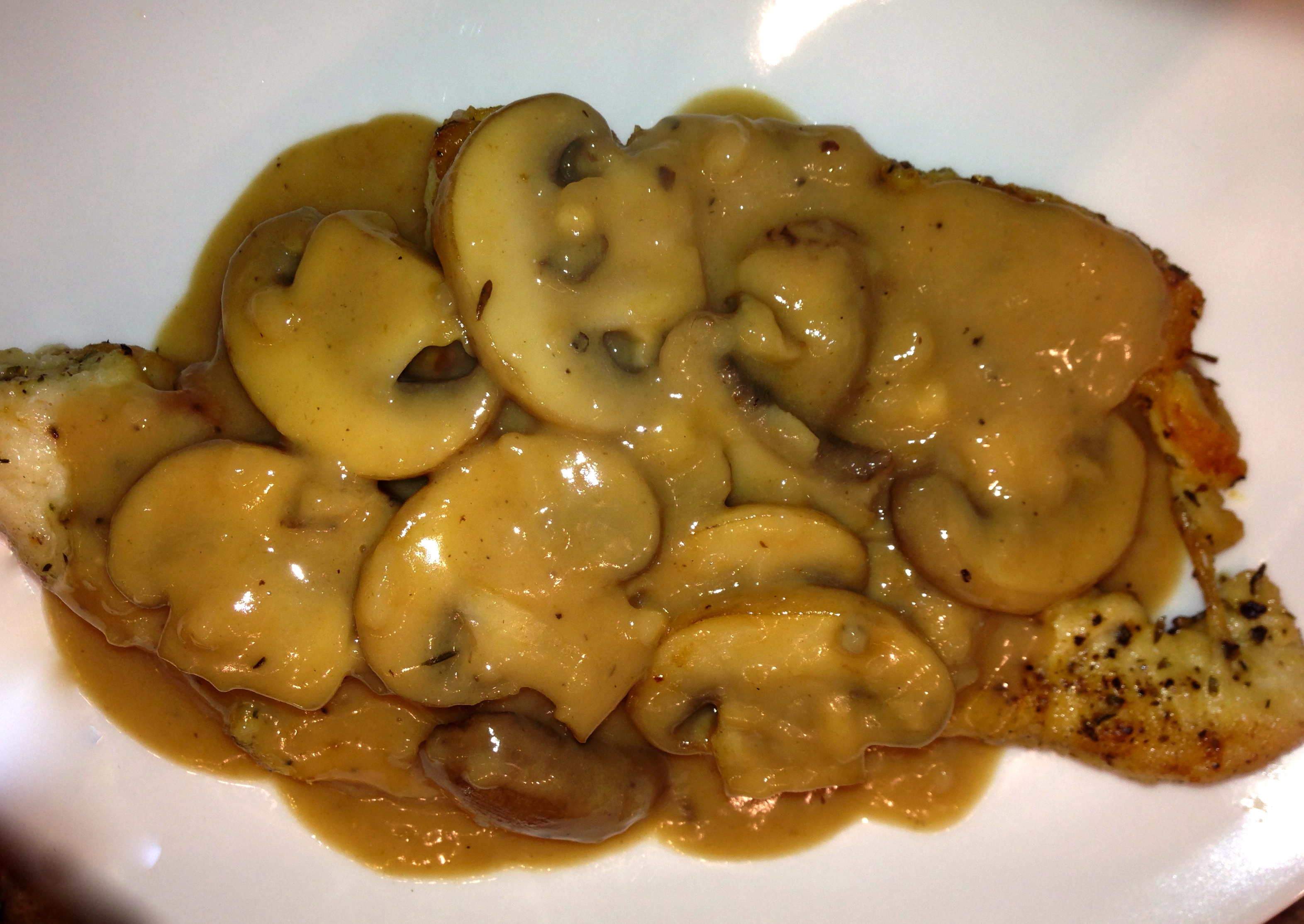
Chicken Cutlets with Thyme Mustard Sauce…

I’m always looking for a quick and easy dinner recipe and I’m always on the hunt for new ways with chicken. This particular recipe definitely fits the bill in both areas. I like this recipe for a variety of reasons but mostly because it’s so easy and so flavorful. If you’re a chicken fan like I am, this recipe will become one of your favorites.

Recipe Rating – A+: This recipe is so good and easy to prepare that even I was a little amazed. My husband, who normally just gives me either a thumbs up or thumbs down on a new dish, felt compelled to comment. He must have said at least three times, “this chicken is really good.” That in itself is super validation for this particular recipe.
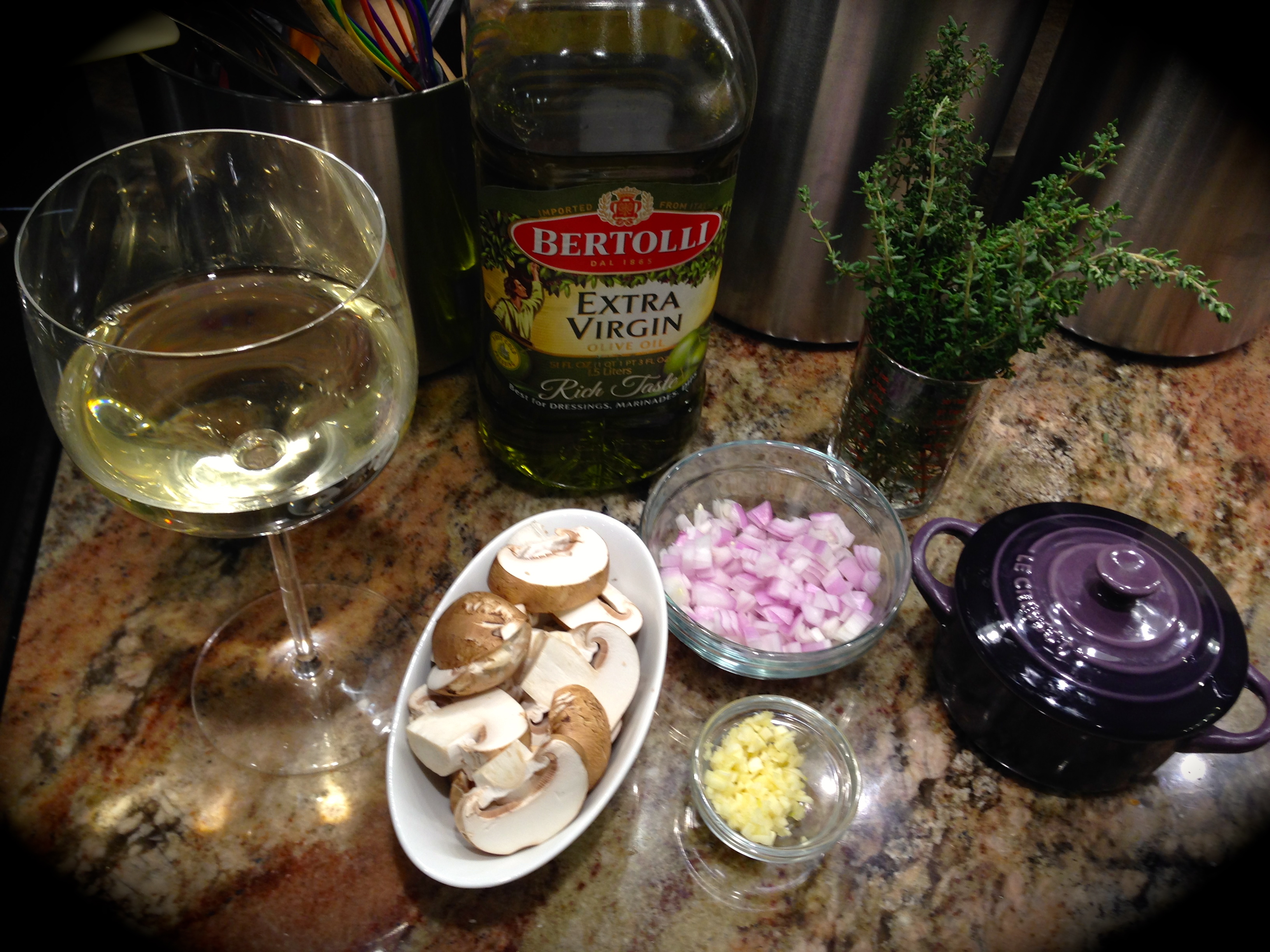
IMG_0548Lessons Learned 1 – Never underestimated the power of having a glass of wine while preparing a new recipe: I just had to put this in here. Usually I am a little nervous when trying out a new dish. Those few sips while I’m cooking away make the experience pleasurable. Add a little music to the mix and I begin to feel like Julia Child’s got nothing on me. I know I’m being slightly tongue and cheek here, but the idea is to do whatever you can to make the experience a good one. Anything that helps you enjoy the process is worth it. Have fun in the kitchen. I know I do.

Lesson Learned 2 – Prepping ahead always makes it easier: A couple of years ago my husband got me a Christmas gift of some cooking classes. One of the things that really stuck with me from those classes was the importance of prepping all of your ingredients first. Cooking time should be cooking time and not prepping time. So mince your shallots, slice your mushrooms, chop your garlic and thyme, measure out any ingredients that you don’t feel comfortable eyeballing, such as the sour cream, wine and mustard, and have everything set and ready to go before you start the cooking process. You’ll find it will help keep your kitchen cleaner and more organized and that will also make the experience better.
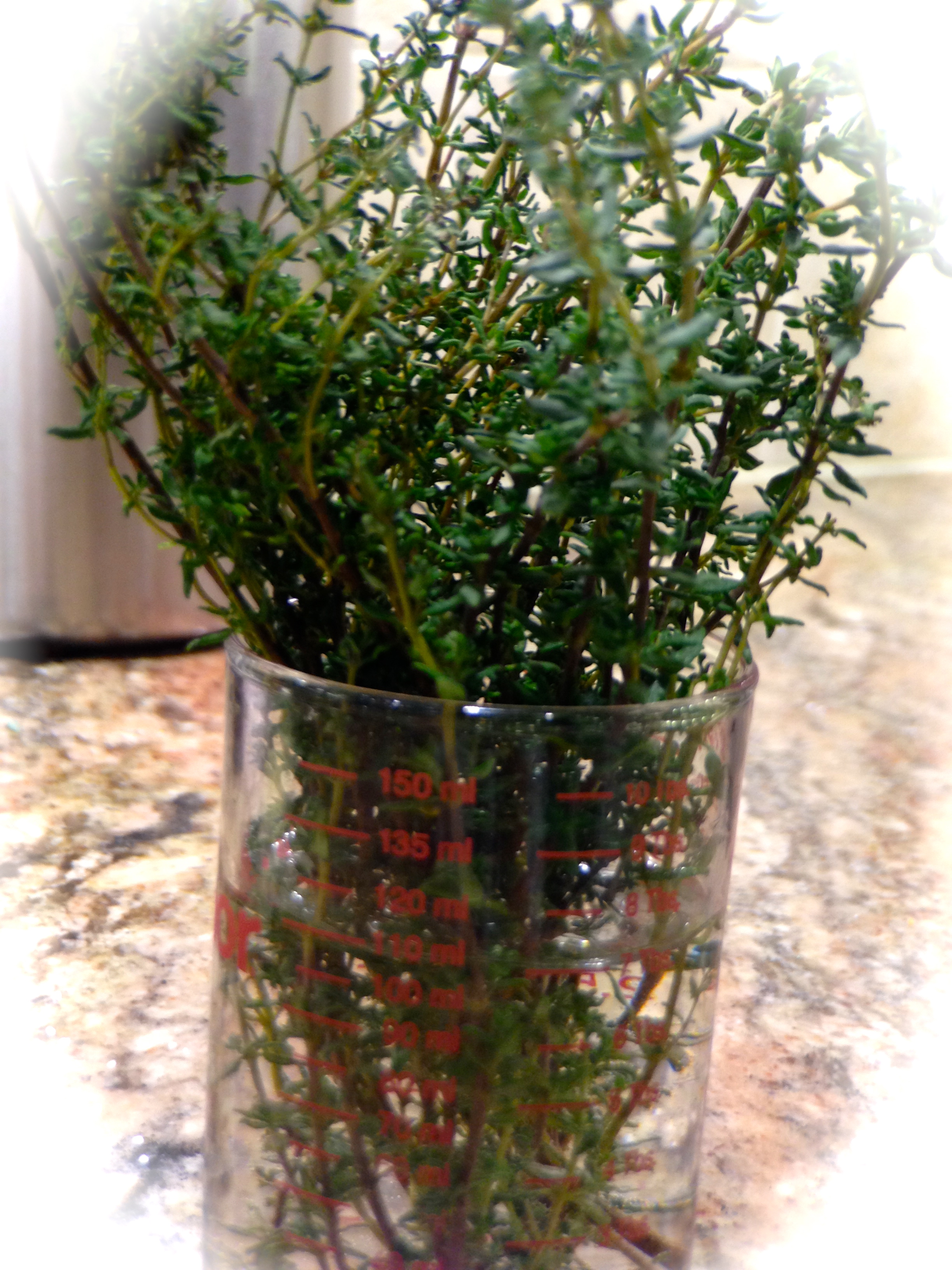
IMG_0544Lesson Learned 3: Don’t be afraid to substitute herbs: I used thyme in this recipe because I have it growing in my garden, but fresh tarragon would also work very well. My only caution would be not to substitute dried herbs for fresh ones. I think using fresh thyme provided more depth of flavor, especially with the short cooking time in this recipe.

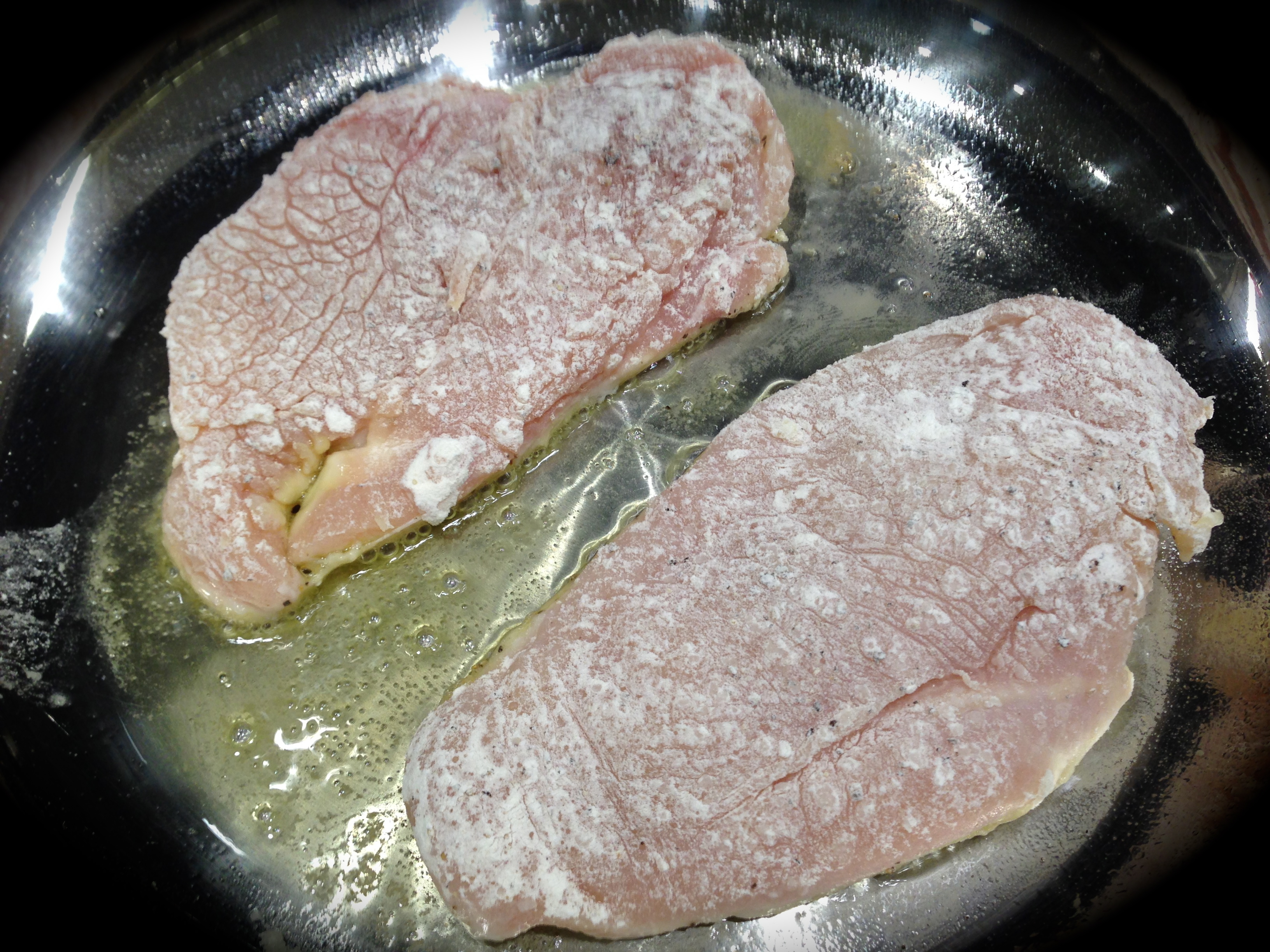
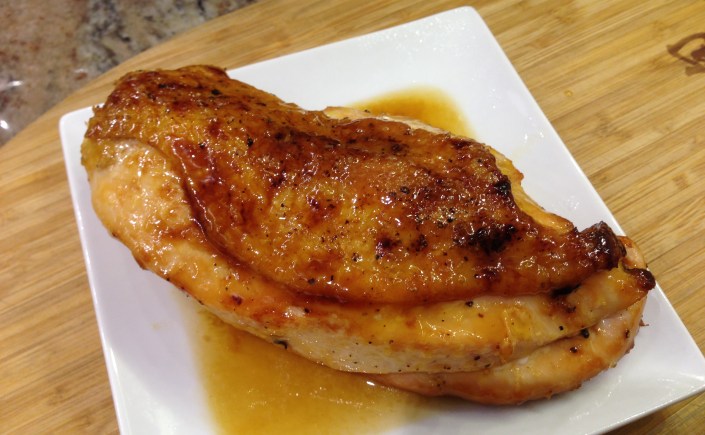
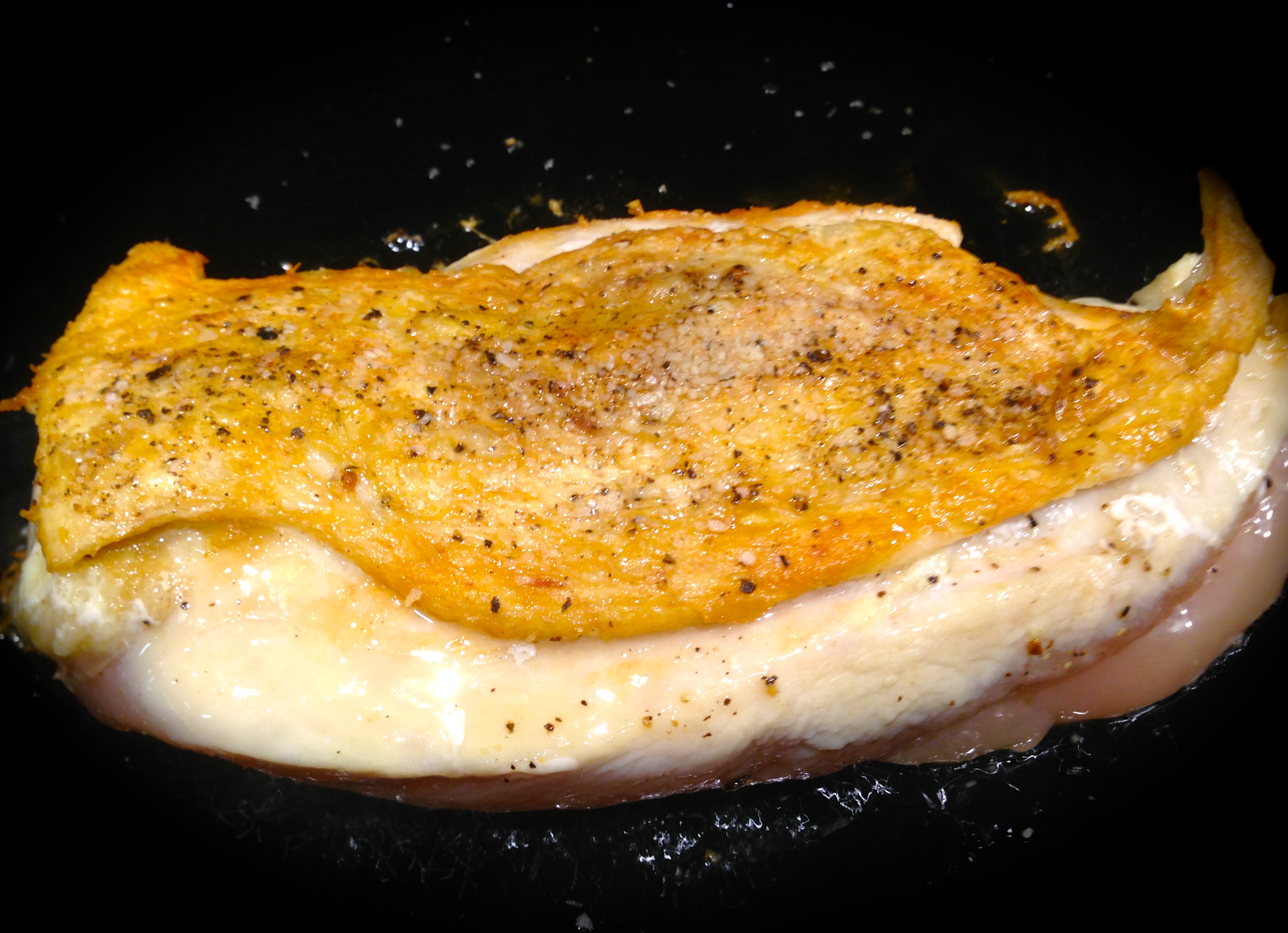
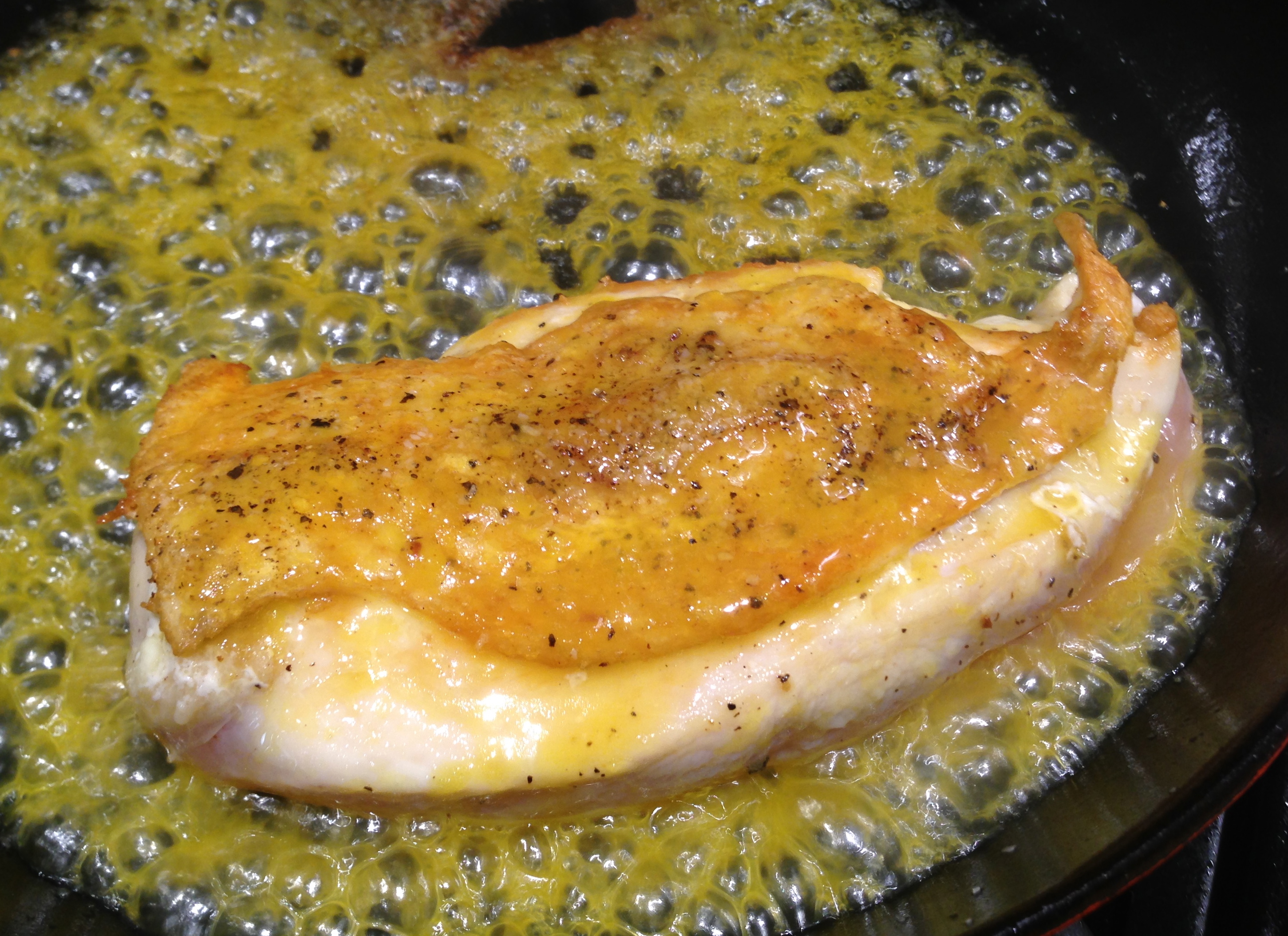
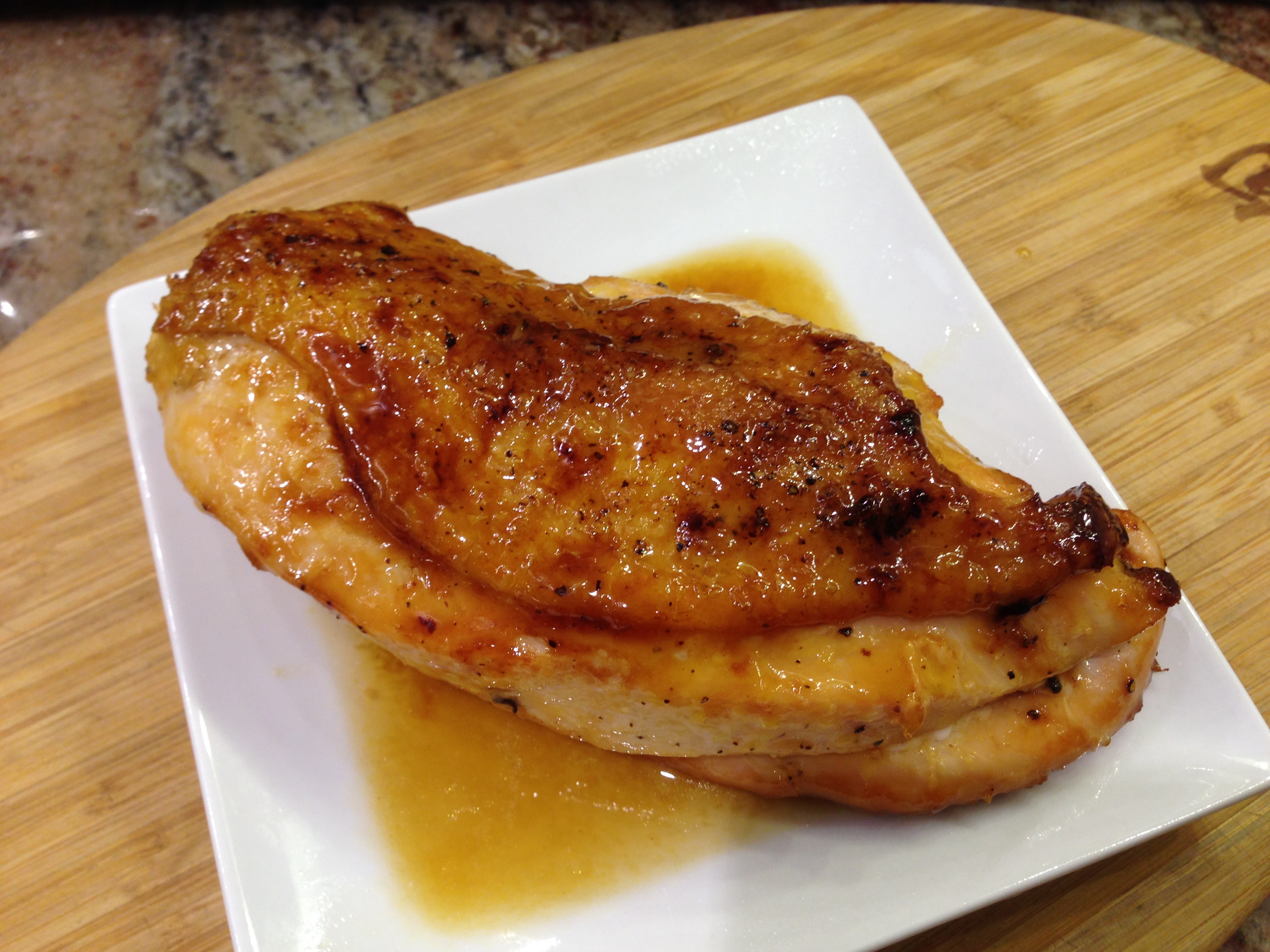
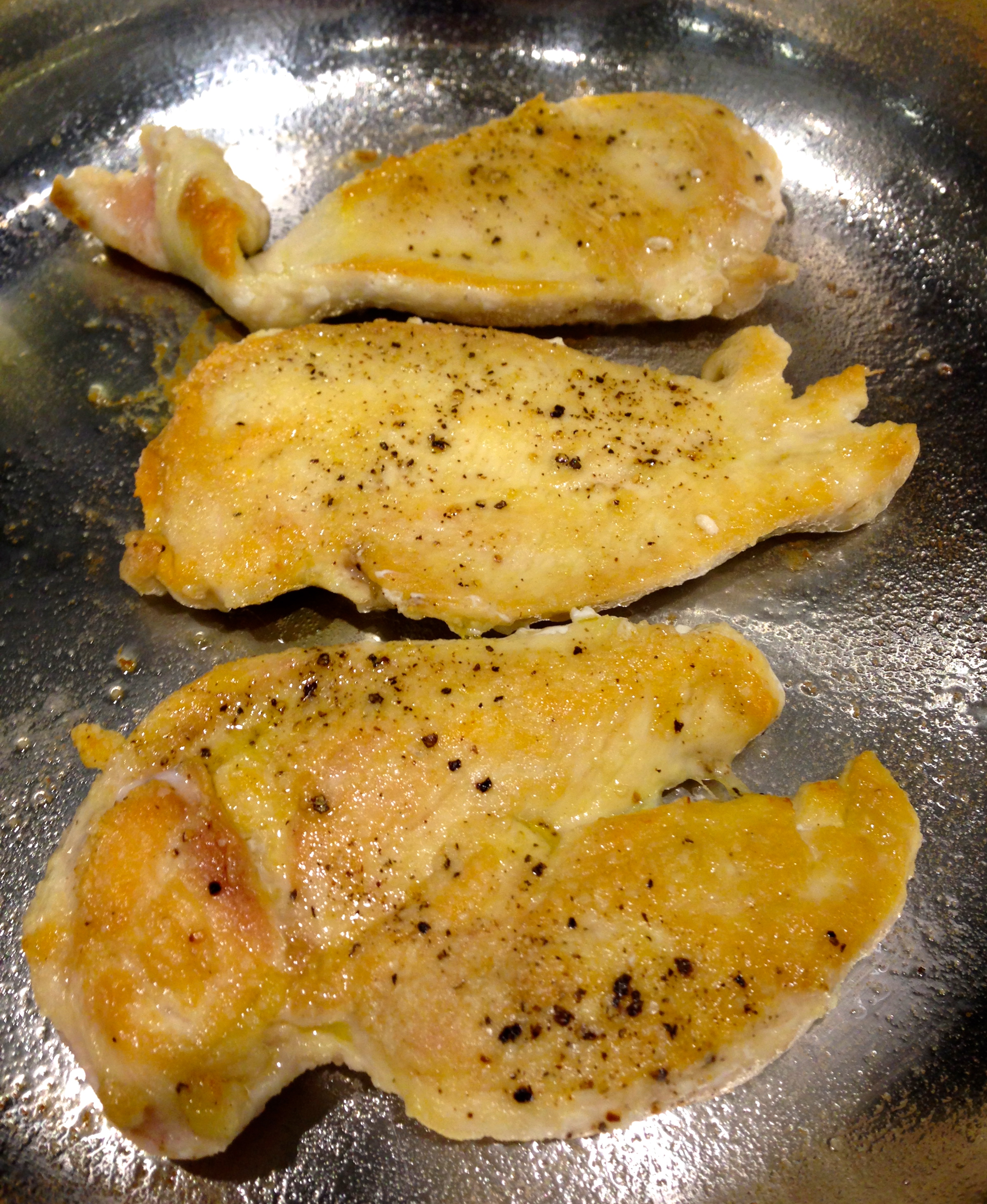
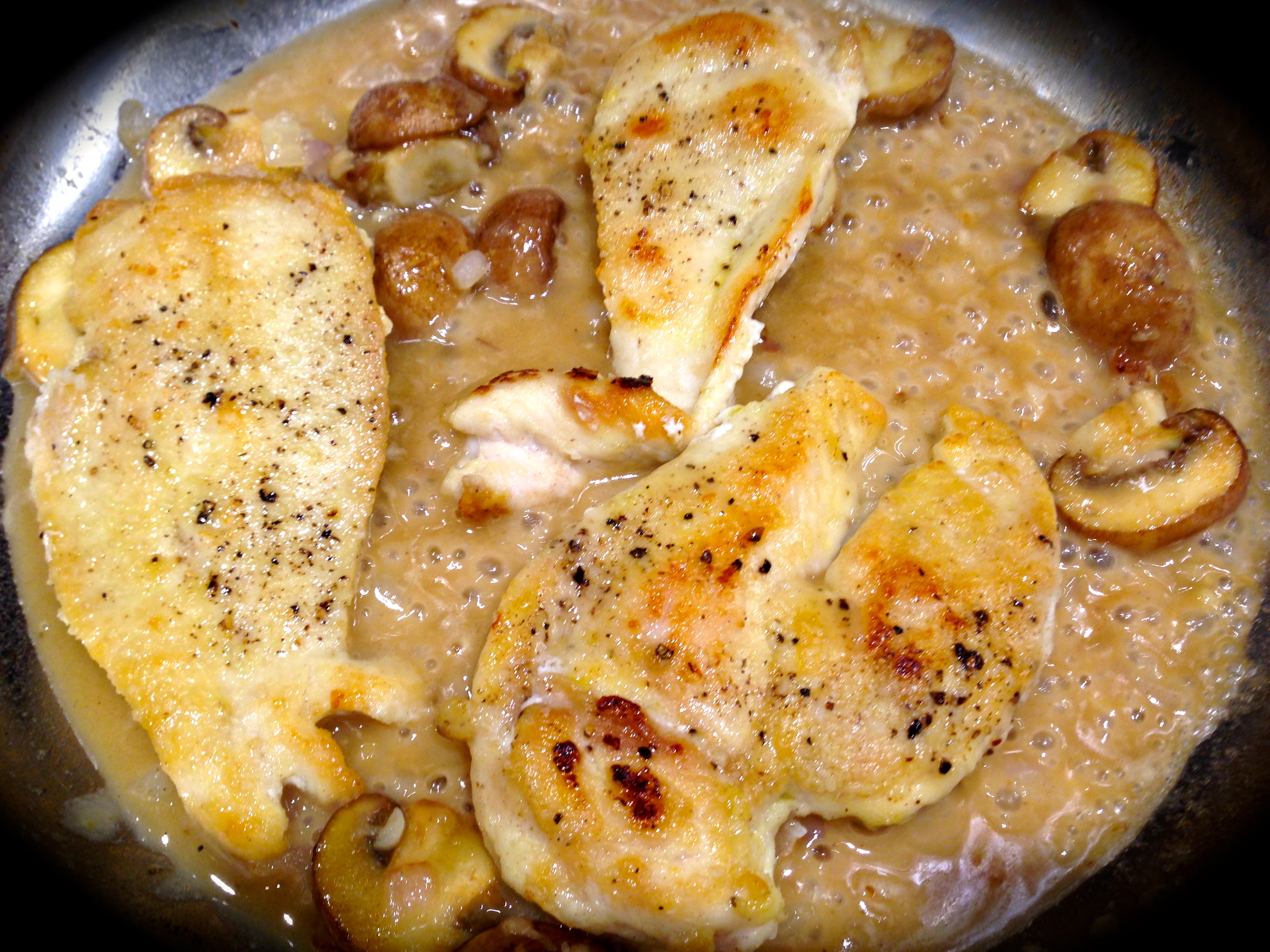
Lesson Learned 4 – Cooking with chicken cutlets can be tricky: By chicken cutlets I mean boneless skinless breasts that either have been cut or pounded to about 1/4 inch thick. I actually found them at my local grocery store so that made it even easier. Chicken cutlets take no time to cook at all and you can easily make them taste like leather if your overcook them. I cooked mine for 3 minutes on each side before taking them out of the pan and preparing the sauce. I kept them on the plate covered with foil which resulted in some minimal carry over cooking. Once the sauce was made I put them back in the pan and let them simmer in the sauce for no more than two minutes. They came out juicy and tender.
IMG_0553

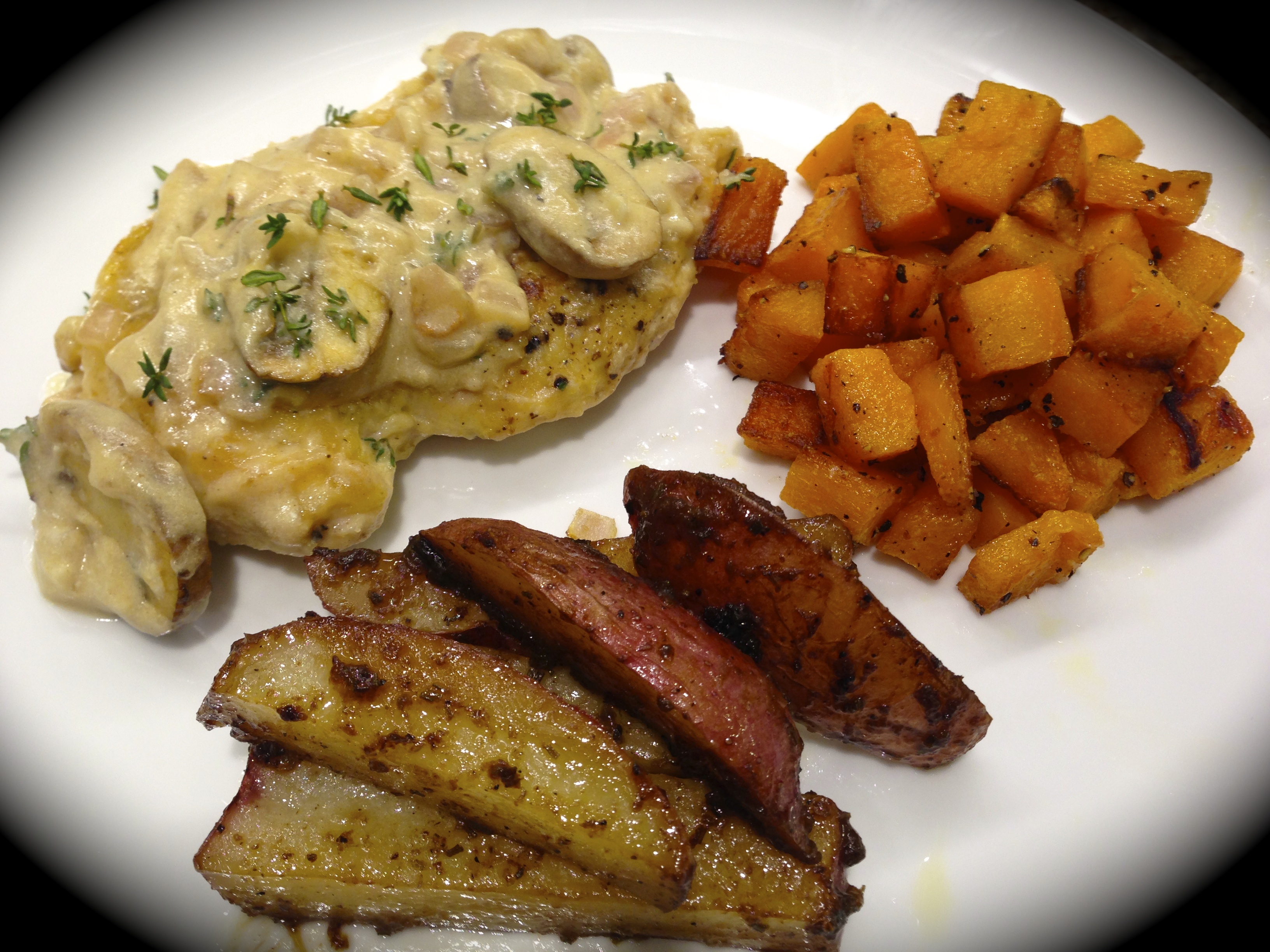
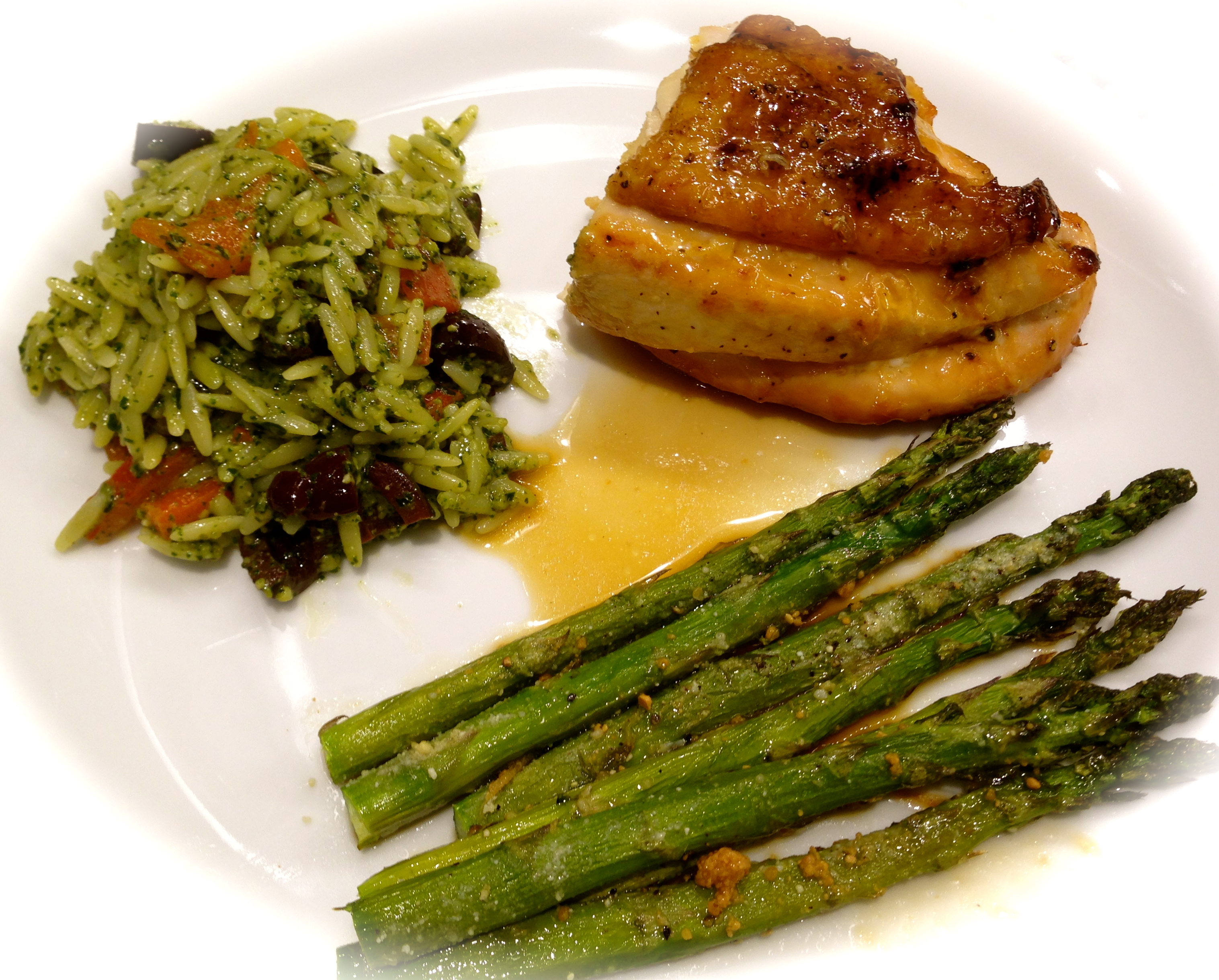
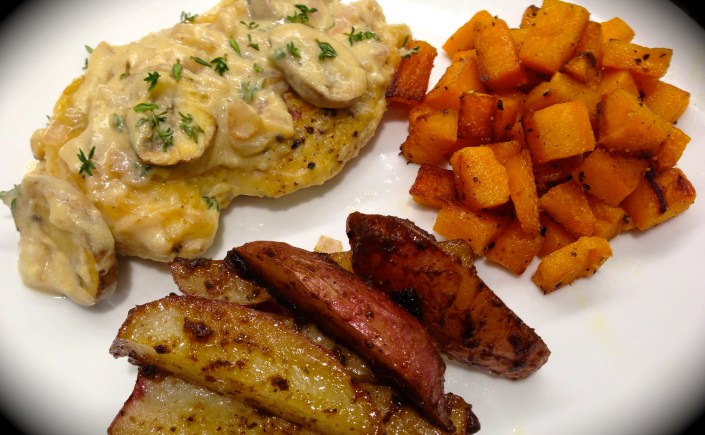
This is a great recipe for the burgeoning chef. The only area I would caution you on is to make sure not to overcook the cutlets. Because they are so thin they cook in no time flat. There is not a lot to prep for this recipe and within 20 minutes, including prep, this chicken is ready to plate. I served it with roasted butternut squash and balsamic roasted potato wedges and it was a big hit. Try this one. I know you will like it.
IMG_0569

Chicken Cutlets with Thyme-Mustard Sauce…

  • Difficulty: Easy
  • Print

INGREDIENTS:IMG_0597

2 TBS. extra virgin olive oil

1 pound chicken cutlets, 3-4 pieces

6 ounces baby bella mushrooms, optional

1/2 tsp. salt

1/4 tsp. freshly cracked black pepper

1 medium size shallot

I clove garlic, minced

1 tsp. flour (for the sauce – additional needed to dust cutlets)

1/2 cup dry white wine

1/4 cup sour cream, light preferred

1 TBS. dijon mustard

2 TBS. chopped fresh thyme leaves

DIRECTIONS:

Do all prep work first. Chop the shallots, mince the garlic, chop the thyme and measure out any remaining ingredients that you do not feel comfortable eyeballing.

Heat a large skillet over medium heat. Dust cutlets lightly with some flour. Sprinkle cutlets on both sides with salt and pepper. Add oil to the pan. Place the cutlets in the oil and cook for 3 minutes on each side. Remove cutlets from pan to a plate and cover with foil.

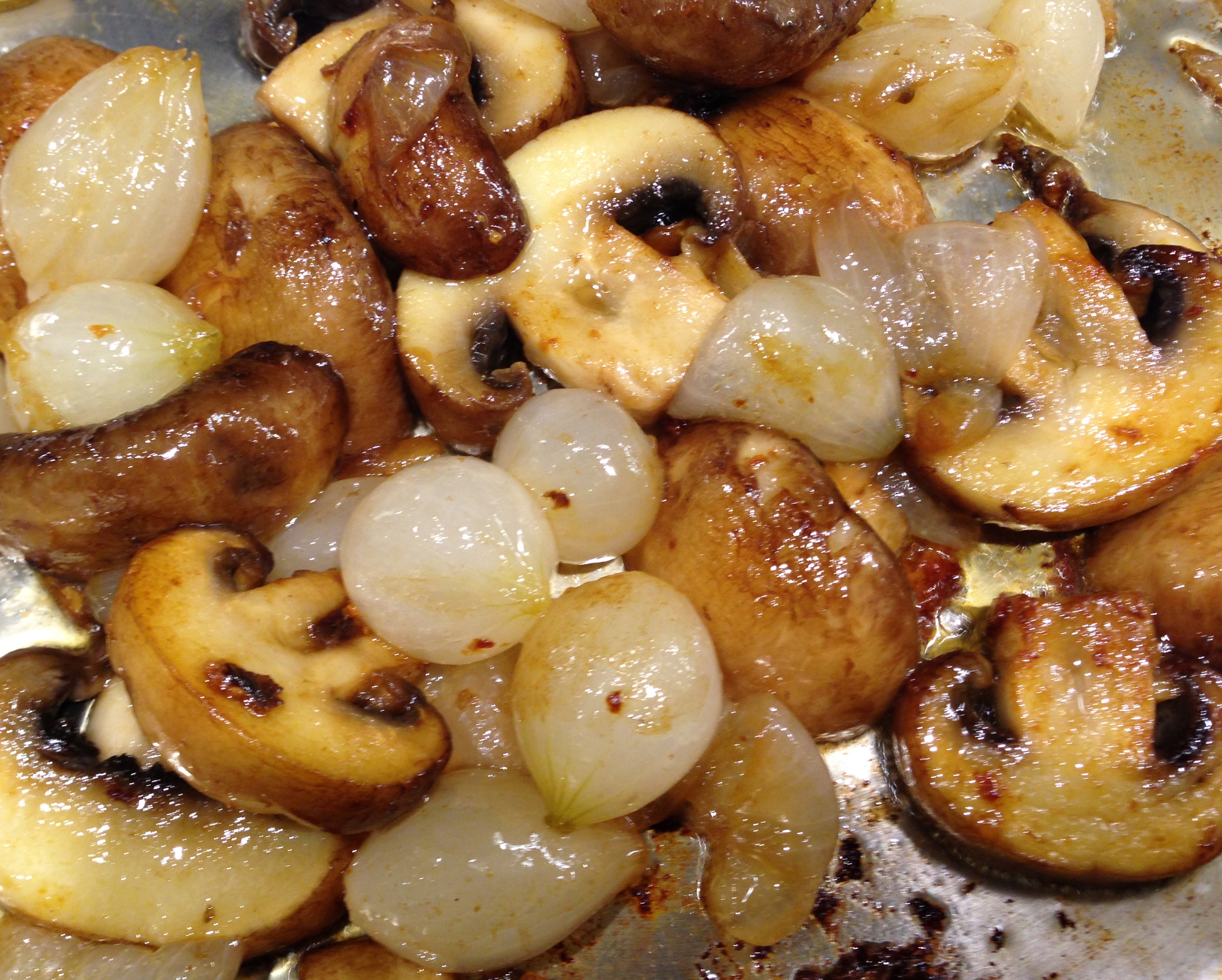
Add some additional olive oil to the pan. Saute mushroom until lightly brown. Add shallots and cook for about 1 minute. Add garlic and cook until fragrant, approximately 30 seconds to 1 minute. Sprinkle flour over shallots and mushrooms and cook for an additional minute stirring constantly. Add wine and bring liquid to a boil. Stir with a spoon to loosen all the brown bits in the pan.

Lower heat. Add mustard, sour cream and thyme. Stir until combined. Add chicken back to the mixture and let simmer for a couple of minutes. Add some additional thyme as garnish when serving.
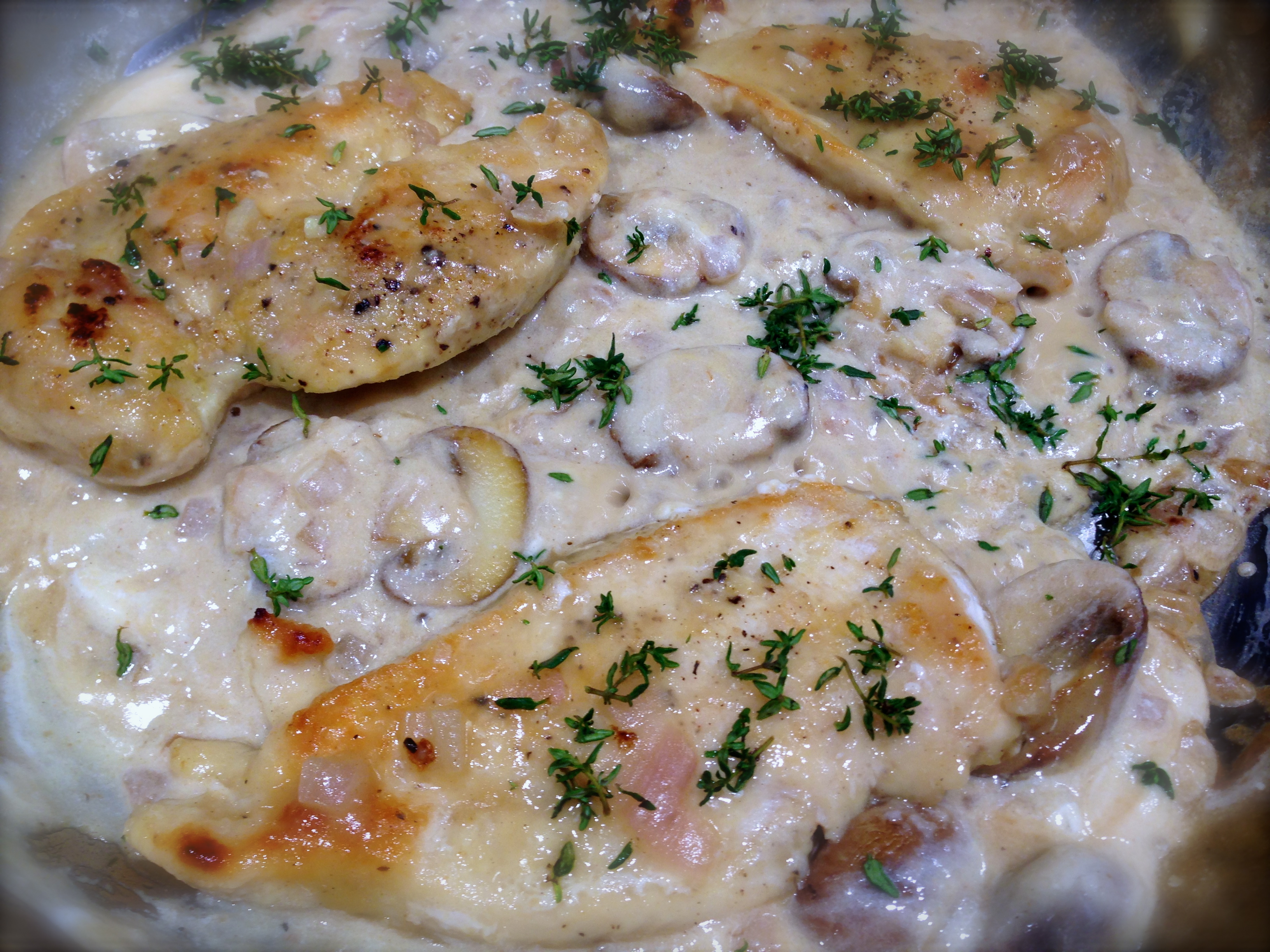
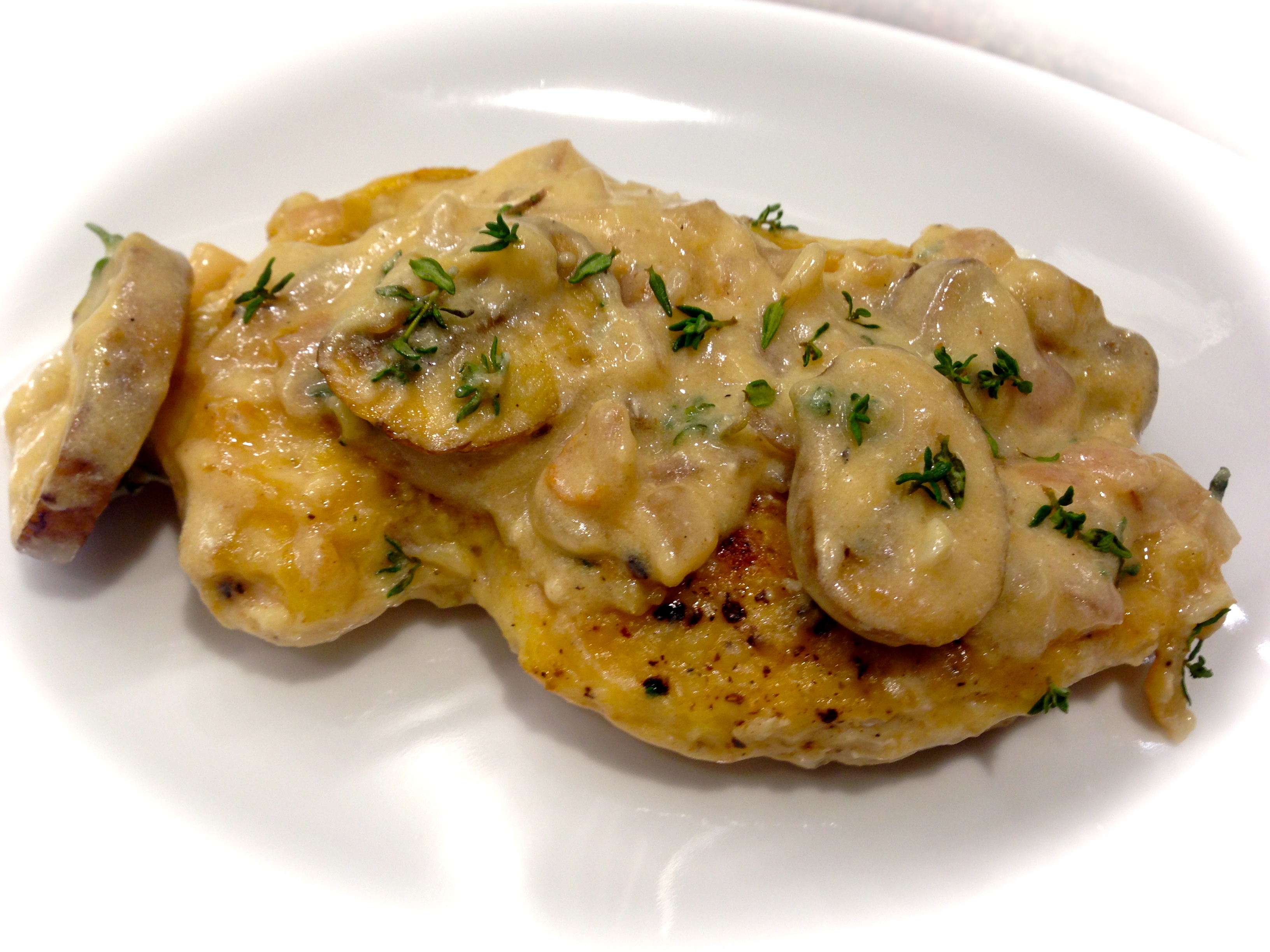
IMG_0575

IMG_0583

IMG_0597

Serving Suggestion: Chicken with Roasted Butternut Squash and Balsamic Roasted Potato Wedges
Serving Suggestion: Chicken with Roasted Butternut Squash and Balsamic Roasted Potato Wedges
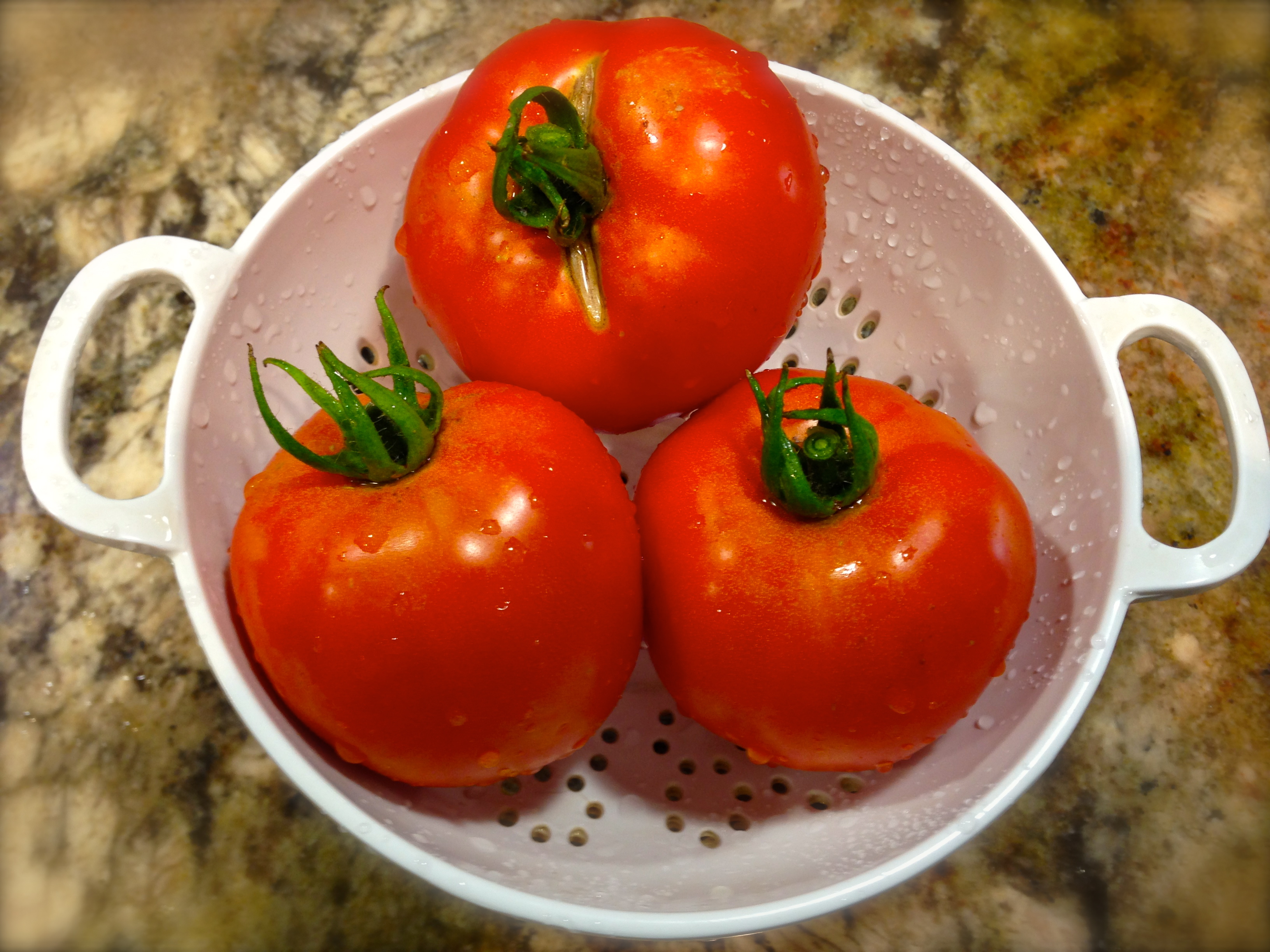
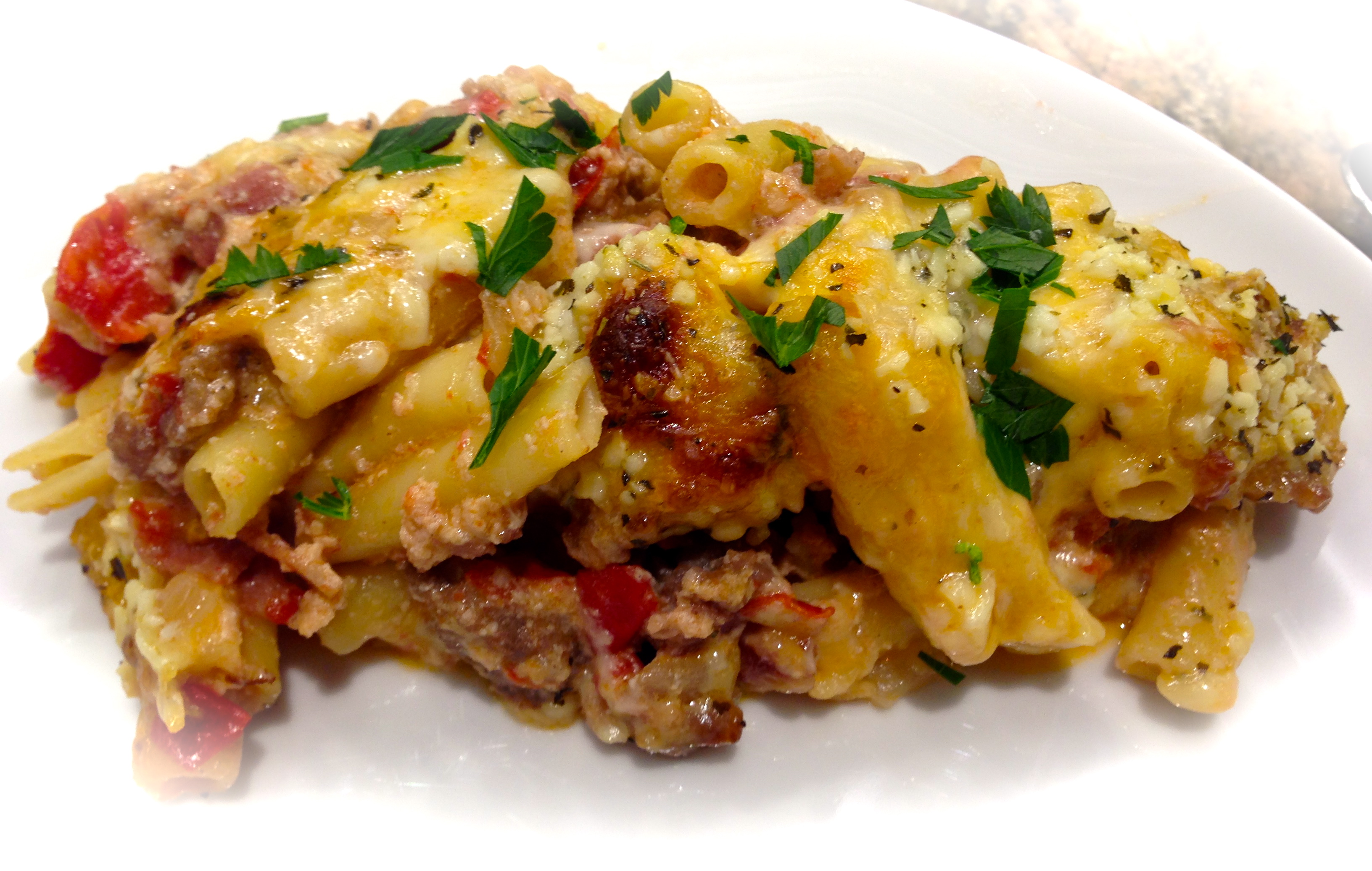
Baked Ziti With Sausage and Pancetta…

The weather is starting to turn. The temperatures are dropping and you can definitely feel Fall in the air. And for me Fall means cranking up the oven. I love grilling and I love dining al fresco but there is nothing like the smell of a pot roast slowing cooking in the oven. The aromas throughout the house make you want to curl up in front of the fire place with a glass of wine and just be glad you’re alive. I guess that’s why so many of these Fall dishes are called comfort food. They make you feel warm and cozy inside, even while they’re roasting away in the oven.

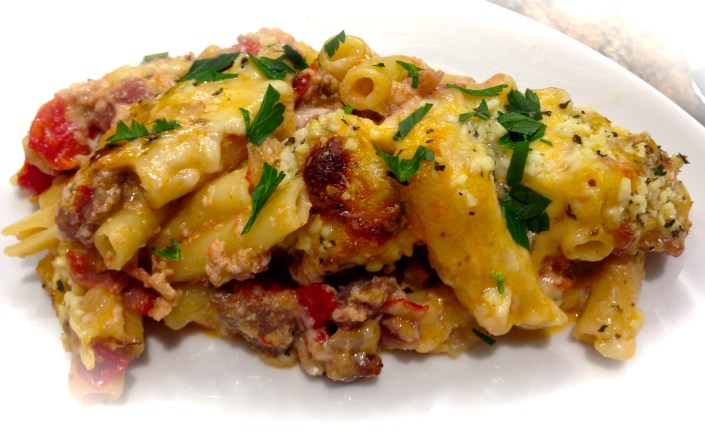
And this time of year I am also scrambling to figure out how to use my tomato crop. I never know from year to year how my tomato plants will fare but this year, due to the great growing conditions, I got a bumper crop. I was also fortunate this year. Just as the zucchini production began to wane the tomato production came into full force. And there are only so many salads you can make. So with all of these tomatoes I was on the hunt for a recipe that would not only warm the house but help me use a bunch of them. When I saw that this recipe called for 28 ounces of crushed tomatoes I thought to myself, heck – no need to buy a can, I can cut up what I have and that will do the trick. And did it ever. I got a delicious casserole and was able to use quite a few of my tomatoes in the bargain.

IMG_0031

I will say I was a little surprised at how long it took to assemble this casserole. But I think the main reason was that I hand chopped all of the tomatoes and that took the bulk of the time. I was also able to use some of my remaining fresh basil so that was a plus. I substituted bacon for pancetta (our local grocery store was out of it) and that worked well too. So all in all, a flavorful recipe that helped me use some of my garden bounty. Here is my recipe rating and lessons learned:

Recipe Rating: A- Great comfort food recipe: This a such a good recipe on a variety of levels – not only does it taste great but being able to use garden tomatoes and basil was definitely a plus. If you don’t have the tomatoes or the time to chop them just use a 28 ounce can of crushed tomatoes. That will work equally as well and will be much quicker.

IMG_0383Lesson Learned 1- You can substitute bacon for pancetta: You probably know already that when you don’t have or can’t find pancetta you can use bacon as a substitute. But did you know the difference between them? Both are made from pork belly and both are cured for a length of time. The major difference is that bacon is smoked after it’s cured and pancetta is not. So using bacon as a substitute will add a slightly smokier flavor to the dish. Needless to say, I used bacon and it turned out great. And I will definitely try this using pancetta to see if can discern a noticeable difference.

Lesson Learned 2 – How to perfectly align the stovetop cooking time: I found that if you start out by boiling the water for the ziti and then start the other ingredients right after you put the ziti into boiling water you can align the cooking times of all the ingredients. Keep in mind that this means that all the chopping and non-cooking prep is done prior to this, but once that’s done both the non-pasta and pasta ingredients cook within a similar timeframe. That allows you to do the final casserole assembly easily.

IMG_0404Lesson Learned 3 – The fresher the ingredients the better: Granted this is the first time I tried this recipe but I think the garden fresh tomatoes and basil made the flavor superb. I realize that having garden tomatoes in most areas is a once a year treat. If you have to use canned tomatoes I would recommend San Marzano tomatoes as they are known for their sweet flavor. At least don’t substitute dried basil for fresh basil in this recipe. If you don’t have basil in your garden buy some fresh at the grocery store. It will make a difference.

Lesson Learned 4 – The wonder of queso mozzarella: In the grocery store with the ethnic cheeses I found something called queso mozzarella. Using it I found it gives a creamier texture to recipes calling for mozzarella cheese. What I do is blend half queso and half regular shredded mozzarella when recipes calls for mozzarella. I think it melts better. And keep in mind, any prepackaged shredded cheese has an ingredient in it that keeps the shredded cheese from sticking together. That same ingredient also prevents it from melting as thoroughly as freshly shredded cheese. So the queso mozzarella helps to combat that. It’s very soft and takes no time whatsoever to grate.

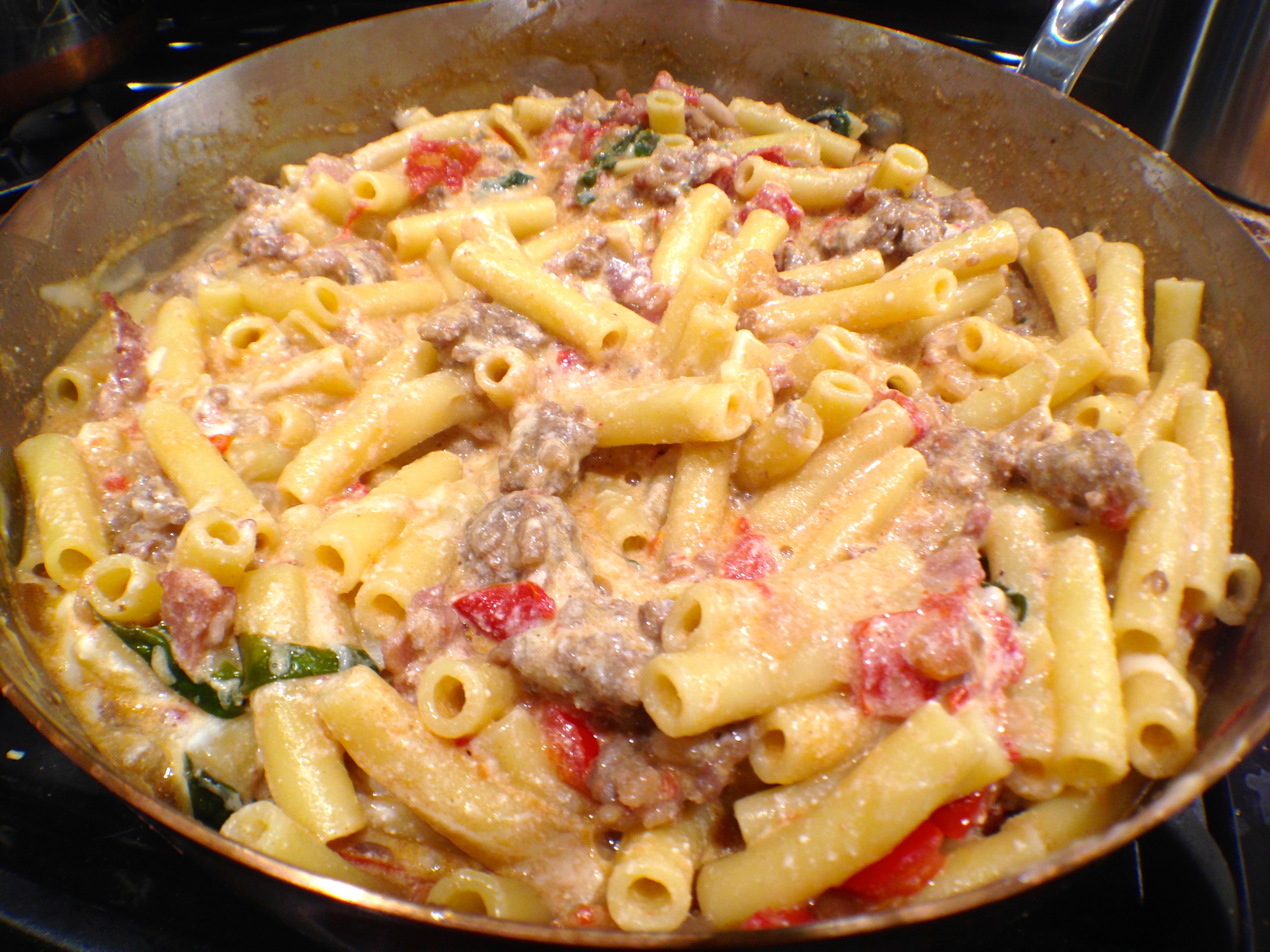
Ready to pour into the casserole...

Ready to pour into the casserole…

Lesson Learned 5 – Take the time to grate fresh parmesan: We all love the convenience of pre grated parmesan cheese. I’ve used it over and over again in recipes, that is until I discovered the difference between packaged and freshly grated parmesan cheese. Freshly grated parmesan melts better and is bolder in flavor. And it is very easy to do, especially if your have a mini-prep processor like I do. All you have to do is cut the parmesan into small pieces, put it in the mini-prep and process it until is is grated. If you haven’t  tried it you really should. It makes a noticeable difference.

Lesson Learned 6 – Using a garnish: Garnishes are just that, something that dresses up the look of a dish but not essential to the recipe. I love Italian parsley for this purpose. I grew Italian parsley in a container on my deck this summer and it grew like a weed. I loved being able to go and snip off a bunch when I needed to.  That way I could control the amount I had versus buying a big bunch at the grocery store and throwing half of it away. Italian parsley is great as a garnish. Simply chop a little and sprinkle it on top of a dish and voila, it looks like the work of a professional chef. Never underestimate the power of a garnish. It can make a dish look fancy with no effort at all!

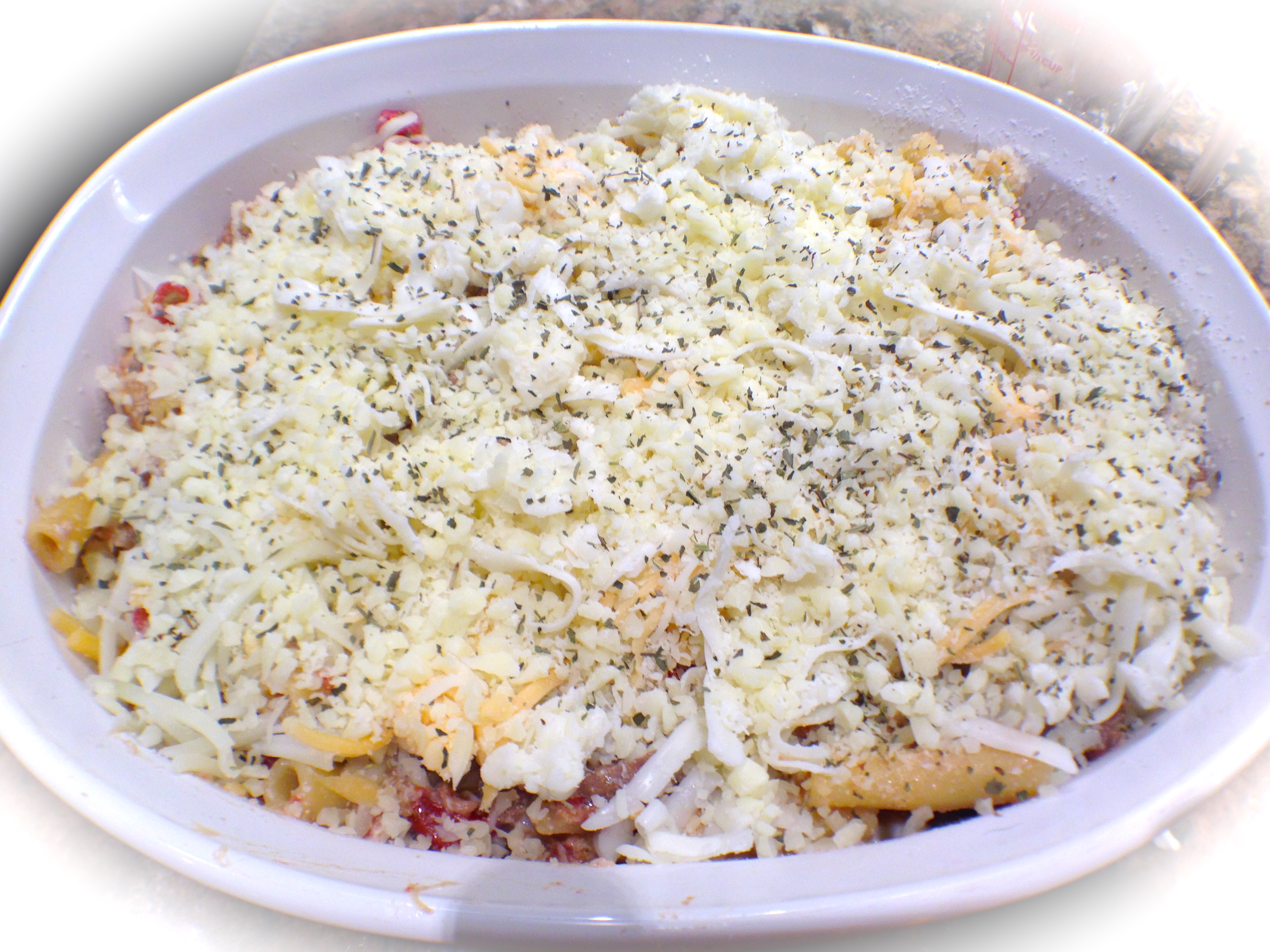
Ready to pop into the oven...

Ready to pop into the oven…

If you’re like me and you like casseroles you will love this dish. It’s also reheats well and is great for leftovers. Warm your house up with this one. You won’t regret it!

Baked Ziti With Sausage and Pancetta

  • Servings: 6-8
  • Difficulty: Easy
  • Print

INGREDIENTS:

12 ounces of ziti pasta

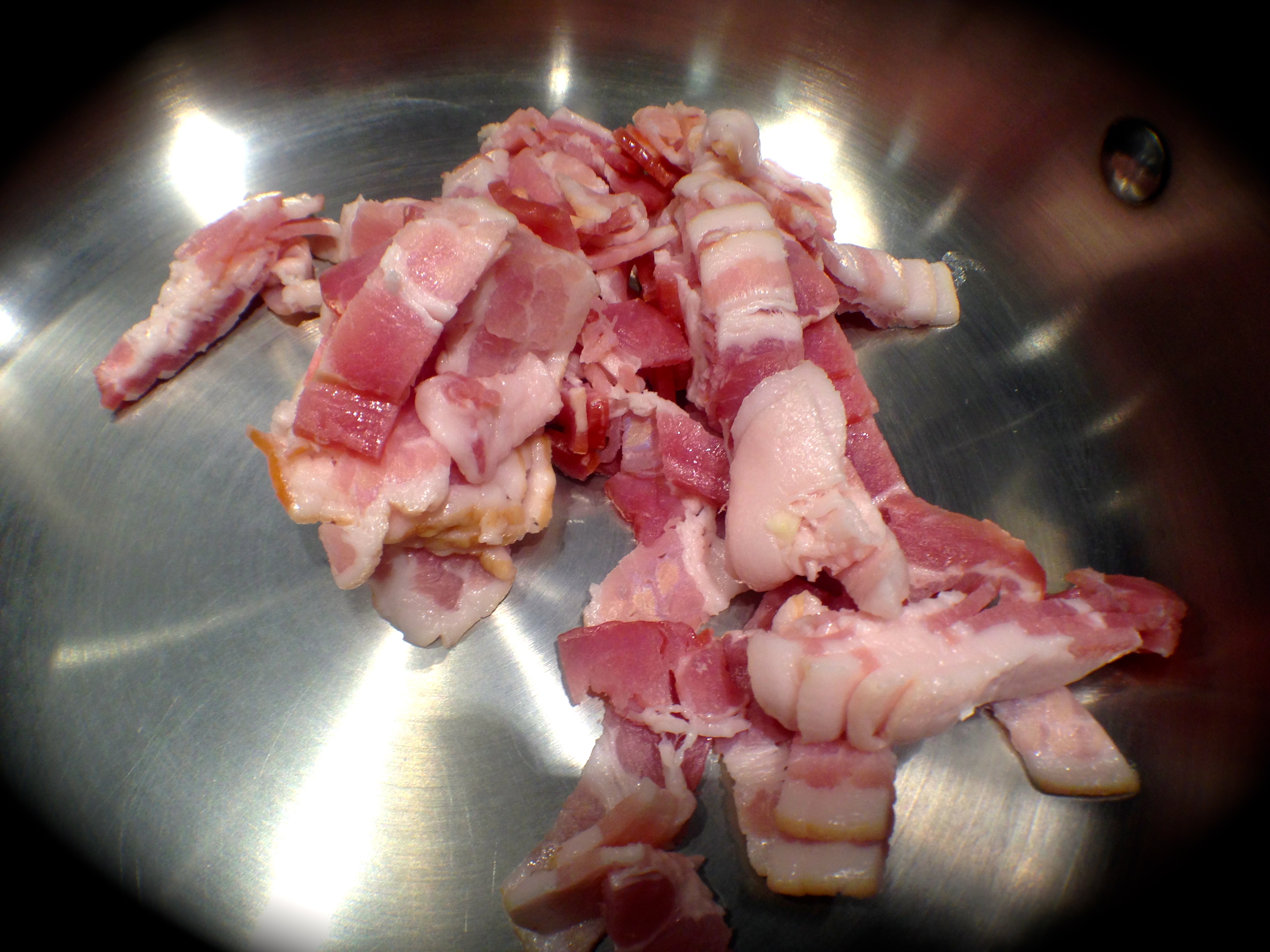
4 ounces pancetta or bacon, diced

1 large onion, diced

2-3 cloves of garlic (to taste)

1 pound ground Italian sausage

1 cup dry red wine

1 can of diced tomatoes (28 ounces), or diced garden tomatoes

Generous handful of fresh basil (approx. 1/2 cup)

1/2 tsp. kosher salt

1/2 tsp. crushed red pepper flakes (optional)

1 cup ricotta cheese

1 cup mozzarella cheese, divided  (1/2 cup queso and 1/2 cup shredded preferred)

1/2 cup freshly grated parmesan cheese

1 Tbs. Italian seasoning

Italian parsley for garnish

DIRECTIONS:

Preheat oven to 350 degrees. Do all the prep work first: slice the bacon into lardons, chop the onion, mince the garlic, and grate the parmesan and mozzarella cheeses.

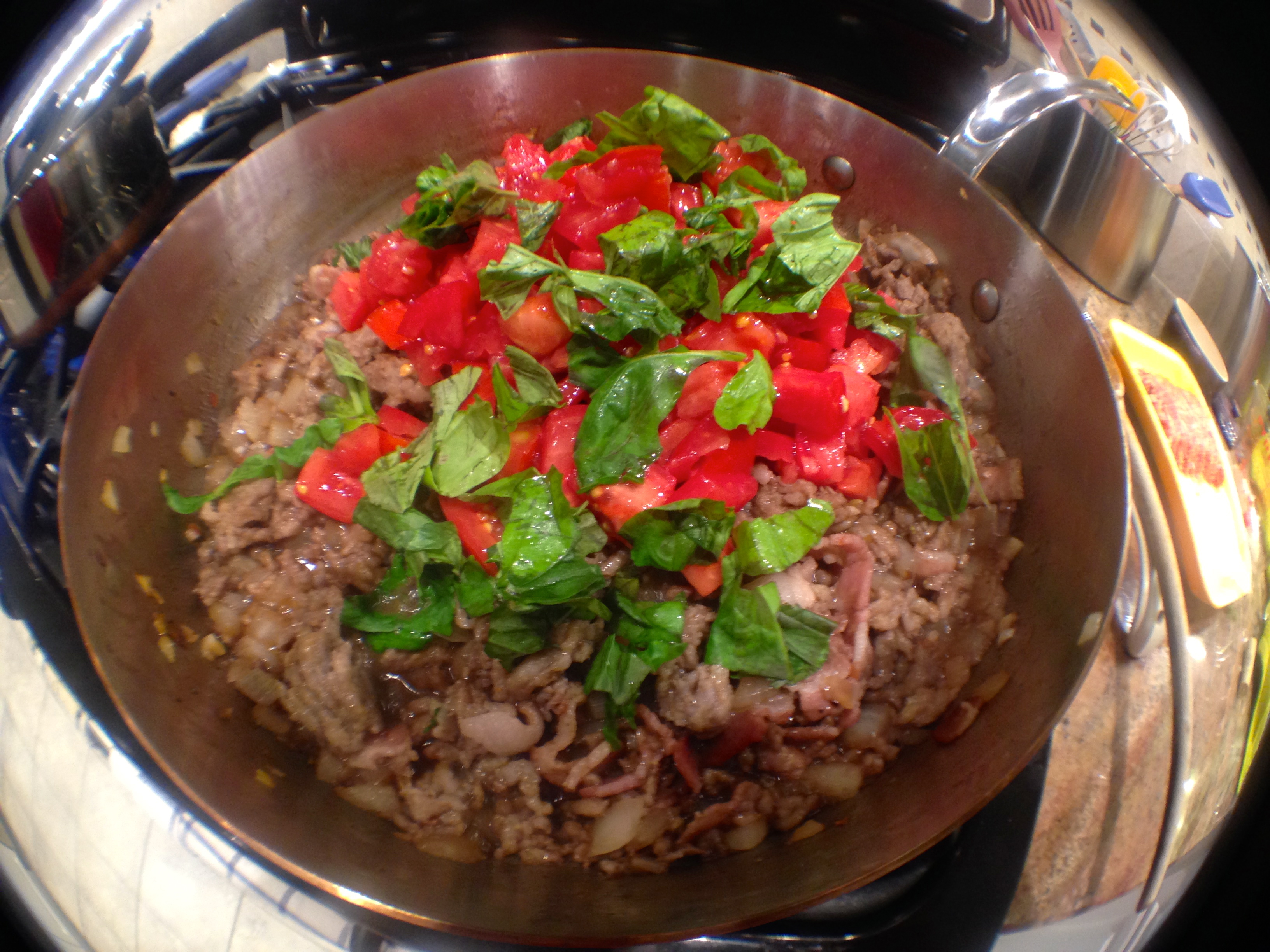
Bring a large pot of water to a boil. Add the ziti and cook according to the package directions. Meanwhile in a large pan cook the pancetta for about 3 minutes (you don’t want to crisp it). Add the onion and sauté for an additional 3 minutes. Add the garlic and sauté until fragrant (30 seconds to 1 minute). Add the sausage and cook until the meat is no longer pink. Add the wine and cook for approximately 3 minutes. Use the wine to deglaze the pan.  Stir in the tomatoes and basil. Reduce the heat and cook for only a couple of minutes.

Drain the pasta and add it to the pan. Stir in the ricotta and half of mozzarella. Put into a 9×13 baking dish. Sprinkle the top with the remaining mozzarella and parmesan. Sprinkle Italian seasoning on top of the cheese.

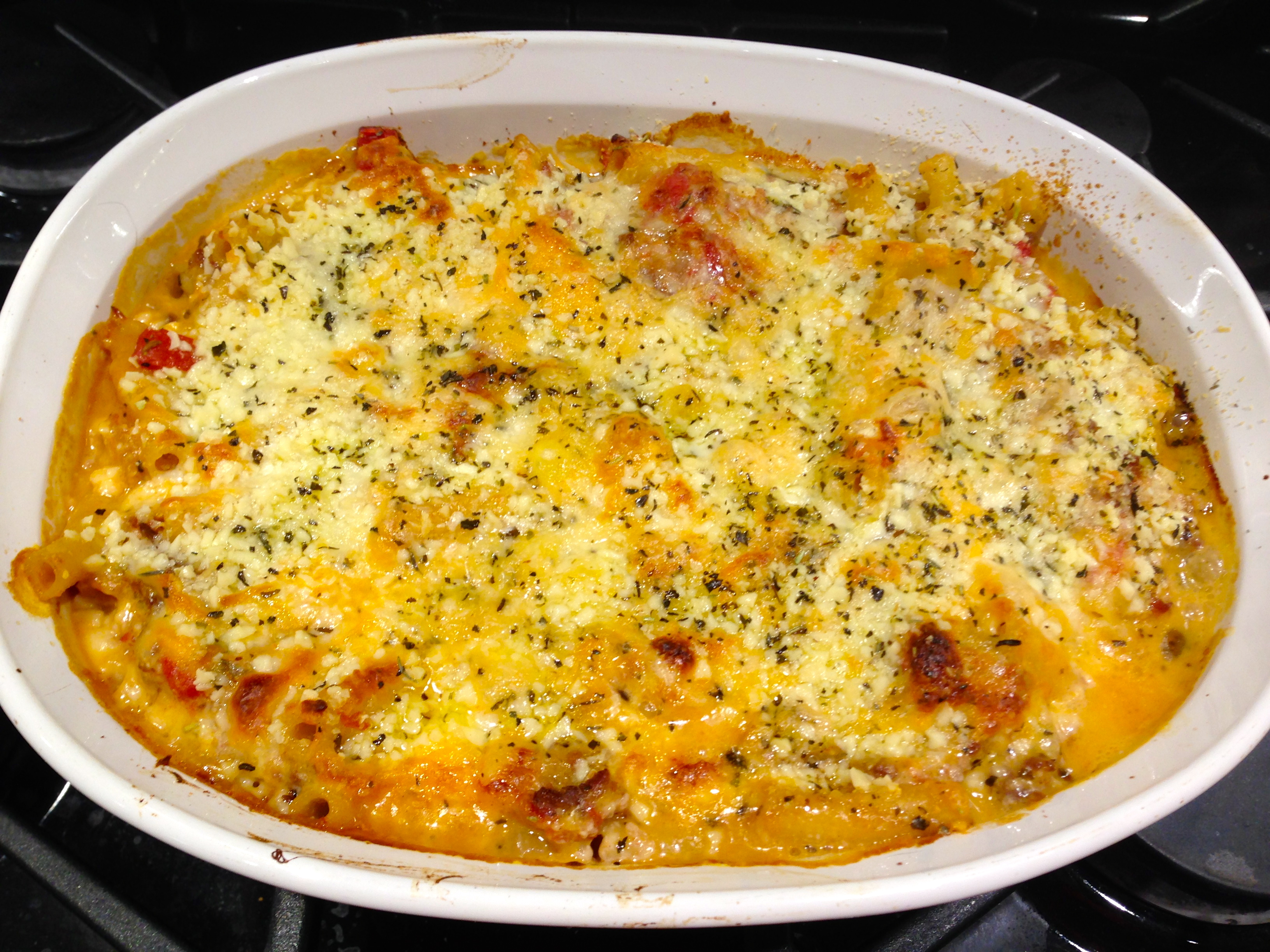
Bake at 350 for 25 to 30 minutes or until the casserole is bubbly and the cheese is nicely browned.

Straight Out Of The Oven...

Straight Out Of The Oven…

Baked Ziti With Sausage and Pancetta

Baked Ziti With Sausage and Pancetta

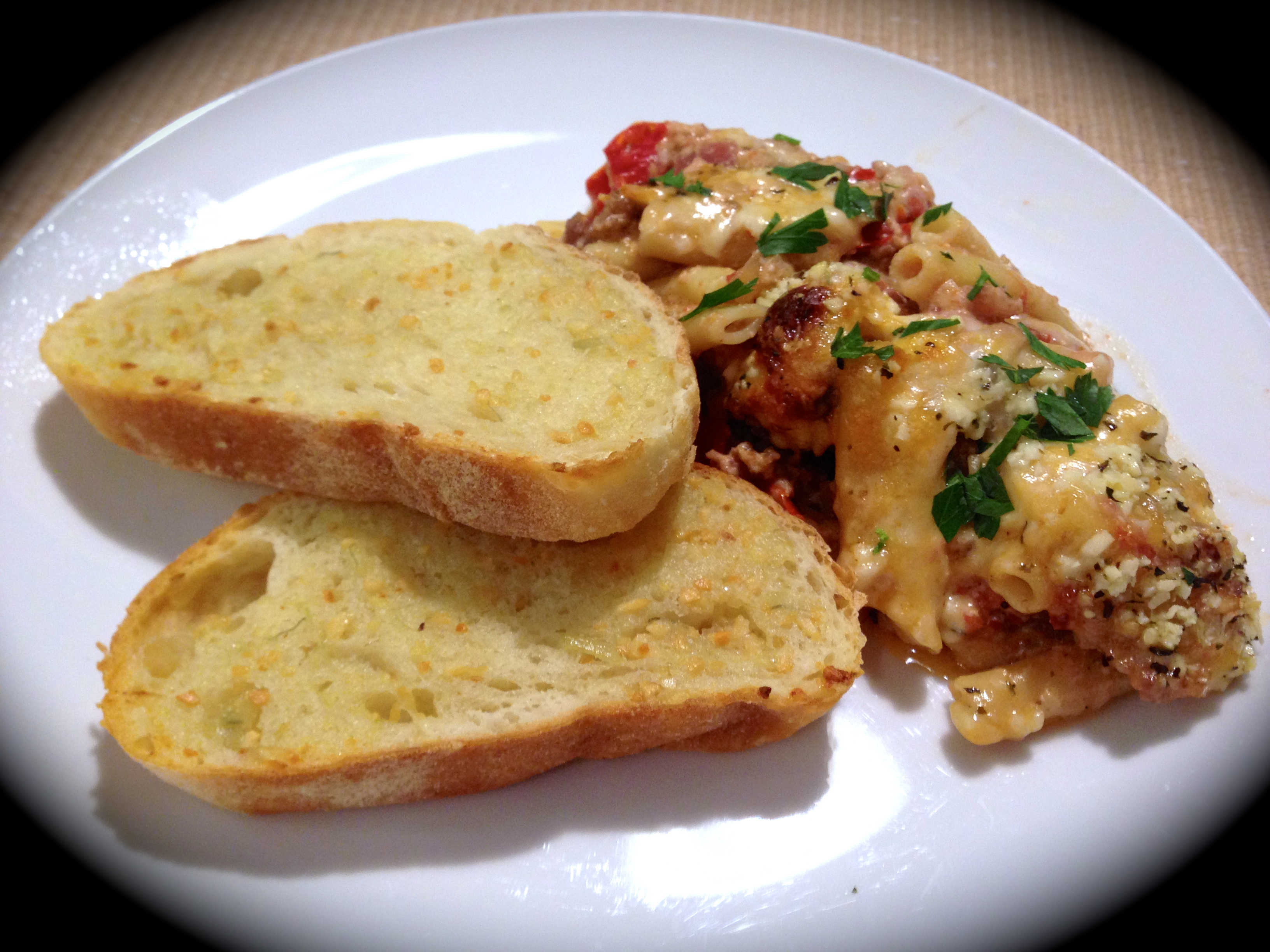
Serving Suggestion: Baked Ziti with Garlic Bread...

Serving Suggestion: Baked Ziti with Garlic Bread…


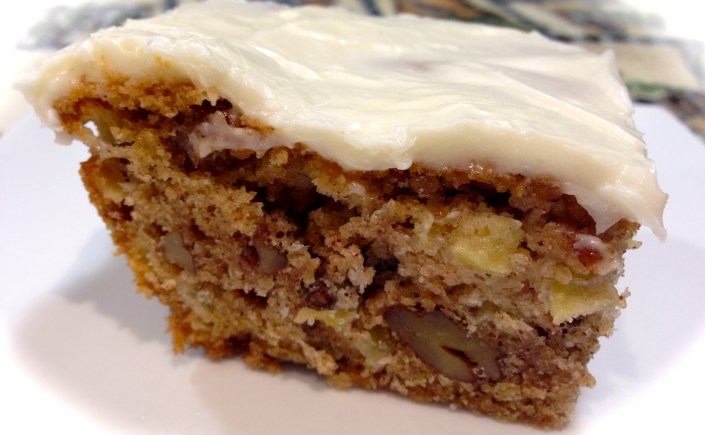
Apple Cake With Cream Cheese Frosting

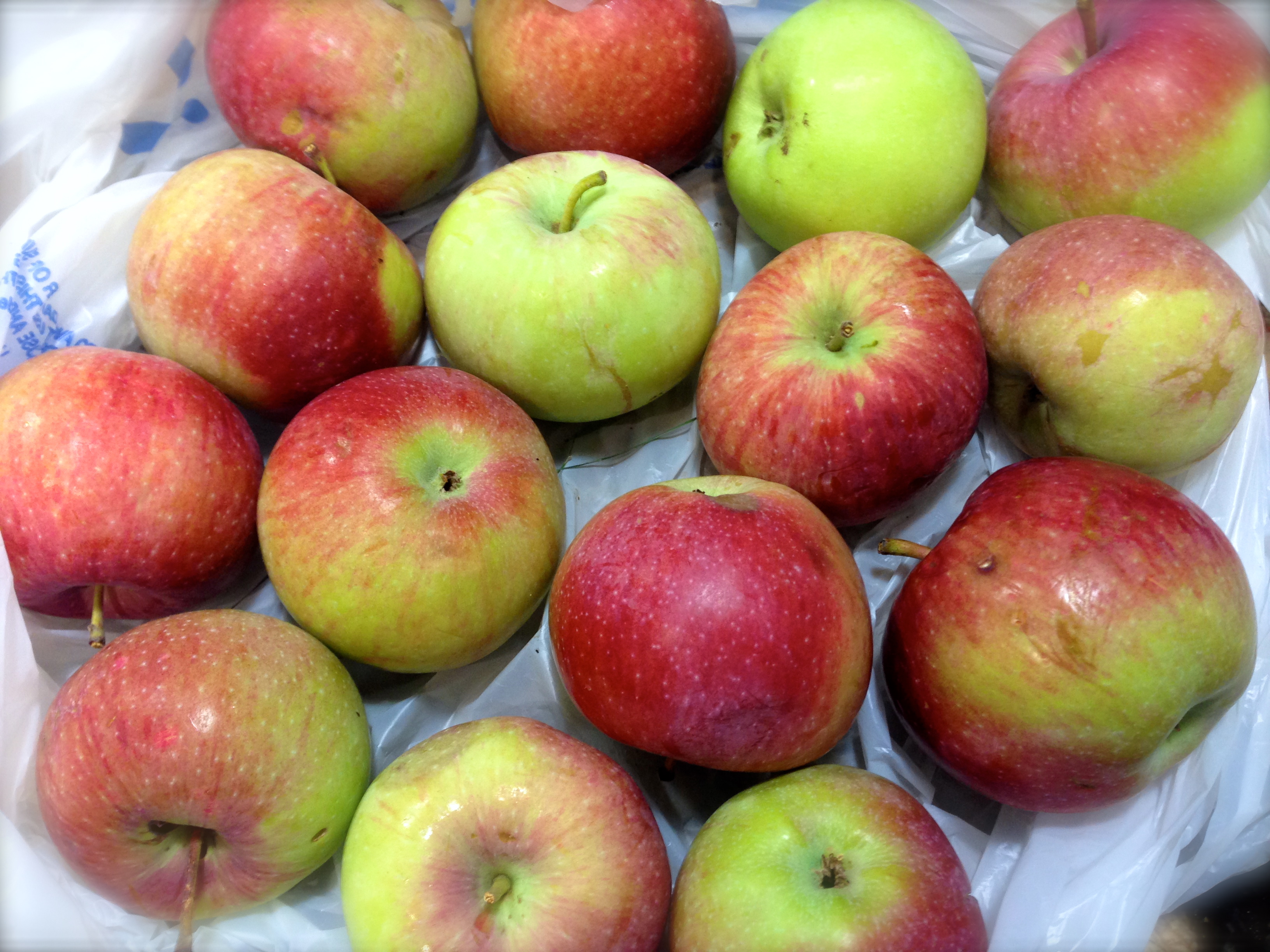
The other day I opened my front door and lo and behold a bag of apples magically appeared on my porch. My neighbor across the street has apple trees in his backyard and was nice enough to share a bag of them with us. I had no idea what type of apples they were but when I tasted one I knew it would lend itself to baking. But what to make – applesauce, apple crisps, apple streusel – the possibilities were endless.

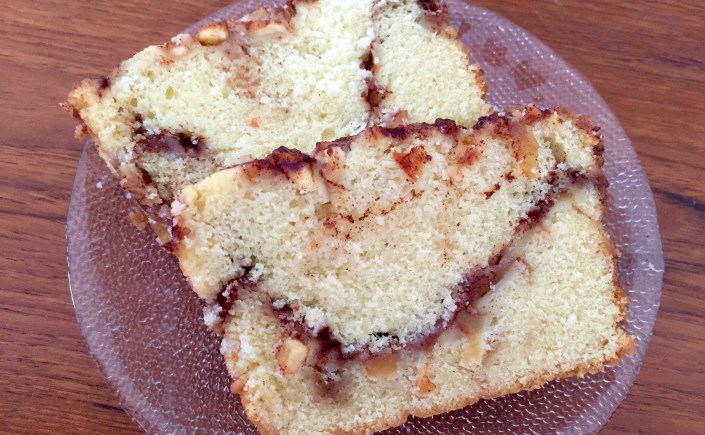
IMG_0273I decided to make an apple cake that is really a combination of two recipes that I found on Pinterest. One intrigued me because of the spices and the other because it included pecans. So why not just take the best out of both recipes and make a new one, right? Well, surprisingly it worked out even better than I thought it would.

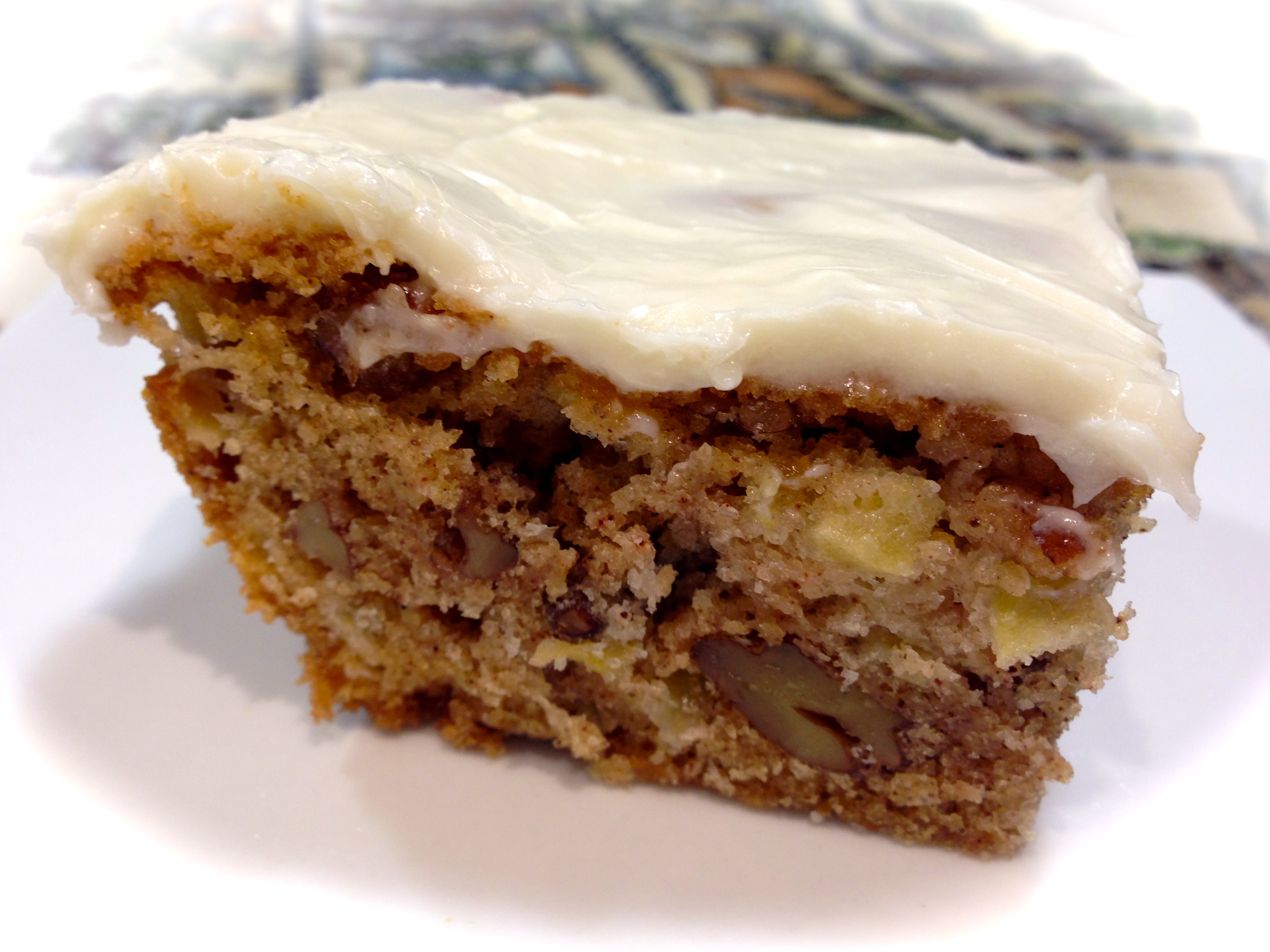
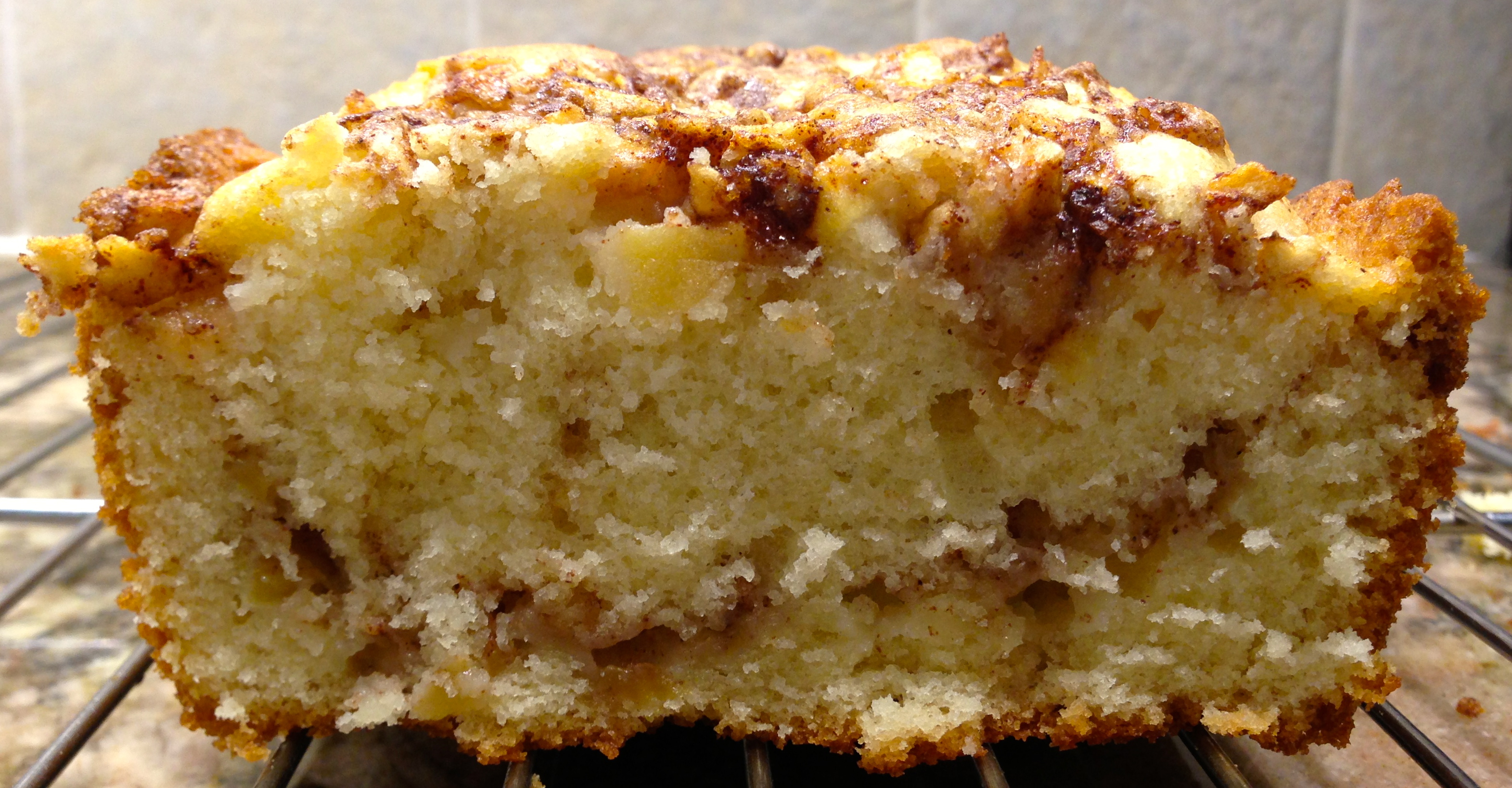
RECIPE RATING: A+ The cake came out great. The apples were moist but not mushy and the spices complimented the apples perfectly. The next time I make this I may add a little more cinnamon but as written it is still a fabulous cake. I took most of it to work and it was gone in less than an hour. The cream cheese frosting was a great compliment to the cake.

It’s Fall, there are plenty of apples out there – so don’t wait – you’ve just got to try this one!

LESSON LEARNED 1- Don’t be afraid to experiment: I say this with a caveat. Remember that baking is not like cooking. The amounts need to be relatively exact for the end result to be good. Eyeballing it is simply not recommended for baking. You must measure your ingredients. Experiment wisely.

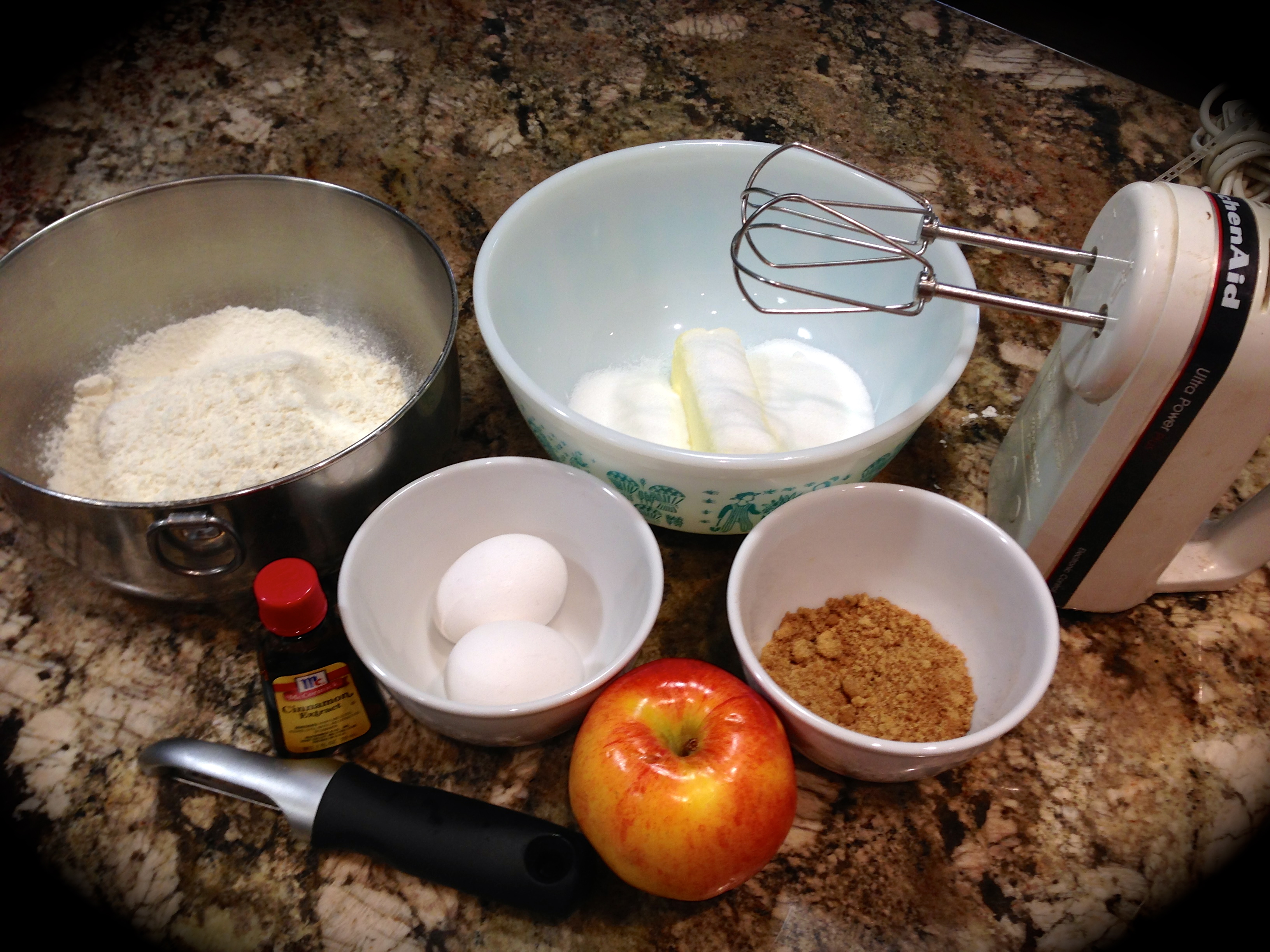
That being said, when I was searching for recipes I found two apple cake recipes that basically had the same proportions for the main ingredients (flour, sugar, oil) but had different spices. I decided to used the main ingredients from one (it used two eggs instead of three) and I also added the spices from the other (cinnamon and allspice). One of the recipes only had vanilla as a spice and I just could not imagine baking apples without cinnamon and allspice. So I borrowed the spices from one recipe and incorporated it into the other while eliminating the vanilla (although I imagine you could put that in as well). It worked like a charm.

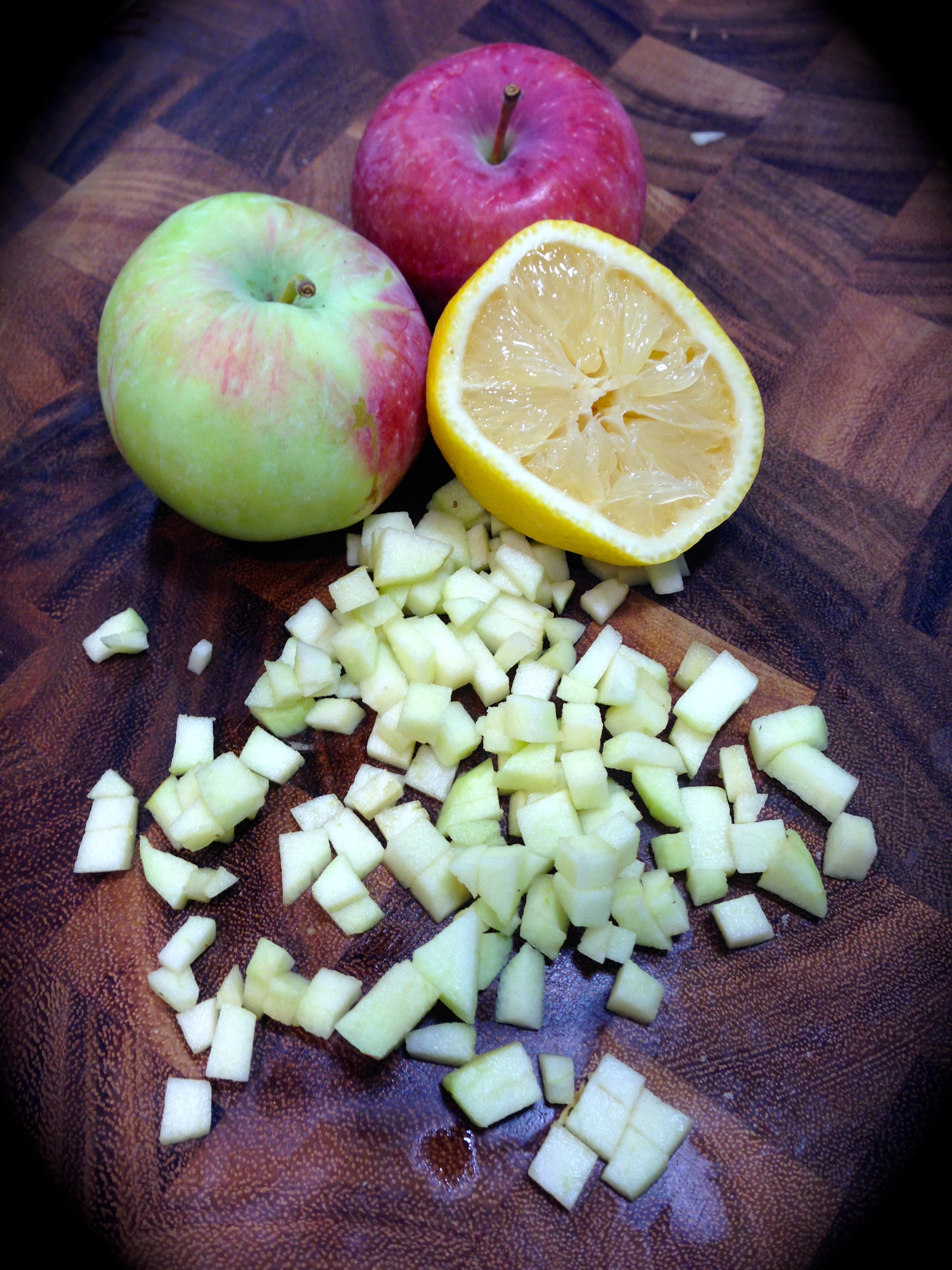
IMG_0277LESSON LEARNED 2 – Cut the apples into small pieces: I learned this lesson the hard way a few years ago. If you cut the pieces too big they won’t cook and the cake won’t taste as good. Cut them into nice small pieces and they will cook beautifully, moist but not mushy, within the allotted time. Also, make sure you peel the apples. Tough apple peels in a cake just don’t cut it in my estimation.

LESSON LEARNED 3: Use lemon juice to keep your apples from turning brown: This recipe calls for three cups of diced apples which takes a little time to prepare. During that time if you don’t sprinkle them with some lemon juice they will begin to turn brown. In order to avoid that take either some fresh or bottled lemon juice and sprinkle it sparingly on top of the apples. Stir the apples so that the lemon juice is incorporated thoroughly. You may have to do this process a couple of times because of the amount of apples but you need just a little lemon juice to keep the apples from browning.

LESSON LEARNED 4: Keep your nuts fresh by putting them in the freezer: Let’s face it nuts are expensive. Rarely do I finish a package of nuts in a recipe. I used to keep the leftover package in my pantry until the next time I needed them and then wondered why they tasted funky when I went to use them. I found out along the way that nuts have oil in them and if you don’t freeze them they will become rancid. Freezing leftover nuts makes them last much longer. And because they are frozen you don’t have to be dust them with flour in order to incorporate them throughout the batter.

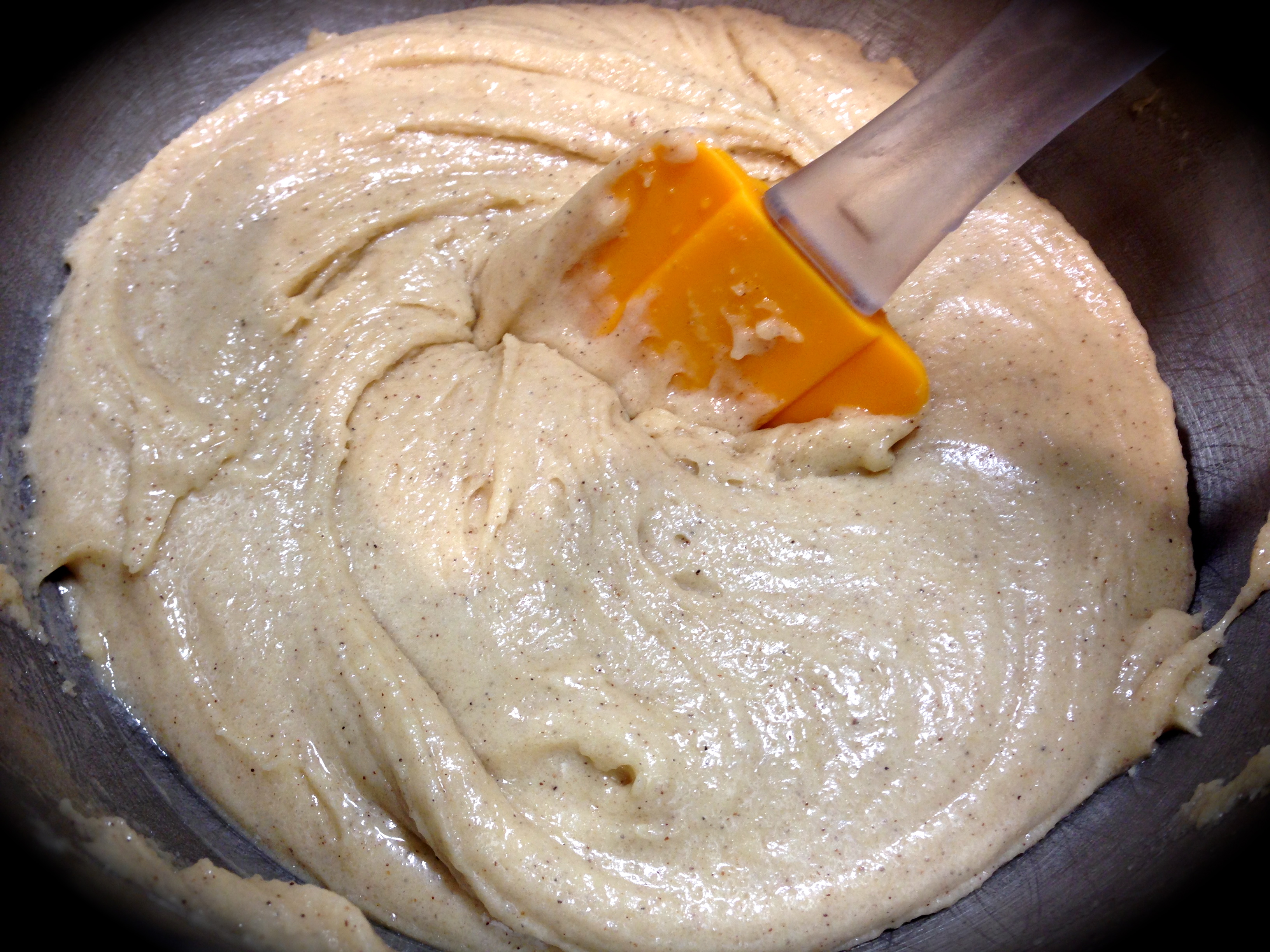
IMG_0291LESSON LEARNED 5 – The batter will be thick:  I was actually surprised to see the thickness of this batter. You will need to spread it to fill a 9×13 pan. Make sure you spread it evenly and get it into all the corners.

This is a perfect Fall recipe. The cake is moist and flavorful and the cream cheese frosting is to die for. One of my co-workers said that he could just eat the frosting it was that good. If you try this one I’m sure it will become a Fall staple in your home.

A friend of mine also gave me a recipe for apple chips. I think I may try that as well. What is your favorite apple recipe?


[recipe: title=”Apple Cake With Cream Cheese Frosting” servings=”16-20″ time=”75 Minutes Including Prep” difficulty=”Easy”]

CAKE INGREDIENTS:

1 1/2 cups vegetable oil

2 cups sugar

2 eggs, room temperature

3 cups flour

1 1/2 tsp. baking soda

1/2 tsp. salt

1 tsp. cinnamon

1/4 tsp. allspice

3 cups chopped apples

1 cup chopped pecans

1 tsp. vanilla (optional)

lemon juice to coat the diced apples

FROSTING:

1 package cream cheese

4 cups powdered sugar, sifted

1 tsp. vanilla

dash of heavy cream (you can substitute with milk)

DIRECTIONS:

Preheat oven to 350 degrees. Grease a 9×13 pan (you can also use cooking spray). Peel and dice apples. Put a dash of lemon juice on them to prevent browning. Combine oil and sugar. Add eggs one at a time and mix thoroughly. Add vanilla if desired. Combine flour, baking soda, salt, cinnamon and allspice. Add dry ingredients incrementally into wet ingredients until combined.

Fold in pecans and apples. Spread in prepared pan and bake for 45-50 minutes or until a toothpick inserted in the center comes out clean. Cool completely before adding frosting. (about 2 hours).

For the frosting: Sift powdered sugar. Beat sugar and cream cheese until combined. Add dashes of heavy cream until you get your desired consistency. (I prefer heavy cream to milk and I feel it gives a thicker, more lush frosting). Spread on top of cake. Enjoy!

[/recipe]

IMG_0362


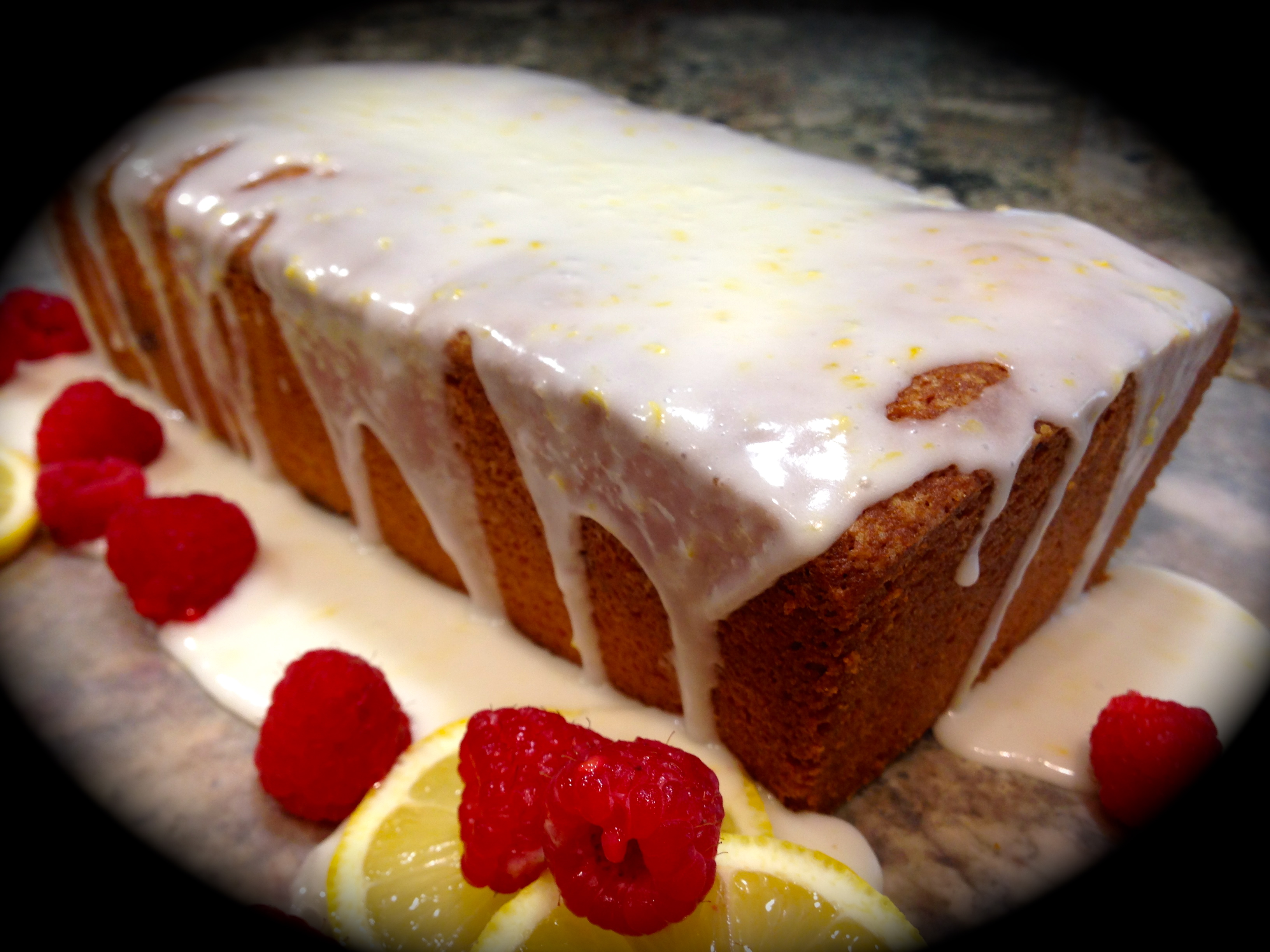
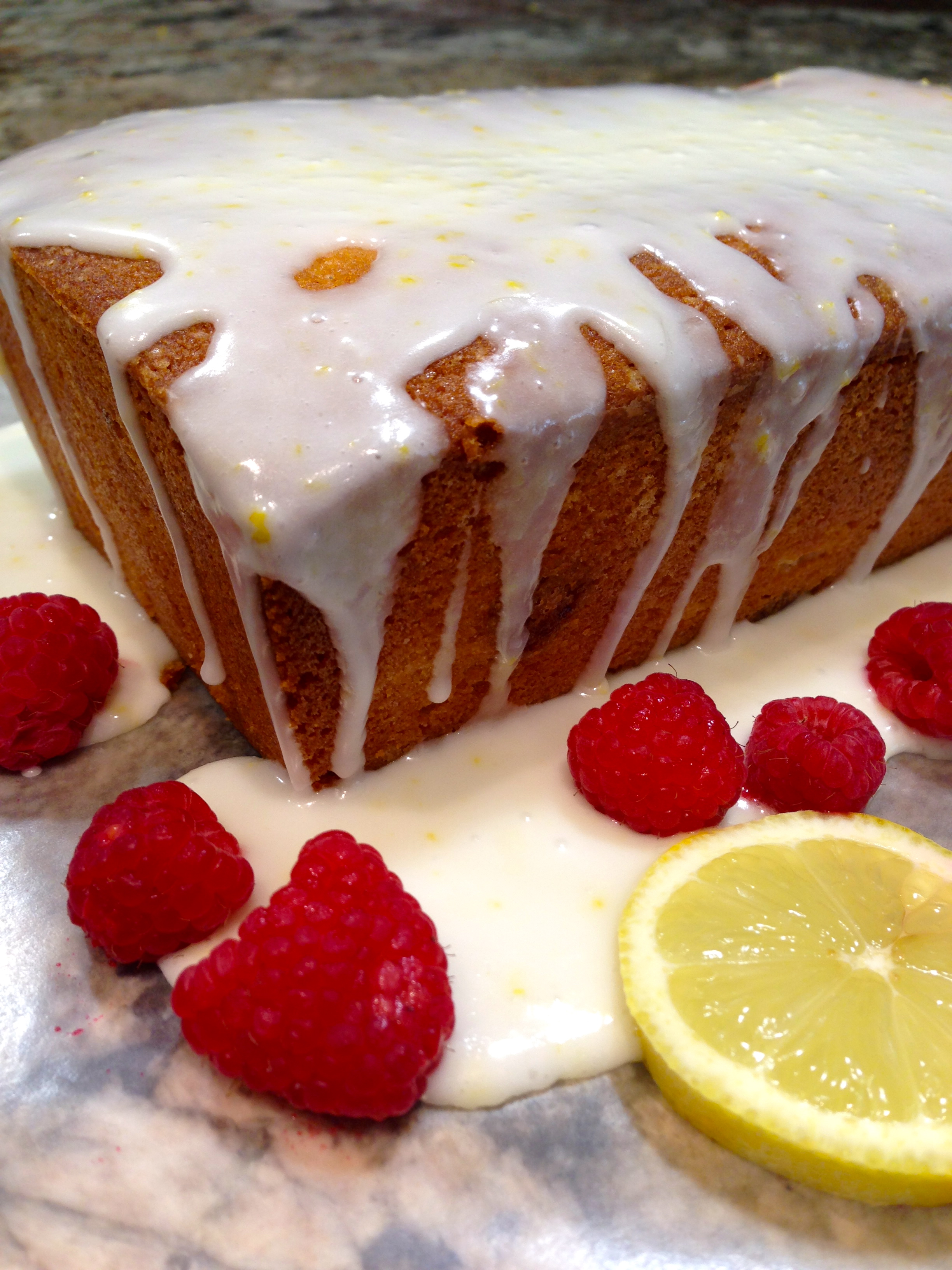
Lemon Raspberry Loaf Cake

August was quite a busy month with a lot of traveling and so I wasn’t able to make my goal of one new recipe a week last month. Now things have settled down a bit and I’m back in the saddle. This recipe I found on (you guessed it) Pinterest and it intrigued me especially since our local grocery store had quite the deal on fresh raspberries. The combination of lemon and raspberries is killer in my estimation and that made the choice even easier. So here is my recipe rating for a lemon raspberry loaf cake and lessons I learned while making it.

IMG_0135Recipe Rating – I’m conflicted so I will give it a range of B+ to A+. I know it’s a strange rating but I had to make this twice in order to get it right. The reason for the range is that I am just not sure whether the issue is how the recipe was written or the the challenges related to baking in high altitude. I will explain in my lessons learned.

Lesson Learned 1 – The flavor of this cake is awesome! The loaf fell in on me the first time I made it but I was determined to perfect the recipe because of the flavor. The cake is super delicious and I’m not kidding. If you love the flavors of raspberries and lemon you have to try this one. It is to die for!

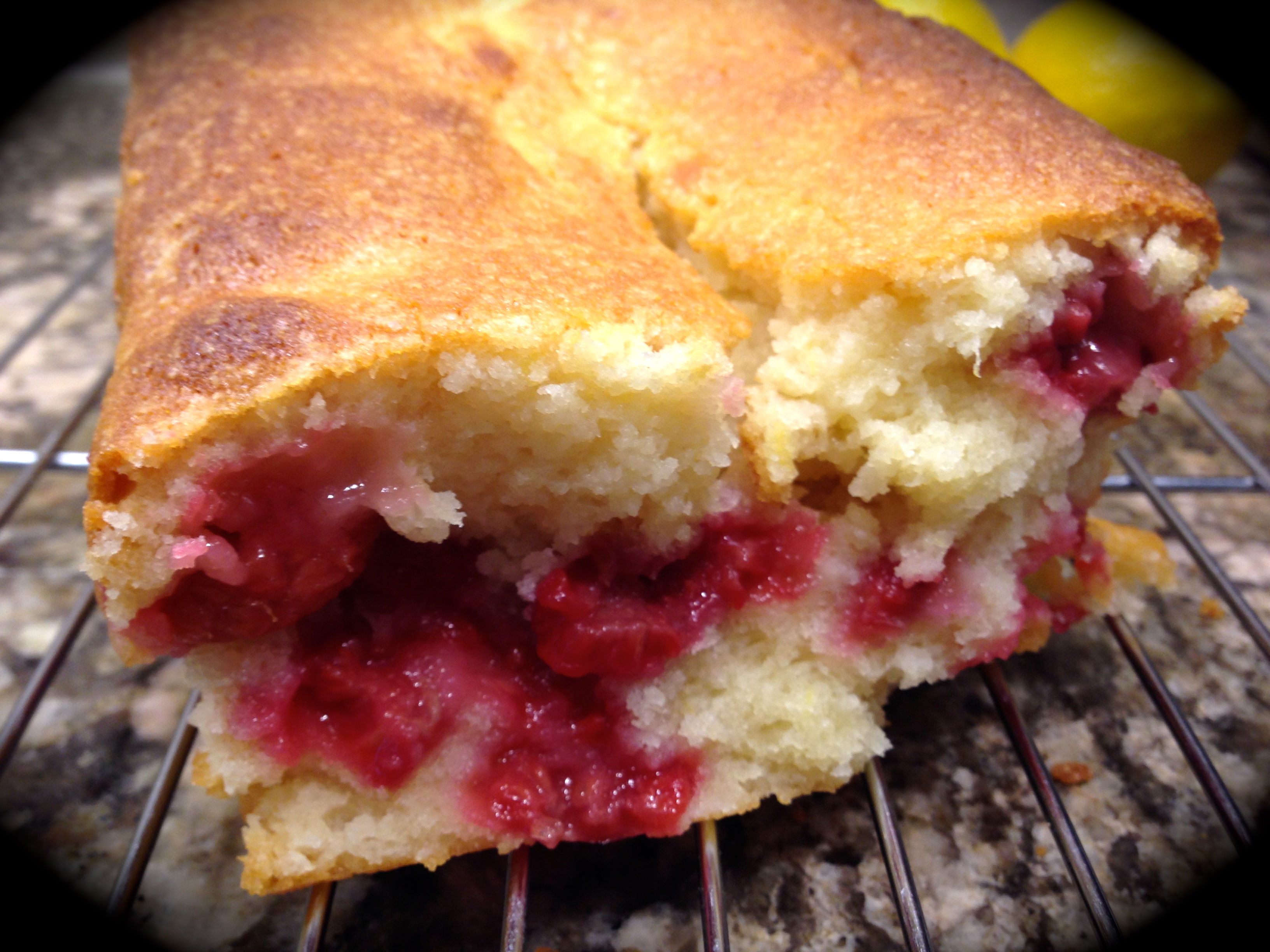
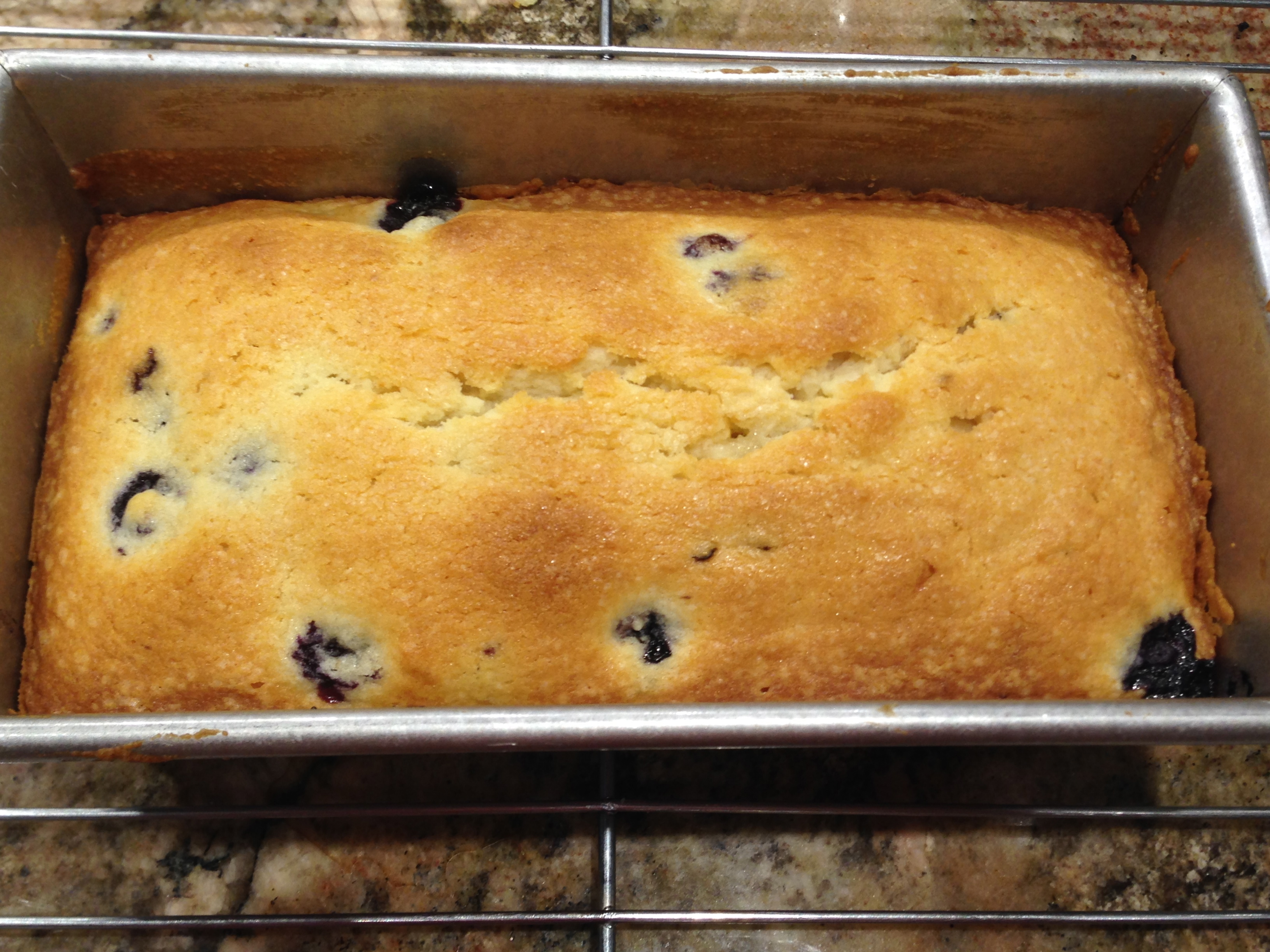
The first try produced a caved in cake...

The first try produced a caved in cake…

Lesson Learned 2 – Cooking with raspberries (and blueberries for that matter) is tricky: I’m not sure whether this is a high altitude or a berry thing but with this recipe (and also with my lemon blueberry pound cake recipe), when I used the amount of berries called for in the recipe my cake either became a mushy mess or sunk in in the middle. Both times I had to reduce the amount of berries in order for the cake to turn out perfectly. Both types of berries tend to get wetter and mushier when you bake them so I am thinking that the proportion of berry to batter is really important in order for the cake to hold its shape and not cave in. If any of my readers have any insights on this, I would certainly appreciate it. The first time I made this cake I used one cup of raspberries as called for in the recipe and the cake fell apart in the middle. The second time I used 3/4 cup and the cake did not cave in. Hmmm……

Lesson Learned 3 – Adding some additional flour: When I use box mixes (which has become less and less these days) I always add two tablespoons of flour to adjust the mixture for high altitude. I did the same for this recipe and I think that along with adding slightly less raspberries prevented the cake from falling in.

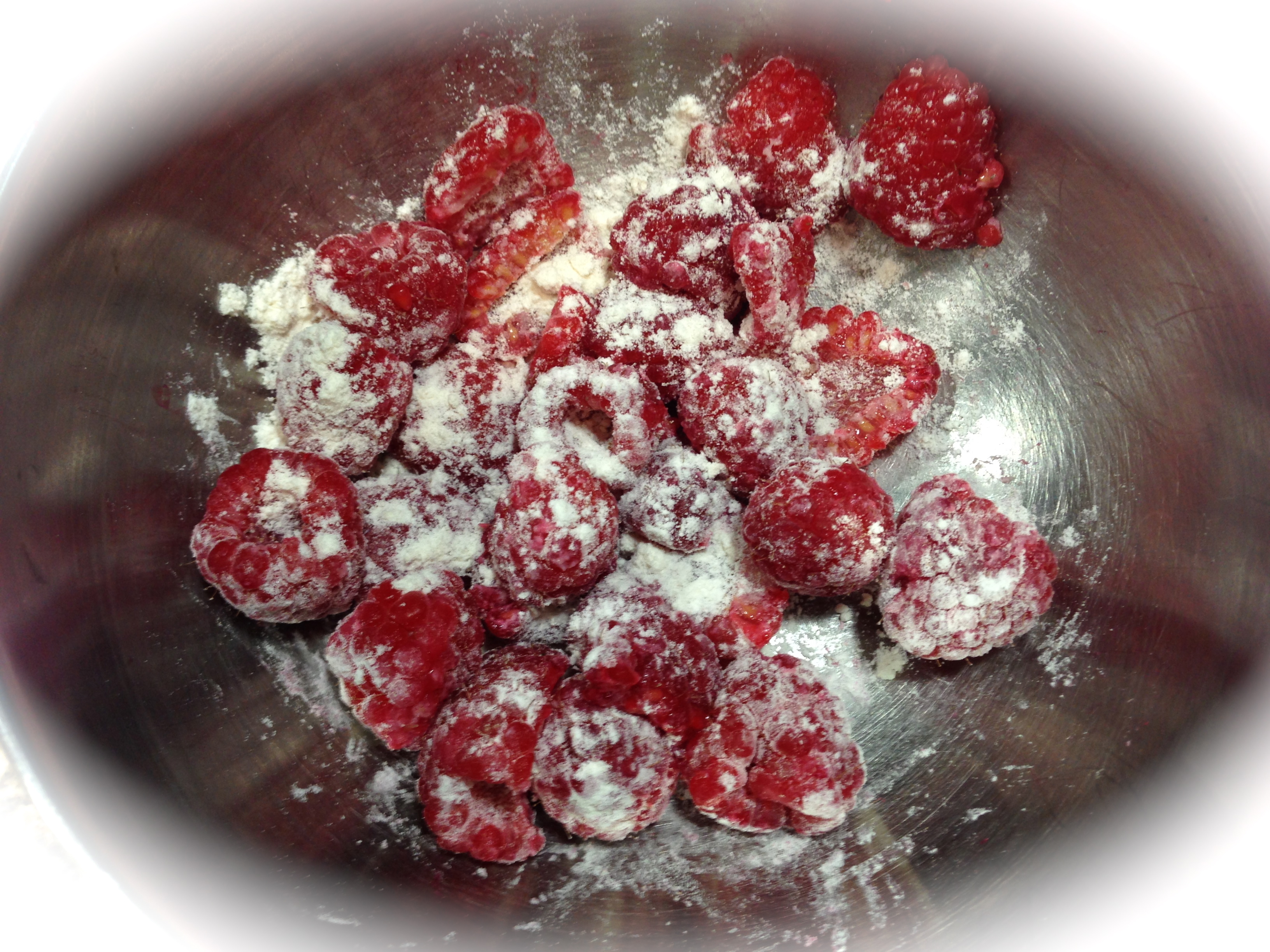
Lightly flour the raspberries to prevent them from all falling to the bottom

Lightly flour the raspberries to prevent them from all falling to the bottom

Lesson Learned 4 – Flouring the raspberries: Shame on the original recipe. It did not tell you that you have to slightly flour fresh raspberries in order for them to evenly distribute themselves in a batter. If you don’t they’ll all sink to the bottom. If you use frozen raspberries you don’t need to flour them, but it is a must with fresh berries. This was the only flaw in this recipe but the flavor of the cake more than made up for it.

Lesson Learned 5 – Adjusting batter for the size of the loaf pan: Maybe part of my problem was that I used my 8×4 loaf pan when the original recipe called for using a 9×5 pan. I googled the adjustments and it was suggested that the 8×4 pan only have 4 cups of batter put into it a opposed to 6 cups of batter for a 9×5 pan. This recipe makes 4 cups of batter so I’m not sure the amount of the batter was an issue in this case. I definitely had to bake the loaf longer, an additional 15 minutes to be exact. The additional baking time did not hurt it and produced a nicely browned top.

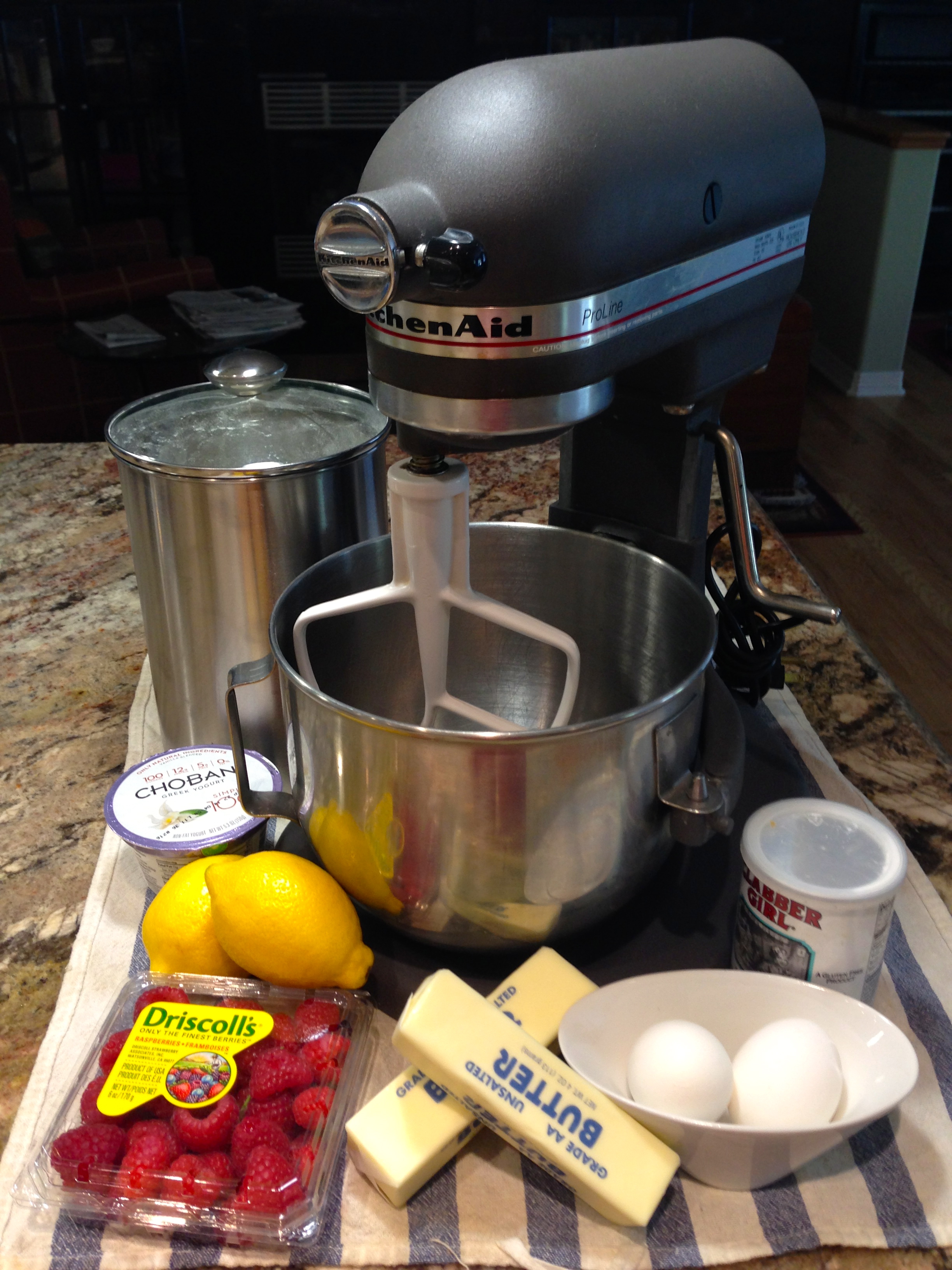
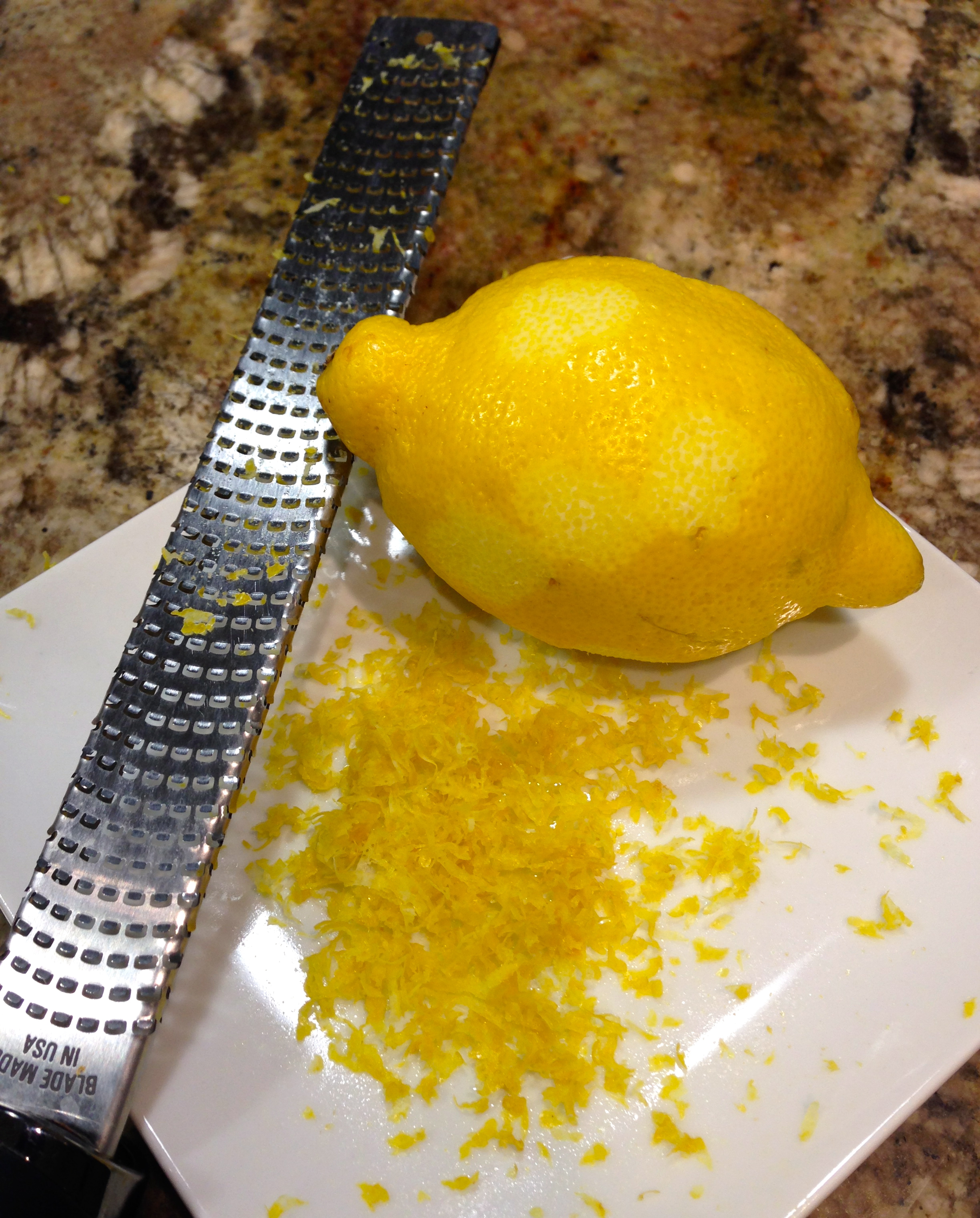
IMG_0153Lesson Learned 6 – The wonder of lemon zest: Zest is one of the best ways to add flavor to a recipe. Lemon zest happens to be my favorite. Not only does it produce a rich lemony flavor but also a great lemony smell. Just make sure you are careful not to zest the lemon down to the white part, the pith, as that will give you a sour zest. To avoid that just move your zester two or three times over an area of the rind and then move on to another yellow part of the rind. Continue until you zest the entire lemon. In this recipe lemon zest provides flavor not only to the cake but to the glaze as well.

Lesson Learned 7 – The technique of folding: This recipe calls for folding in the greek yogurt and then gently folding in the raspberries. Folding is a technique whereby you use a large spoon (I use a wooden spoon) and gently turn over the batter from the bottom to the top, continuing that process in a circular motion until you’ve combined the ingredient(s) you need to fold into the batter. The purpose of folding is to gently combine ingredients and in some cases not to deflate the air out of an ingredient (such as a whipped cream or meringue). If you are not gentle with the raspberries they will break apart and you will wind up having a pink cake versus a white cake dotted with raspberries. Be careful at this point not to break up the raspberries but make sure they are evenly distributed throughout the batter before pouring the batter into the baking pan.

Even though this recipe took me two tries I would highly recommend it. The combination of lemons and raspberries produces a fabulous flavor and the use of lemon zest in the glaze punctuates it. Just beware it may not turn out right the first time and be comfortable with that.  I guarantee you, the flavor is worth getting it right. Let me know how yours turned out and any adjustments you needed to make to get it right. Enjoy!

Lemon Raspberry Loaf Cake

  • Servings: 8-10
  • Difficulty: Easy
  • Print

INGREDIENTS:

IMG_0225Loaf Cake:

1 1/2 cup flour (plus two heaping TBS. for high altitude)

1 1/2 tsp. baking powder (reduce to 1 tsp for high altitude)

1/2 tsp. salt

1 1/2 cup sugar (reduce by 1/8 cup for high altitude)

1 1/2 sticks of butter, softened

2 eggs, room temperature

3 TBS. lemon juice (you will need 2-3 lemons for this recipe depending on size)

1 heaping TBS. lemon rind

1/2 cup greek yogurt

3/4 cup fresh raspberries

Glaze:

1 1/2 cup powdered sugar, sifted

3 TBS. lemon juice

1 tsp. lemon rind

A splash of heavy cream (you can use milk as a substitute)

DIRECTIONS:

Preheat the oven to 350. Grease an 8×4 loaf pan and set aside.

In a bowl combine the flour, baking powder and salt. Set aside.

Using an electric mixer, combine the butter and sugar for at least 3-4 minutes. Add eggs one at a time and beat until fully incorporated. Mix in lemon rind and lemon juice.

By hand, mix in the dry ingredients (do not use the electric mixer for this). Once combined, fold in the greek yogurt. After that, gently fold in the raspberries.

Bake in the oven for 55-60 minutes or until a toothpick inserted in the center of the cake comes out clean. Let cake stand in pan for 15 minutes. Remove from pan and cool completely.

Combine powdered sugar, lemon rind, lemon juice, and heavy cream to make the glaze. Drizzle on top of cooled cake.

IMG_0237


Lemon Raspberry Loaf Cake

Lemon Raspberry Loaf Cake


Cheesy Zucchini Mushroom Bake…

I guess at this point you can probably tell that I’ve been a little fixated on zucchini recipes and with good reason. The zucchinis just keep coming and coming. Every day it seems I’m harvesting two to three new zucchinis. Last year my zucchini plant (I only have one as I have limited space in my garden) hardly produced anything. This year my plant is producing prolifically. Go figure. Mind you, I am not complaining. The challenge is to determine ways to use all this zucchini as I won’t let any go to waste. I know I can give them away if I need to, but most of my neighbors are looking to give their zucchini away as well. Some have even gone to the lengths of just leaving them on neighbor’s door steps. The whole neighborhood must be over run. So my challenge – how can I not only use my zucchini but also make it exciting when having it several times a week.

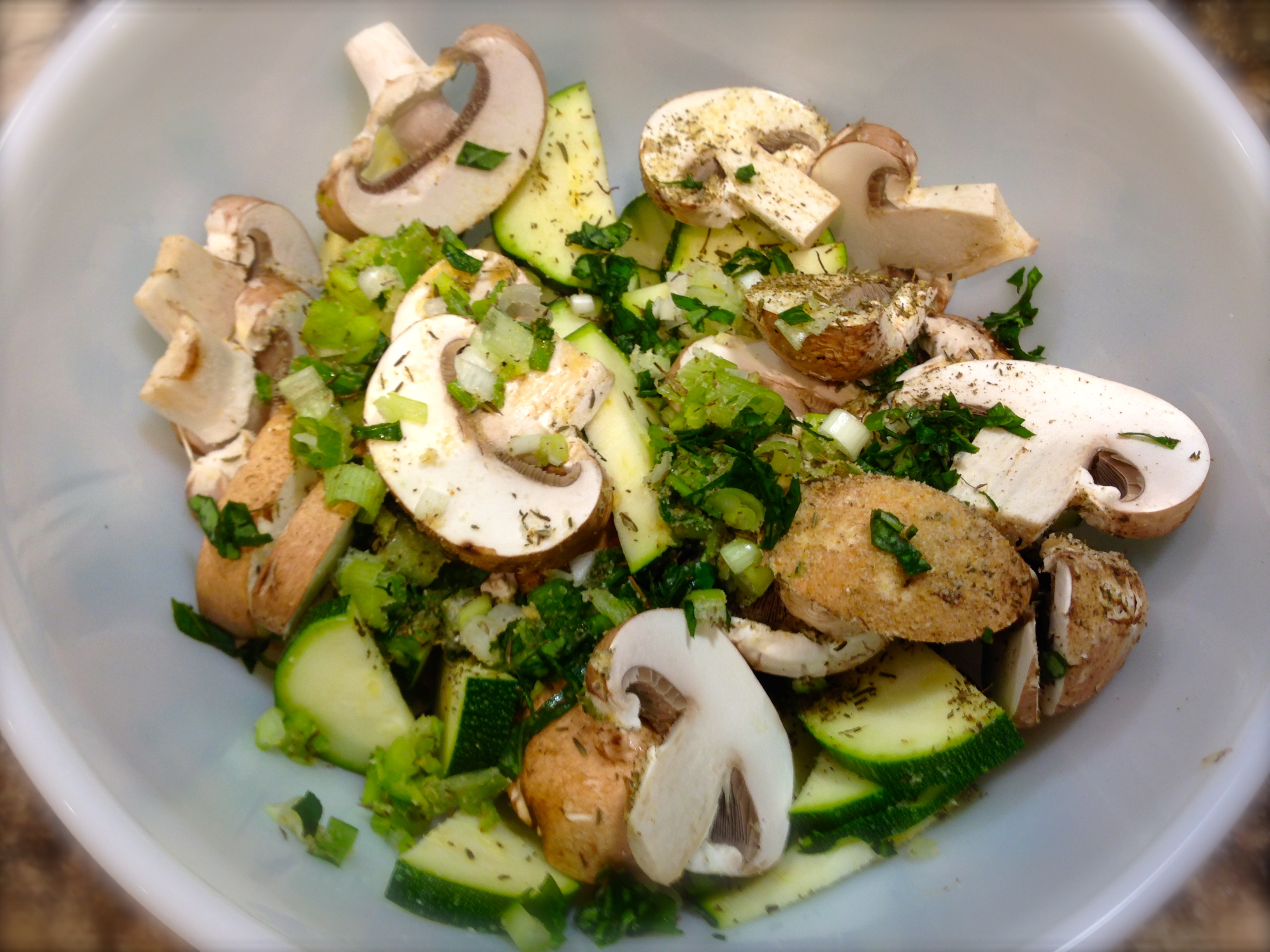
IMG_9540The latest recipe I tried was a side dish.  Those are probably the easiest recipes to find. This recipe came off of a website that featured 35 different zucchini recipes and I always like to one stop shop. This one seemed relatively easy and so I thought I’d try it. The original recipe called for paring zucchini with yellow squash and I think that would have been perfectly fine, but I had so much zucchini that I wanted to use and so I just skipped the yellow squash. I did add some mushrooms that I had and that worked very well (I always seem to have mushrooms in my refrigerator). My point is that this recipe is adaptable and I am all for adaptable. Bottom line, this is an easy recipe to prepare and it’s actually quite good. I had some issues with how the recipe was written and I will share those in my lessons learned.

Recipe rating: B+ – most of my issues came from how the recipe was written as I am a stickler for detail and how to achieve success the first time you make something. In my experience even the best of recipes are seldom tried again if they can’t be done well the very first time. These days everyone is so busy that recipe success the first time around is just about a given for making a recipe again. This one had one critical piece of information missing that, in my estimation, made the dish look great as well as taste great.

IMG_9550Lesson Learned 1 – prepping ahead: The beauty of this recipe is that it can be prepped ahead and put into the oven when needed. I prepped all of the ingredients about an hour ahead of time and simply covered them in plastic wrap and put them into the refrigerator. The only other thing I did was to take it out of the fridge about 15 minutes before putting it into the oven to take the chill off. Right before putting it in the oven I topped it with some additional cheese. I am thinking this is something that can be prepped in the morning and then finished off when you get home from work – a nice little advantage especially for a busy day.

Lesson Learned 2 – use fresh herbs whenever possible: The original recipe called for 1/2 teaspoon of dried thyme. I have thyme growing in my garden and I used that. You always need to add more of an herb if it is fresh, so I substituted 1 teaspoon of fresh thyme and I felt it gave the side dish a great flavor boost.

Ready to go into the oven

Ready to go into the oven

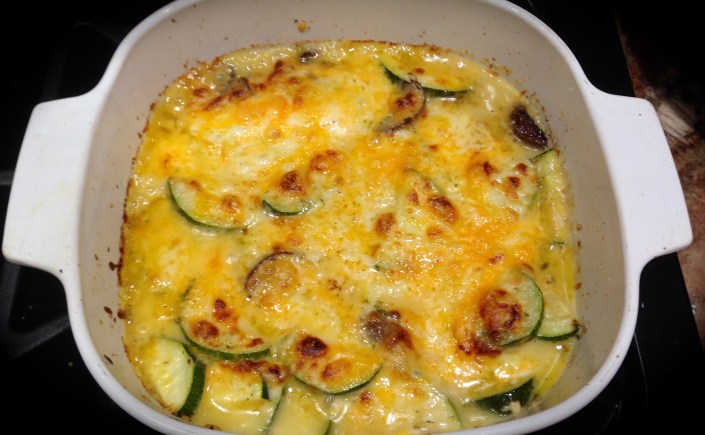
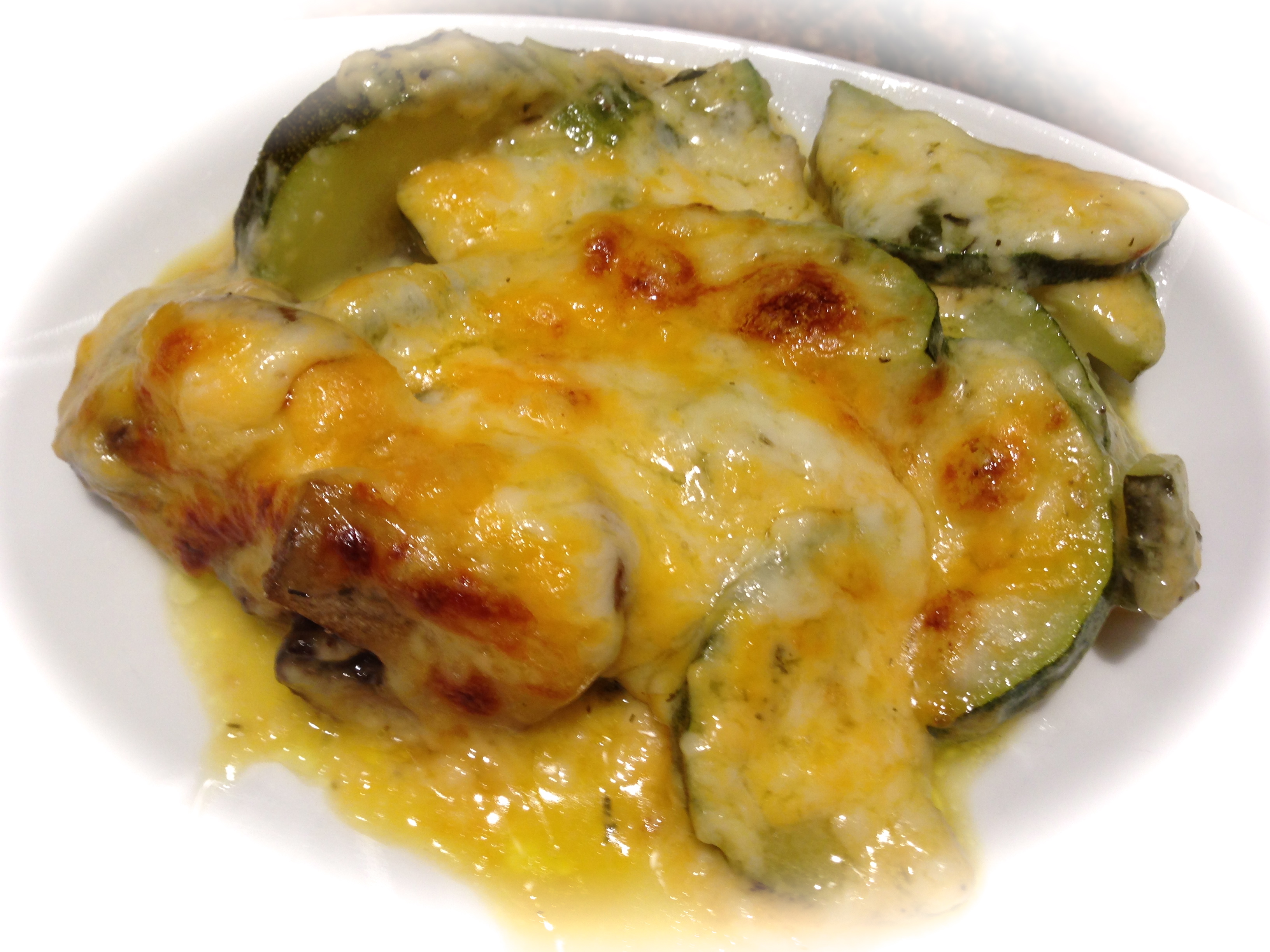
Lesson Learned 3 – you eat with your eyes first: How often have you heard someone say, “Oh that looks delicious!” When you think about it, it’s really a sort of oxymoron since something can only taste and not look delicious. But the truth of the matter is we eat with our eyes first. If something looks great, we automatically assume it will taste great. And this is probably my biggest bug-a-boo with the original recipe. That recipe called for baking the ingredients uncovered for 25-30 minutes then adding the remaining cheese and baking it for an additional 10-15 minutes. I would never have gotten the rich color on the cheese by doing that. What I wound up doing is putting the dish under the broiler for the last 5 minutes thereby getting those nice brown bits of color on the cheese. If I had not done that, the top would’ve just looked gooey white. Getting the browning from the broiler, in my estimation, makes the dish look much more inviting. Believe me, it did not look nearly as inviting when I followed the directions in the original version of the recipe. At 350 degrees you would have to cook the cheese much longer to get it to brown on top.

I realize that my rant about using the broiler may be very picky, and it probably is. Don’t let that deter you from trying this recipe. It’s a great way to use up some of that extra zucchini and I’m pretty sure it will be a family pleaser as well.

Right Out Of The Oven

Right Out Of The Oven

Cheesy Zucchini Mushroom Bake

  • Servings: 6
  • Difficulty: Easy
  • Print

INGREDIENTS:

4 medium zucchini

4-6 ounces of baby portobella mushrooms sliced

3 Tbs. chopped fresh basil (this can be adjusted depending upon personal taste)

2 green onion spears thinly sliced (white and green parts)

1 tsp. fresh thyme chopped (1/2 tsp. dried thyme)

3/4 tsp. garlic powder

1 cup cheese, divided (I used a combination of mozzarella and pizza cheese – you can use more cheese if you like, I think I actually used 1 1/2 cups of these cheeses all total)

1/2 cup parmesan, divided

salt and pepper to taste

DIRECTIONS:

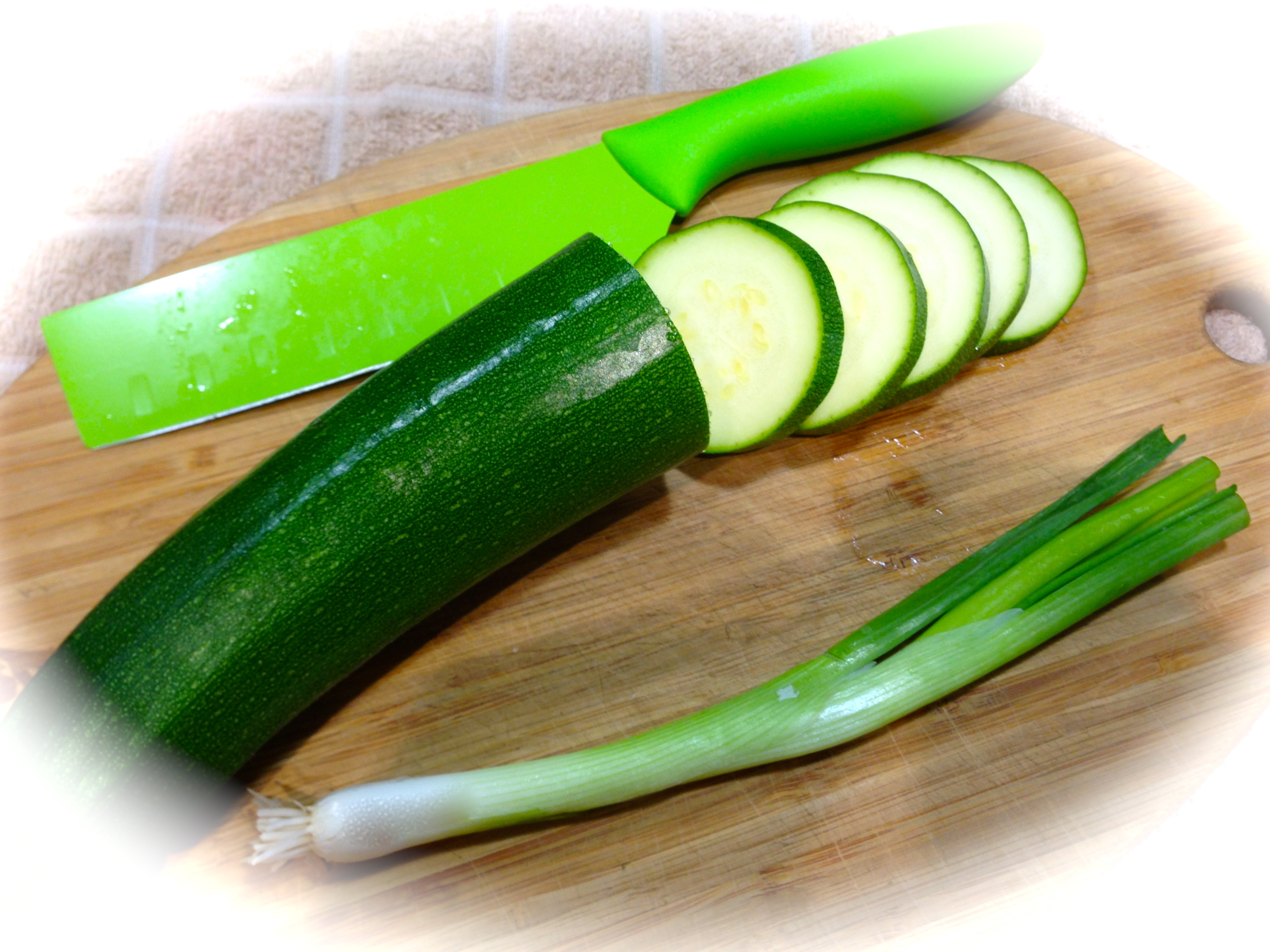
Preheat the oven to 350 degrees. Wash and cut the zucchini into half moons. Slice the mushrooms into thick slices. Finely chop the basil. Thinly slice the green onions. Chop the fresh thyme.

Combine the sliced squash, mushrooms, basil, onion, thyme garlic powder and half of each of the cheeses. Stir carefully to combine all of the ingredients making sure that the cheese and herbs are well distributed. Season with salt and pepper. Put the mixture in an 8 x 8 baking dish that has been sprayed with cooking spray. (At this point I added a little more cheese on the top). Bake uncovered for 25 minutes.

Take the dish out of the oven and sprinkle with the remaining cheese. Let bake for an additional 5 – 10 minutes then place casserole under the broiler for the last 5 minutes. Let stand for a few minutes and serve.

Cheesy Zucchini Mushroom Bake

Cheesy Zucchini Mushroom Bake

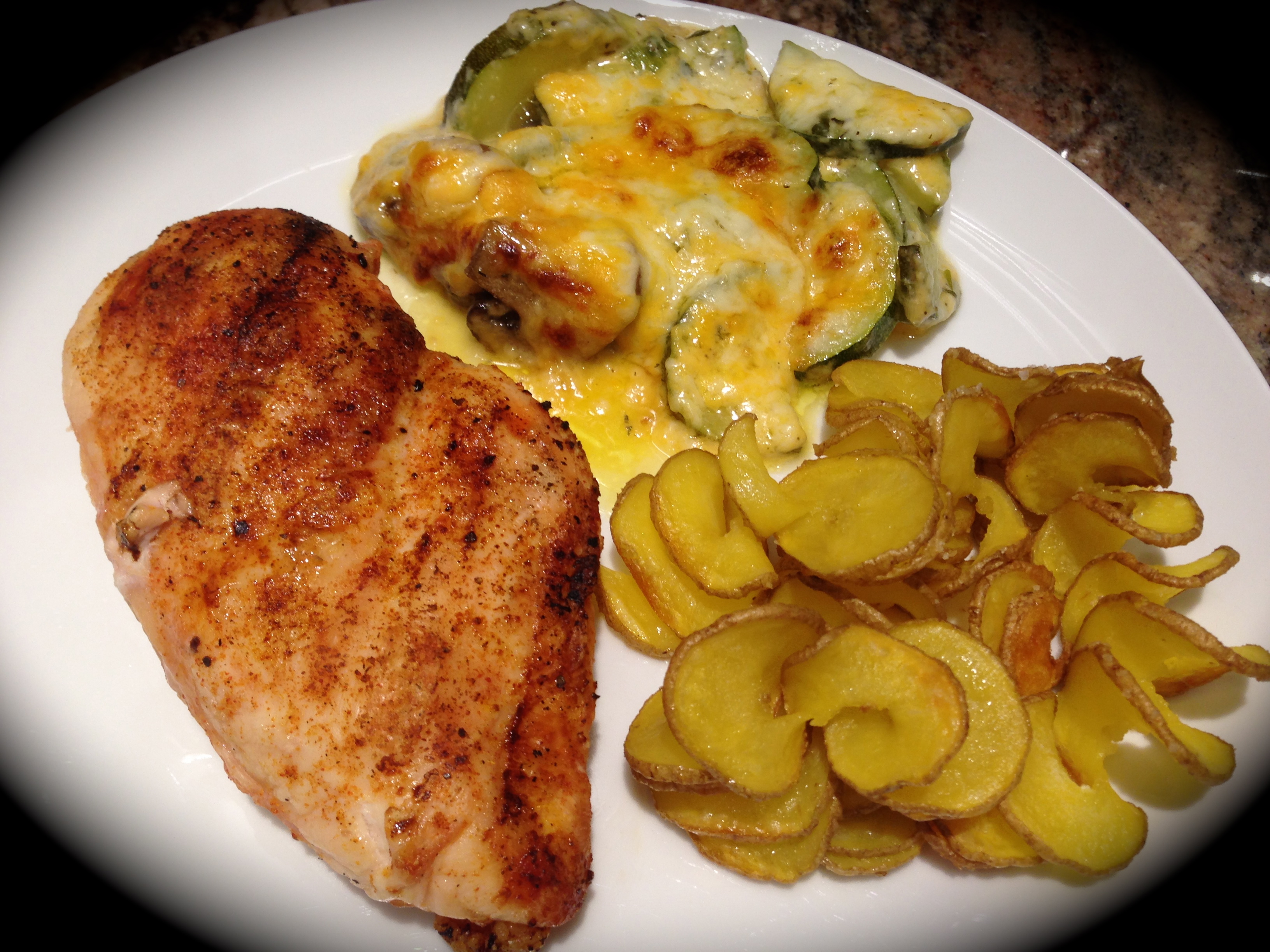
Serving Suggestion: With Grilled Chicken Breast and Oven Baked Potato Chips

Serving Suggestion: With Grilled Chicken Breast and Oven Baked Potato Chips

How Do You Solve A Problem Like Zucchini…

I am in the midst of selling and buying a house so I have not had time in the kitchen to try out recipes. I should be back doing my regular schtick by the end of July. In the interim enjoy some of my reposts. See you soon!

[Note: A version of this post published a few years go has been my most successful blog to date. I get at least one hit on it every day and often more. I’m not sure if it’s the title or the content, but it’s had amazing success. I have updated it with some additional thoughts since I’ve made this recipe dozens of times since first posting it, have definitely perfected it and can provide some additional lessons learned. This is the ideal post for this time of year, especially if you’re like me and have tons of zucchini and are running out of ideas on how to use them. Of all my zucchini recipes, savory or sweet, this is by far my absolutely favorite!]


I love to grow vegetables in my garden. It’s not only fun it’s also very satisfying. And I’ve learned over the years, just like anything else in life, that less is more. So I’ve finally come to terms with having blank space in my garden knowing that as the summer progresses the vegetable plants will fill them in. They’re also much happier and produce more because now they have the room to grow and don’t have to compete with other plants for space and water. What a concept. I wish I’d figured that out a lot sooner.

Zucchini Flowers...

Zucchini Flowers…

And for some reason my gardening prowess seems to be growing zucchini. Once the onslaught begins it never seems to end. I love grilled zucchini and I have a great recipe for Zucchini and Mushroom Gratin (thanks in part to Ina Garten) but I’ve struggled with using zucchini to make zucchini bread. The usual recipes seemed too dry and too bland to me. I was searching for the perfect recipe and happened to stumble upon it last year thanks to Pinterest and my friend Kelly Brown who originally pinned it. It is a recipe for double chocolate zucchini bread and I am not kidding when I say it is to die for! I can’t take credit for the original version of the recipe, it is from King Arthur’s Flour, but I love my version for several reasons. So let’s rate the recipe and talk about some lessons learned by making it several times over the past year.

Recipe Rating: A+ to the moon and back (my highest rating ever)! This is by far the best recipe recipe I’ve found to use zucchini, sweet or savory. It is easy to make and uniquely flavorful. I guarantee if you try this, it will become one of your staple recipes.

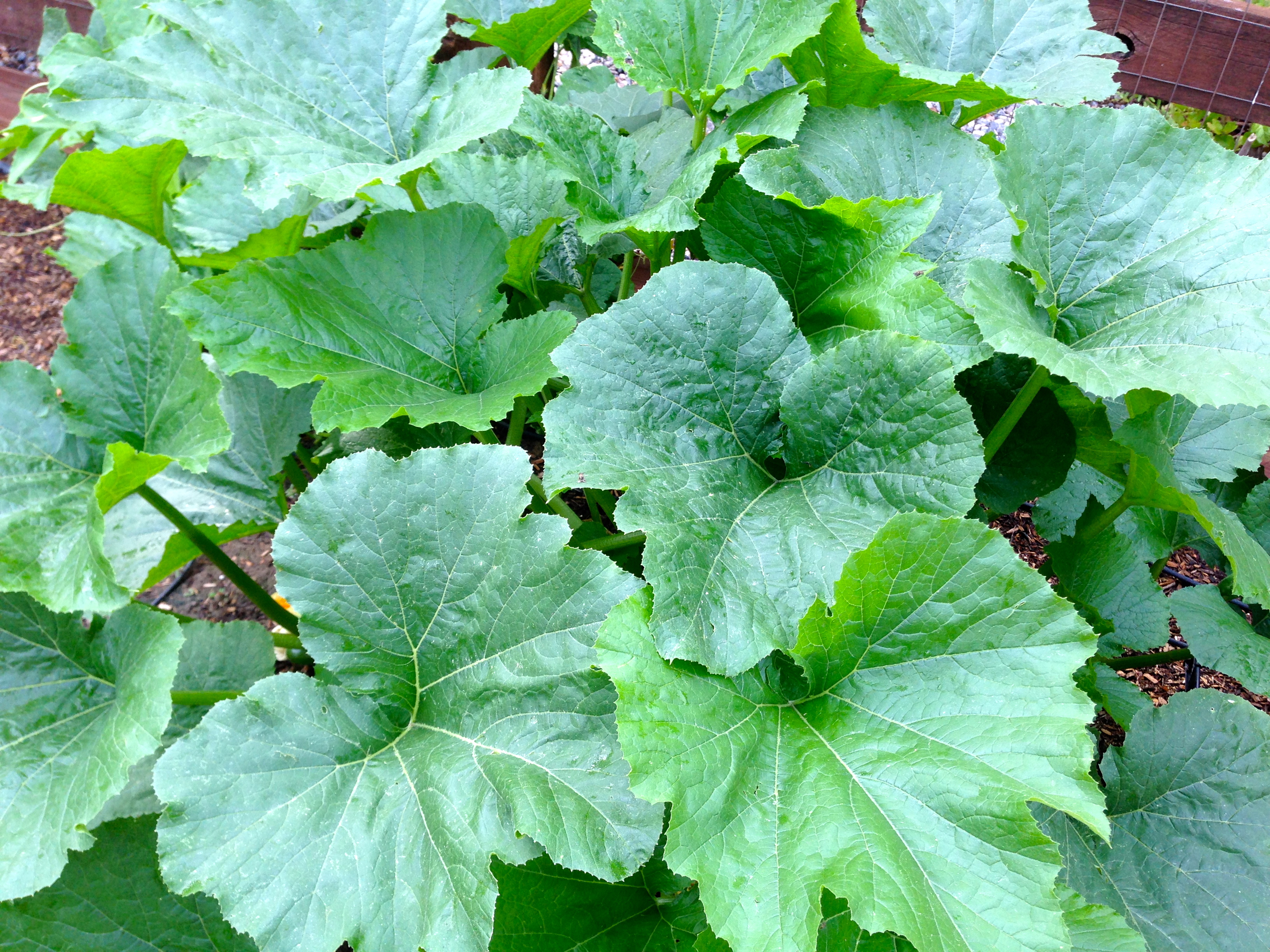
My very happy zucchini plant...

My very happy zucchini plant…

Lesson Learned 1 – You don’t need butter and white sugar to make a cake sweet: There is no butter or white sugar in this recipe. The substitutes for them are vegetable oil, honey and chocolate chips. This produces a cake/bread that tastes like a flourless chocolate cake with just the right amount of sweetness without being sickeningly sweet. We are so used to a lot of sugar in recipes that the first time I tasted this I wasn’t sure if I liked it. After a few bites I was hooked and now I prefer it to the sweeter versions of zucchini breads.

Lesson Learned 2 – Zucchini enhances the moistness of the bread: This recipe uses a good quantity of zucchini, two cups patted down (that translates into about two 8-9 inch long zucchinis). As with other types of zucchini breads, you really don’t taste the zucchini but it gives the bread a wonderful moistness. Plus it is a great way to use up a bumper crop of zucchini which I tend to get just about every year.

IMG_9519Lesson Learned 3 – Coffee enhances the flavor of chocolate: The original recipe calls for 1/2 teaspoon espresso powder used as a flavor enhancer. I couldn’t find espresso powder at my local grocery store so I just used plain ole’ brewed coffee as a substitute, 2 tablespoons to be exact. It’s amazing how much more robust coffee makes the flavor of chocolate! Plus we make coffee everyday and don’t drink espresso so I didn’t have to spend money on something that would wind up taking up shelf space in the pantry and only used for a few recipes.

Lesson Learned 4 – Add frozen chocolate chips: When adding ingredients like fruit or baking chips you normally have to coat them in flour so they don’t all fall to the bottom of the bread. If you freeze your chips and then add them at the very end right before pouring the mixture into the pan, they will distribute evenly in the bread without having to flour them.

This recipe is simple to make and is so killer delicious you won’t believe what you are tasting. Try it and let me know what you think. Also, I am always on the lookout for zucchini recipes so please if you have a favorite, share it and I will try to make it. I am determined to use all of the zucchini my garden produces and so variety is key to getting that accomplished! Enjoy this one!

Double Chocolate Zucchini Bread

  • Servings: 1 loaf
  • Difficulty: easy
  • Print

INGREDIENTS:

2 large eggs, at room temperature

1/3 cup honey

1/2 cup vegetable oil

1/2 cup brown sugar

1 tsp. vanilla extract

1 tsp. salt

1/2 tsp. baking powder

1/2 teaspoon baking soda

2 TBS. brewed coffee (or 1/2 tsp. espresso powder)

1/3 cup baking cocoa

1 2/3 cup flour

2 cups shredded unpeeled zucchini, gently pressed

1 cup frozen chocolate chips (I use dark chocolate chips)

DIRECTIONS:

1. Preheat oven to 350 degrees, lightly grease an 8 1/2 x 4 1/2 inch loaf pan. Grate two 8-9 inch zucchinis. Set aside.

2. In a large mixing bowl, beat the eggs, honey, oil, brown sugar, vanilla and coffee until smooth.

3. In a separate bowl combine the salt, baking soda, baking powder, cocoa and flour whisking until well combined. (if using espresso powder add it to the dry ingredients). Gradually add the dry ingredients to the wet ingredients. Do not over mix.

4. Stir in the zucchini until combined. Add the frozen chocolate chips.

5. Pour the batter into the prepared pan.

6. Bake the bread for 65-75 minutes. Test for doneness (a toothpick or cake tester inserted into the center will come out clean save for perhaps a light smear of chocolate from the melted chips).

7. Remove the bread from the oven and let it cool for 15 minutes before taking it out of the pan.

8. Cool completely before slicing (although slightly warm is delectable as well). Store well wrapped at room temperature.


Double Chocolate Zucchini Bread

Double Chocolate Zucchini Bread

Serving suggestion: with strawberries and a dollop of whipped cream...

Serving suggestion: with strawberries and a dollop of whipped cream…


The Saga of the Lemon Blueberry Pound Cake…

Let me start off by saying that even the most proficient of cooks isn’t always successful when trying new recipes. In this blog I prefer to post my recipe successes but there have been failures along the way, more than I can count I assure you. So I thought I’d dedicate this blog to a recent failure that eventually turned to triumph.

IMG_9293The nice thing about honing your skills as a cook is that your successes come more frequently. But every once in a while an attempt at making something is botched and you recognize it’s never good to get too smug about your culinary skills. Just this past week I botched a recipe – BIG TIME – and thought I would share that escapade with you. I call it the saga of the lemon pound cake.

It all began simply enough with my usual quest for that one new recipe I would make this week. Flipping through the various posts on (you guessed it) Pinterest I came across a recipe for lemon blueberry pound cake. I already have a recipe on this site for a lemon blueberry yogurt loaf  but thought I’d try this one as I had never made a pound cake before. The recipe seemed simple enough, the only difference being that it was written to make two loafs instead of one. Great, I thought, I can have one loaf for home and give one as a gift to an unsuspecting neighbor. I liked that idea. I had to purchase some disposable foil pans as I don’t have two professional grade loaf pans. No biggie, they’re certainly cheap enough. This should be a no brainer. WRONG!!!

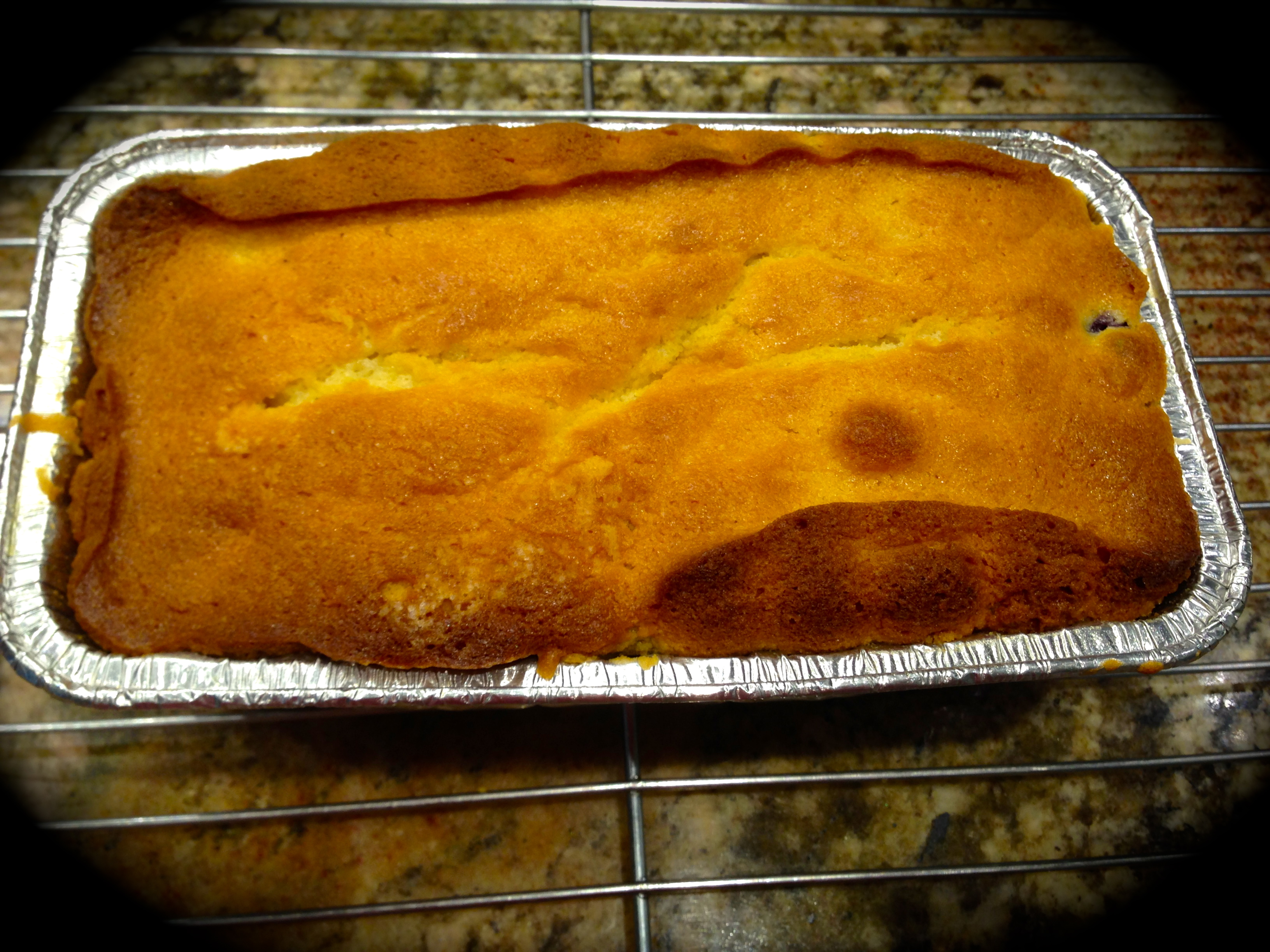
The blueberry disaster...

The blueberry disaster…

OMG – that’s all I can say. The end result was awful on so many levels. My husband suggested that I take a picture of the disaster and post it in the blog for all to see. So here it is to the left – can you even believe it? It looks like a blueberry explosion! Of course in the picture the cake is upside down, but right side up it was no prize either. The cake never fully cooked, the blueberries took over the entire cake and to add insult to injury they all congregated at the bottom.  On top the cake had risen onto itself and created what I call a lap over effect on the edges as can be seen in the picture below . I’m not sure what causes that but I never get that effect when I use my good loaf pan. It must have something to do with the evenness of the temperature during the cooking process and the quality of the pan.

The distorted top with the cake folding over itself on the top and bottom edges

The distorted top with the cake folding over itself on the top and bottom edges
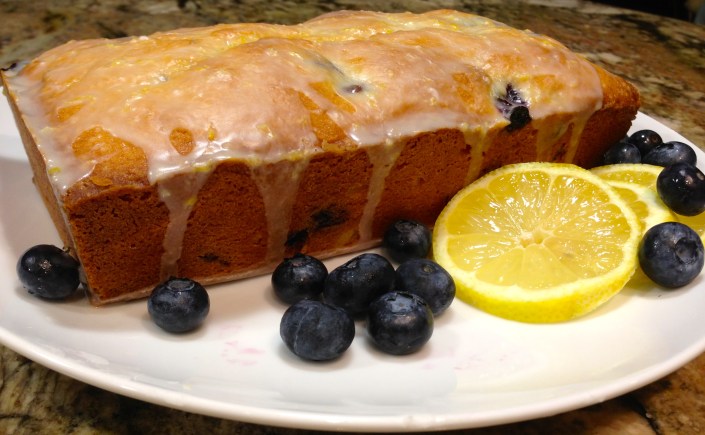
Needless to say, it was a total disaster. I haven’t had one this bad in a long time – just enough to keep me from getting too smug regarding my baking skills. I wound up having the throw both cakes away – they just were not salvageable. So why, you might ask, would I even try this recipe again? To be honest, although it looked bad and did not cook all the way through the part that did cook actually tasted pretty good. So I thought this actually could be a keeper recipe but it definitely needed an overhaul. I guess I wanted to see if I could fix what obviously was a broken mess. So the next day I put my delicate baking ego on the line and tried my hand at making the pound cake once again.
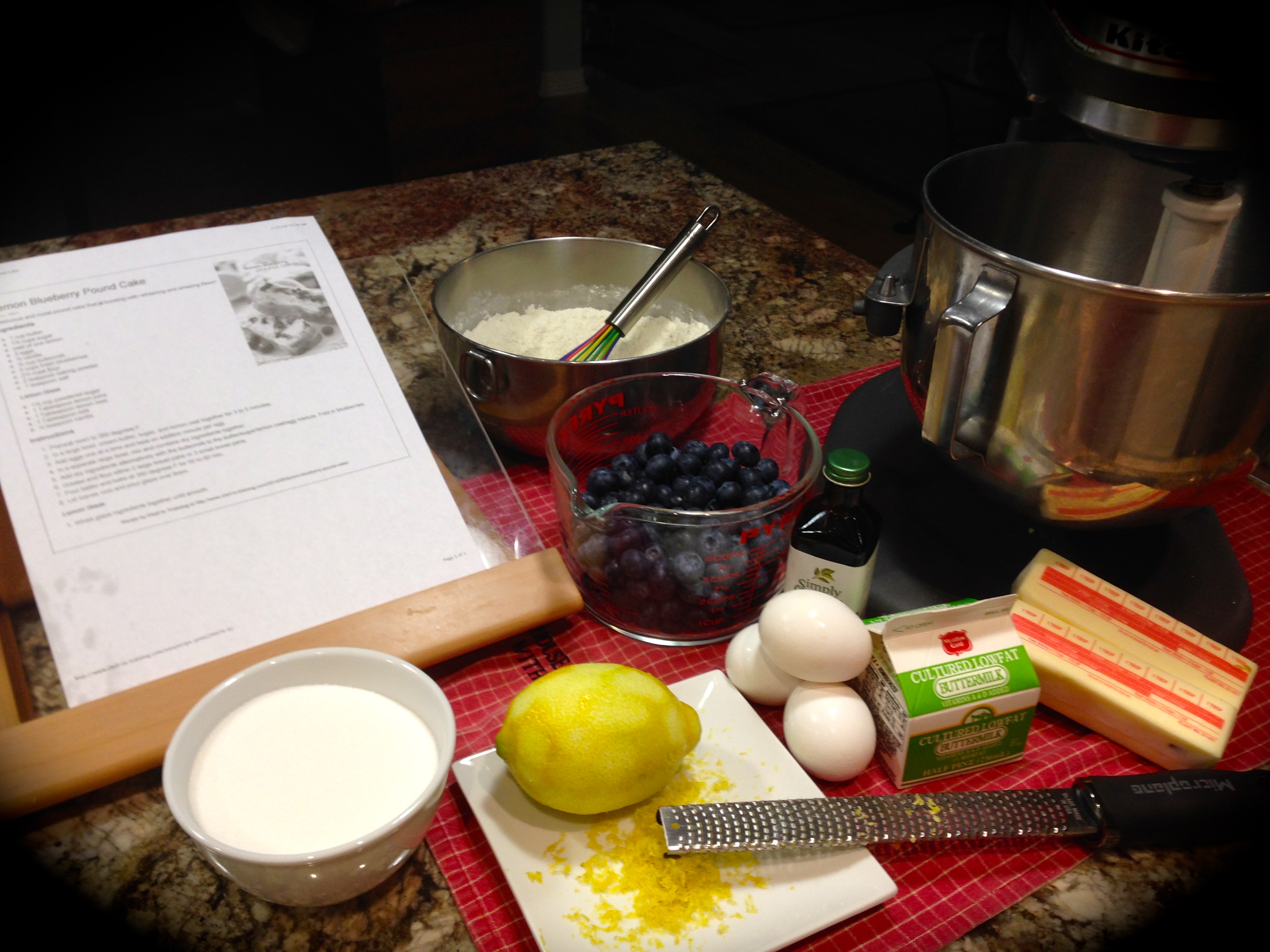
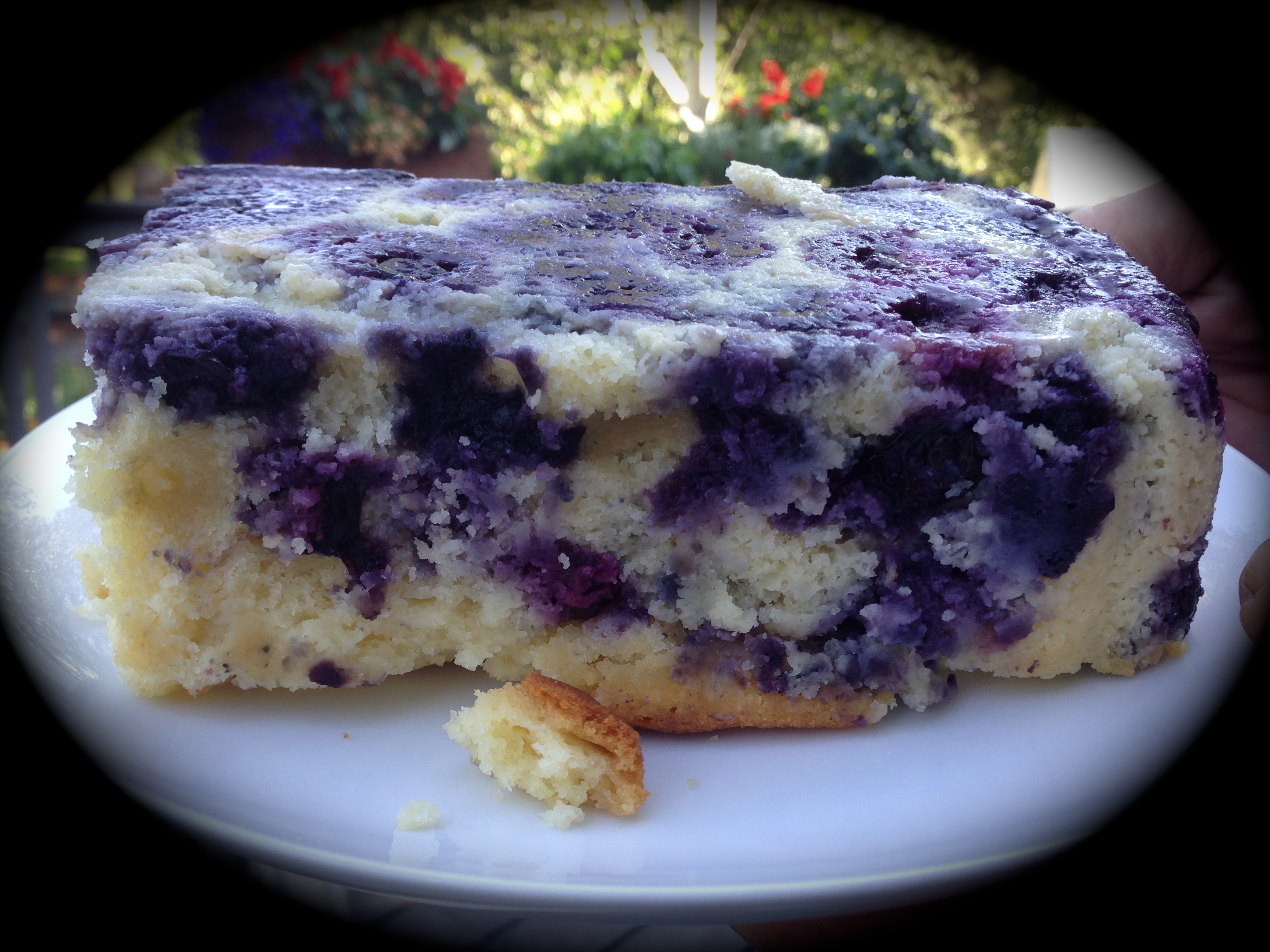
The second time I was successful but it took some manipulation of the recipe to achieve what was intended. In deference to the author of the recipe I will not mention the site where I found it. The recipe as originally written was horrific and, regardless of altitude considerations, I find it hard to believe that the proportions as written are correct (especially where the blueberries were concerned). What I decided to do was adjust the proportions to make one pound cake instead of two. I also significantly adjusted the amount of blueberries used in the loaf and the end result is I think what the author had intended when writing the recipe. So here are my lessons learned and recipe rating.

Recipe Rating: I have two ratings for this recipe, one for the original version and one for the version I created. The original version gets an F+. Although the overall flavor combinations were very good (meriting the + in the grade) there were far too many blueberries called for in the recipe. Blueberries expand and burst during the cooking process and the original amount created a blueberry nightmare (as can be seen in the picture above). My version created a cake that was nicely integrated with blueberries but was still primarily a cake and not a blueberry compote. My version gets an A.

Lesson Learned 1 – You only get what you pay for: My advice to anyone wanting to be successful in the kitchen is to use good kitchen equipment. From pots and pans to knives to baking sheets and loaf pans, I can tell you from experience you only get what you pay for. Professional grade equipment consistently produces professional results. My professional grade loaf pan cooks cake batter evenly, does not produce a batter layover effect and generally cooks in the allotted time or slightly less than the allotted time. I don’t have to use sprays or worry about greasing and flouring the pan, the cake always comes out cleanly after it has rested for 15 minutes. Do yourself a favor and invest in good kitchen equipment, it’s worth it!

IMG_9475Lesson Learned 2 – How to bake with blueberries: As I mentioned earlier, the original recipe for this pound cake called for way too many blueberries – 3 cups for two loafs to be exact. When I was measuring it I thought it was a lot, but I know that baking requires precision in order to be successful and so I followed the recipe as written. Big mistake. The cakes became 95% blueberries and 5% cake – the blueberries just took over.

And even though I dusted the blueberries with flour to keep them from sinking to the bottom of the cake, they still did. I think the amount of blueberries contributed to that. There simply was too many of them. Just keep in mind when baking with any fruit like blueberries, you need to coat them with flour so they evenly distribute themselves and don’t all sink the the bottom of the cake. I also read that if you use frozen blueberries (which in this case I did not) and incorporate them at the very end right out of the freezer they will evenly distribute as well without the use of flour. I’ll have to try that sometime and see if it works.

In this case, the smaller amount of blueberries dusted with flour before incorporating them into the batter did the trick. In my second attempt, the blueberries evenly distributed in the pound cake. The last tip with baking with blueberries or other fruit is to make sure you add them at the very end, right before putting the batter in the pan. Fold them in gently so that they don’t burst and create a blue cake. If you follow these simple tips you will be just fine.

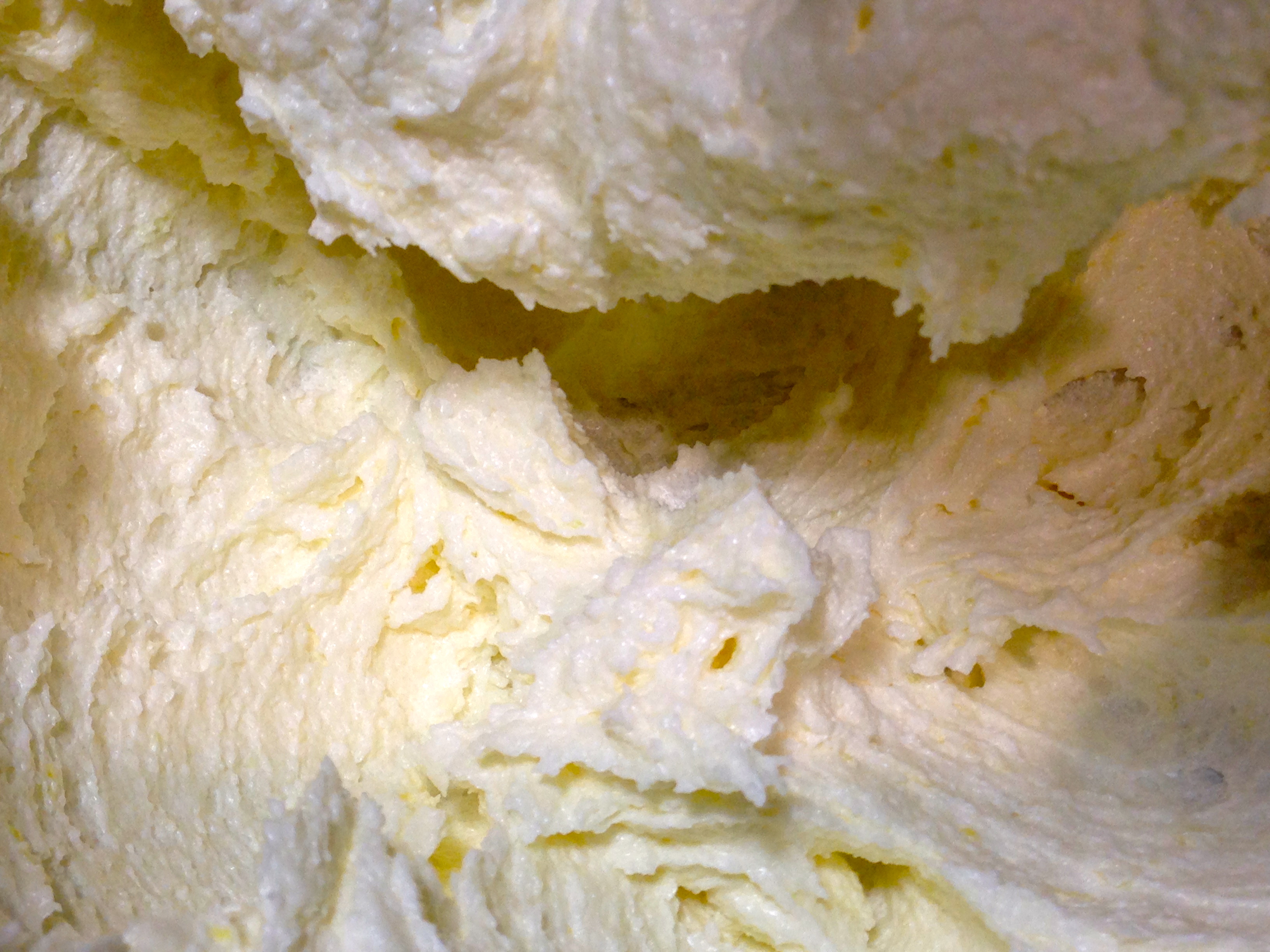
Lesson Learned 3 – Creaming the butter and sugar – a common baking mistake: Most people do not cream the butter and sugar when baking, they simple combine them. Creaming takes a little more time than you would think and the end result is a mixture that is light in color and very soft and fluffy. Doing creaming correctly allows for all the added ingredients to incorporate themselves more completely and also creates a fluffier, moister cake. So next time spend an extra few minutes and do the creaming process correctly.

Creaming butter and sugar should produce this consistency...

Creaming butter and sugar should produce this consistency…

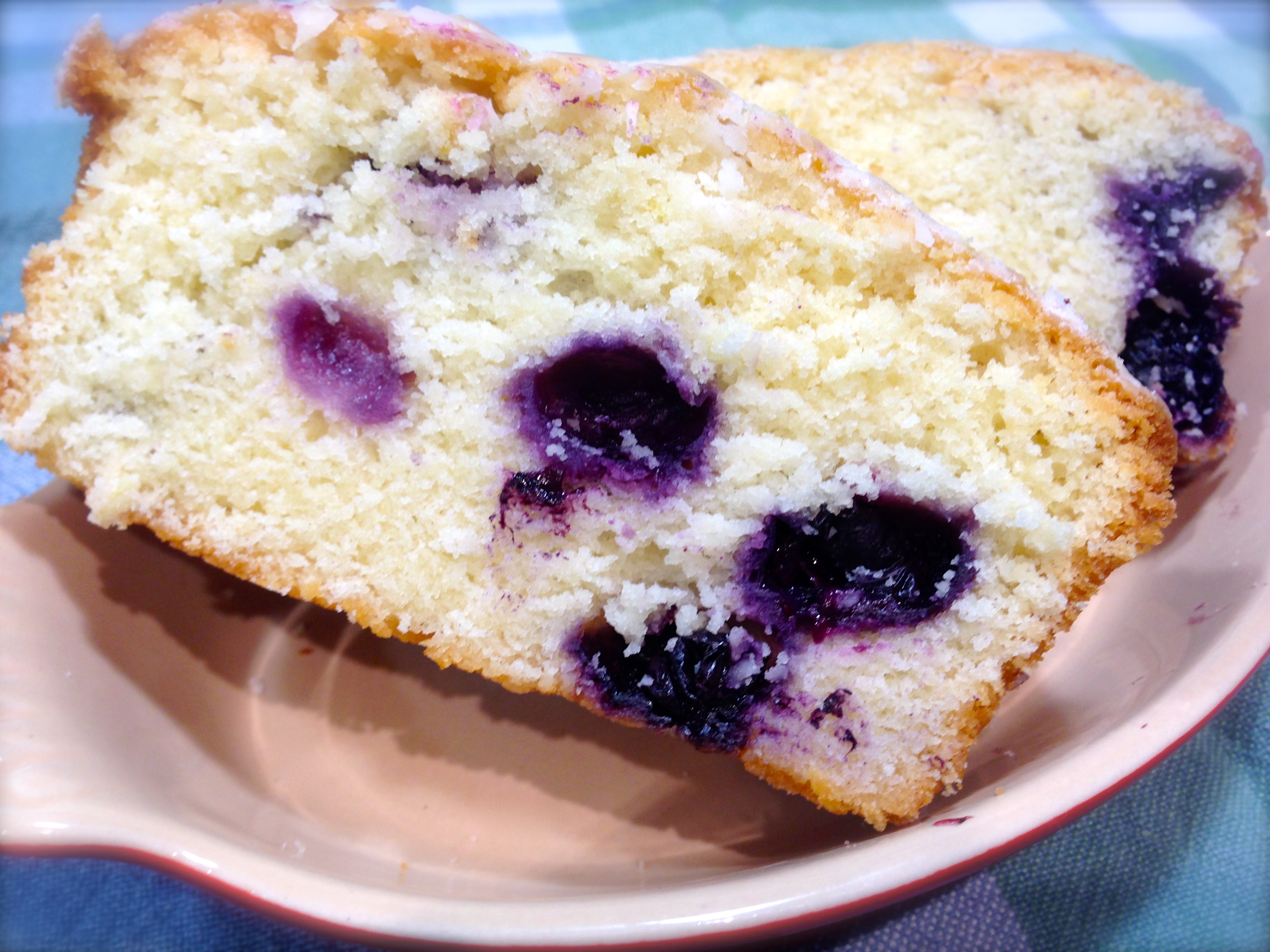
Lesson Learned 4 – The glaze: I’m not a big fan of glazes. For some reason they just don’t do it for me. But I like the glaze in this recipe. It complimented the cake and did not overpower it. I also felt the use of lemon zest as well as lemon juice made the flavor richer.

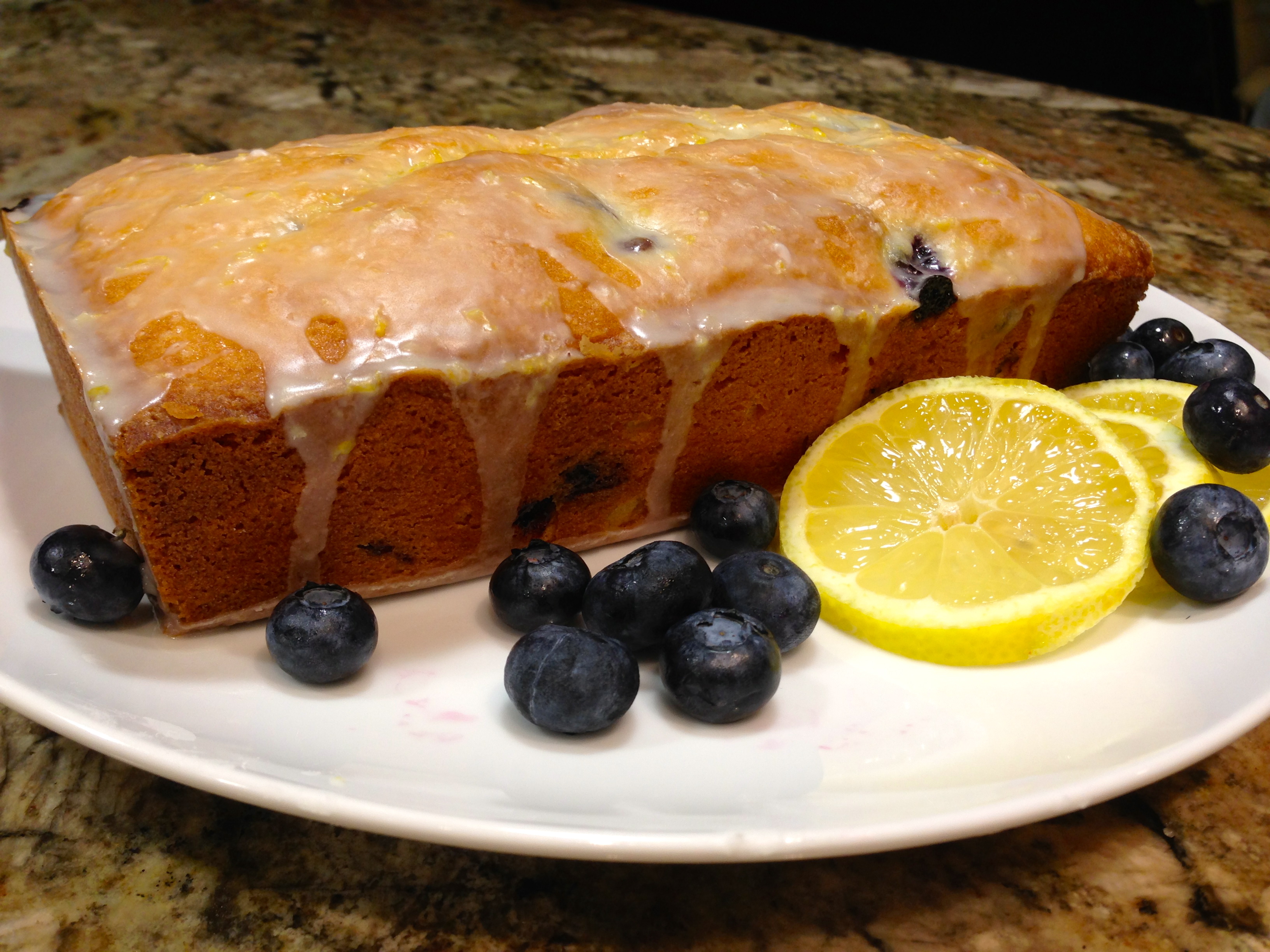
Even though the initial attempt to make this cake was a disaster, the second version was a big hit. After a few days there was absolutely none left. So try my version and see what you think. You can always double it to make two loaves, but be I would be careful about doubling the amount of blueberries. I would err on the side of caution and use less instead of more. You certainly don’t want to be left with a blueberry explosion!

Lemon Blueberry Pound Cake

  • Servings: 10-12
  • Difficulty: Easy
  • Print

INGREDIENTS:IMG_9458

1/2 cup unsalted butter at room temperature

3/4 cup sugar

zest of half a lemon

1 extra large egg at room temperature

1/4 tsp. vanilla

1/3 cup buttermilk

3/4 cup fresh or frozen blueberries

1 1/4 cup flour + 1 tsp. to dust the blueberries

1 tsp. baking powder

1 tsp. salt

LEMON GLAZE:

1 1/2 cup powdered sugar

1 Tbs. fresh lemon juice

1 Tbs. lemon zest

1 Tbs. milk

1/4 tsp. vanilla

DIRECTIONS:

Preheat oven to 350 degrees. In a large bowl cream the butter, sugar and lemon zest. (3-5 minutes). Add egg and vanilla and beat an additional minute.

In a separate bowl whisk together all of the dry ingredients.  Add dry ingredients alternately with buttermilk to the butter mixture. Start and end with the dry ingredients and combine each addition thoroughly. Dust the blueberries with flour. Fold them into the batter until incorporated.

Grease and flour an 8 inch loaf pan if the pan is not non-stick. Pour in batter and smooth the top with a spatula.  Bake for 45 minutes or until a toothpick inserted in the center comes out clean (there may be some blueberry moisture on the toothpick). Let the loaf cool for 15 minutes and then remove it from the pan. Cool completely before adding the glaze.

To make the glaze: whisk all ingredients together until smooth.

Right Out Of The Oven

Right Out Of The Oven (notice no fold-overs)

Lemon Blueberry Pound Cake

Lemon Blueberry Pound Cake


Salted Caramel Brownies…

Doesn’t salted caramel seem to be all the rage right now? Maybe it’s just me but I’m seeing this flavor trend just about everywhere these days – salted caramel pretzels, salted caramel ice cream, salted caramel peanuts – it just seems to be “the thing.” So as I looked for my next new weekly recipe, it didn’t surprise me that I found one for salted caramel brownies.

IMG_8658

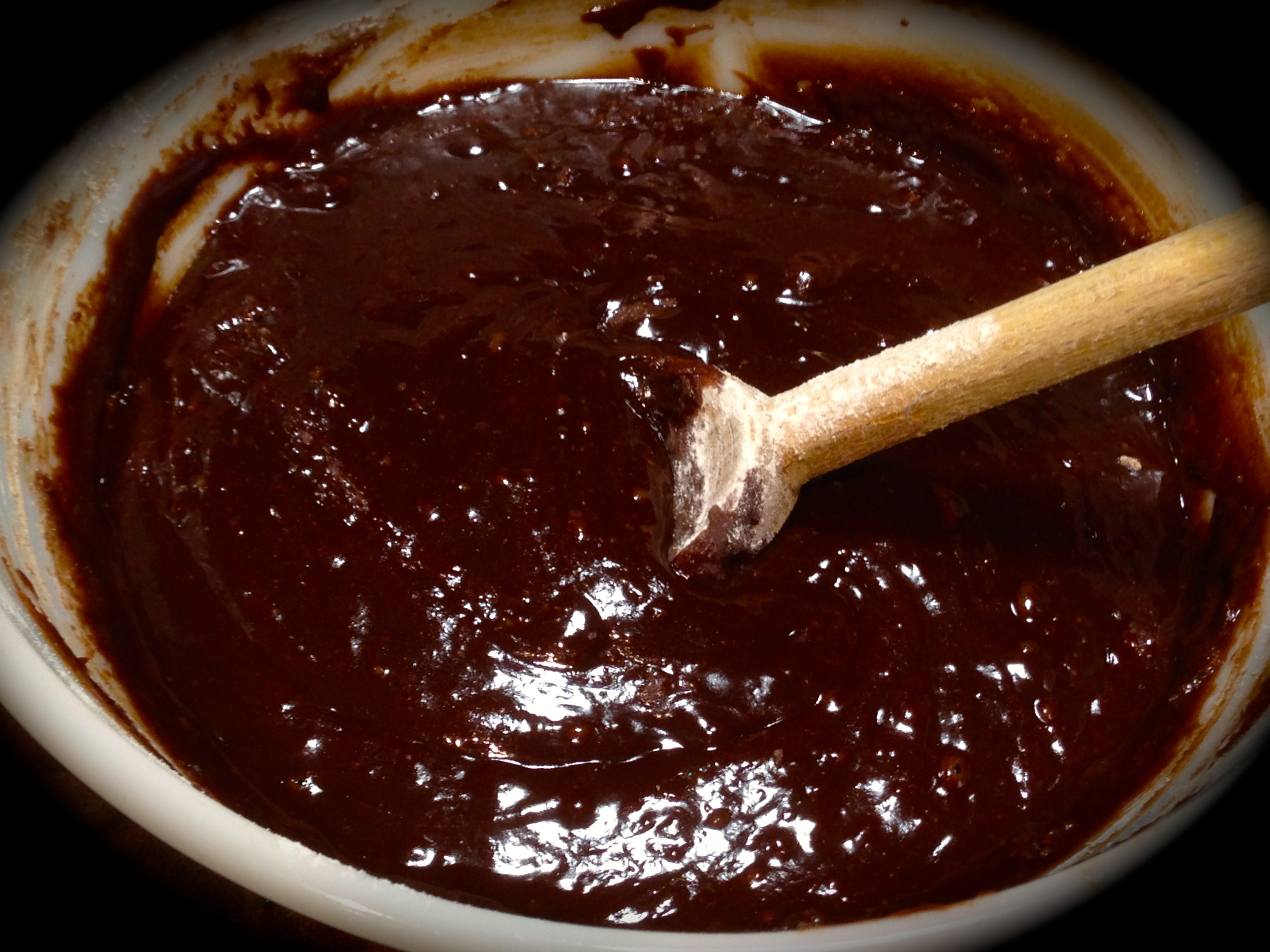
Unsweetened chocolate and butter mixture…

I found a version of this recipe on a website called mybakingaddiction.com. I thought this would be great to make for my husband especially because he’s been in the doldrums since Haagen Dazs discontinued their test market salted caramel truffle ice cream. I thought this might make a good substitute for him, and I have to admit the recipe intrigued me.

I normally don’t do this but I made this particular recipe twice before blogging about it. I will explain why in my lessons learned.

Recipe Rating: B+ There are many reasons why I like this recipe and one very important reason why I think it still may need something. It’s easy to make, not overly sweet (which I like a lot) but the salted caramel taste was not as pronounced as I thought it should be. I’m not quite sure what can be done to enhance the salted caramel flavor.  That being said, it’s still a great brownie and you should try it and see if you agree with me.

LESSON LEARNED 1 – Use the ingredients called for in the recipe: I know you’re probably saying, c’mon Jan everybody knows that! And that’s true. But when I first made the recipe I thought to myself, “I’ve got a bunch of walnuts in the freezer – I’ll just use those instead of the Planter’s Salted Caramel Peanuts called for in the recipe”. Then as I’m eating the brownies I’m wondering why I’m not getting more of a salted caramel flavor. Well, last time I checked walnuts did not have a natural salted caramel flavor all on their own. So you see, I told you I can be challenged in the kitchen. I even had to laugh at myself over this one.

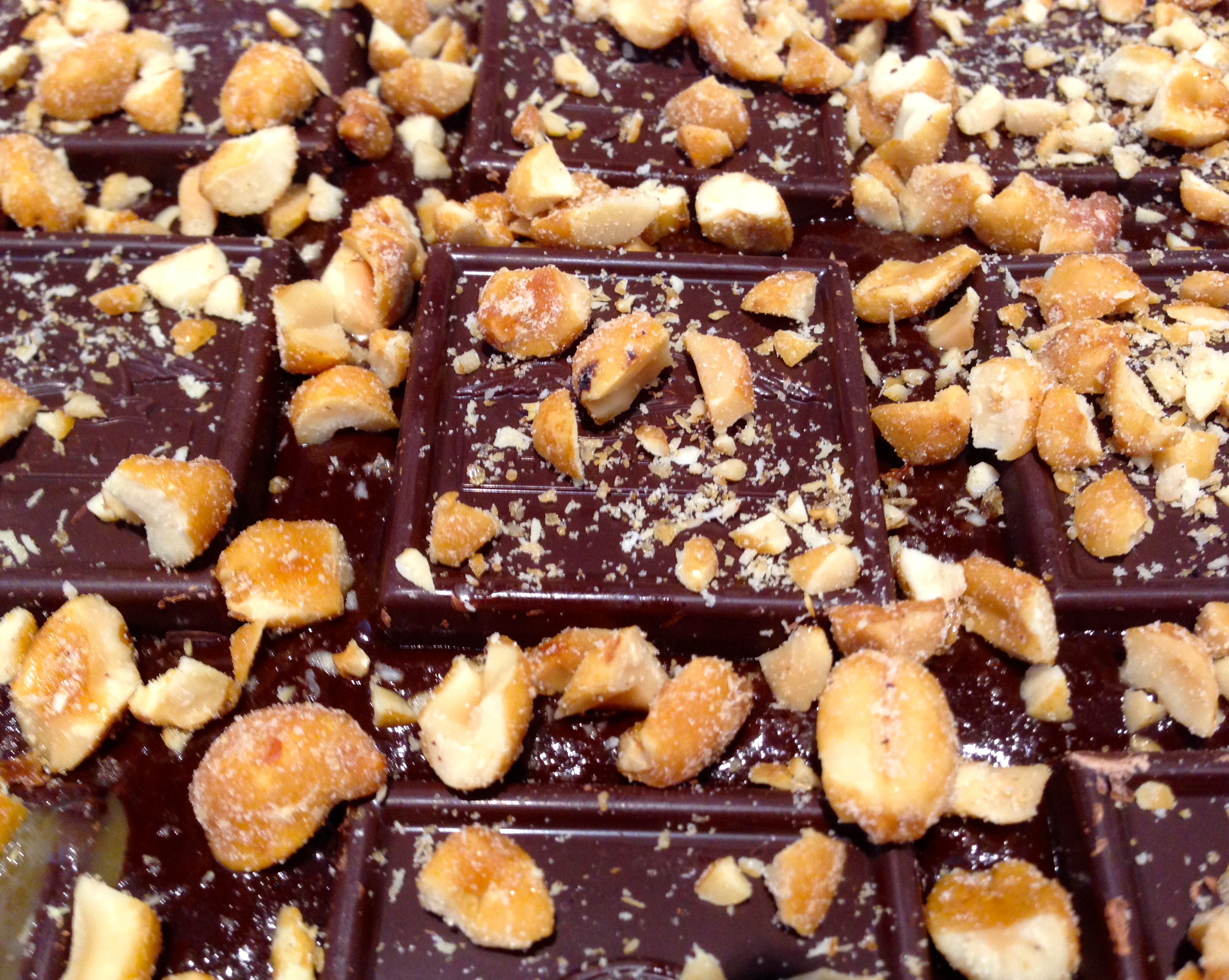
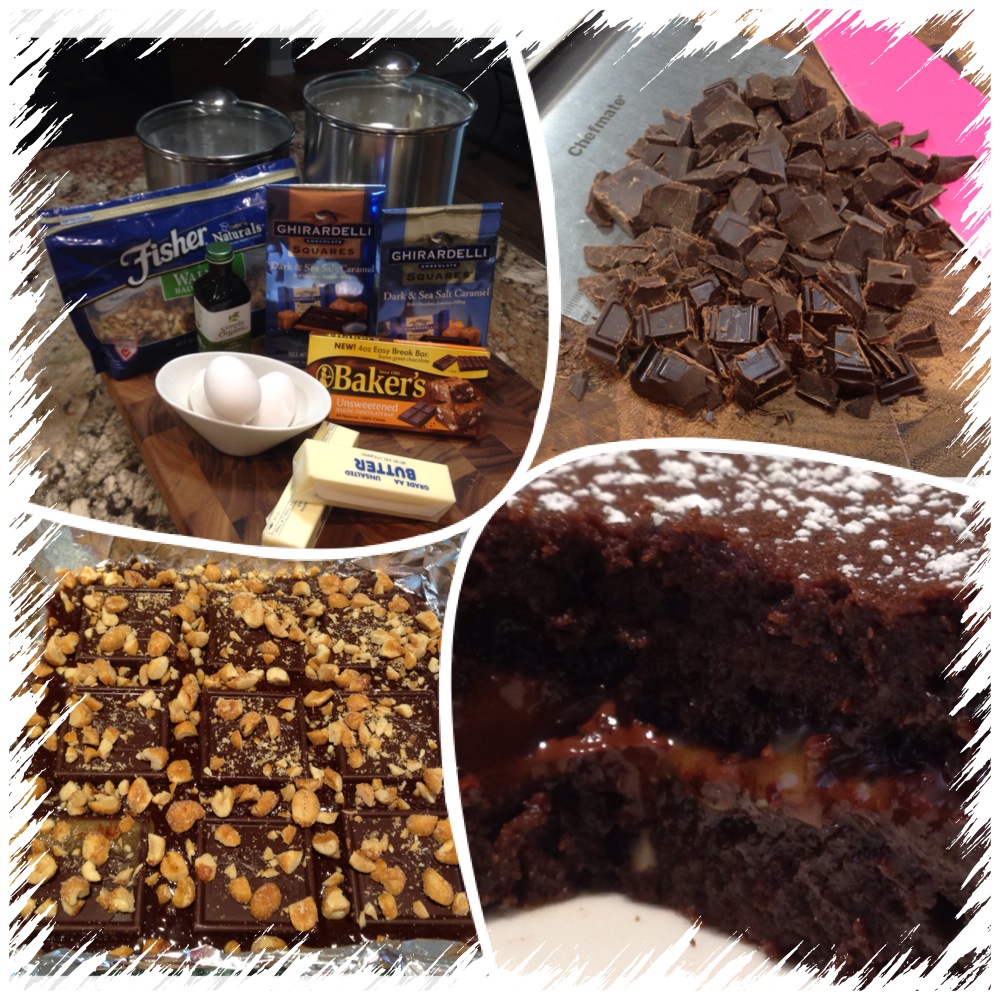
Chocolate squares and peanuts layered in the center of the batter

Chocolate squares and peanuts layered in the center of the batter

And that’s why I made the recipe twice. I had to see how different the flavor of the brownies would be with the salted caramel peanuts. Lo and behold, to my surprise they really didn’t make a huge difference. But I knew I had to make it with the ingredients called for in the recipe before I could talk about the flavor of the brownies. I expected there to be a much stronger caramel flavor using both the Ghirardelli Chocolate and Sea Salt Caramel Squares and the salted caramel peanuts. Using the Planter’s Peanuts changed the flavor somewhat, but not to the degree that I expected. So if you don’t have them or can’t find them you can use any kind of nuts you have on hand. It won’t make that much difference. Personally I had a very difficult time finding them in our local grocery stores but I eventually prevailed. The peanuts had a very strong salted caramel flavor right out of the can. That flavor seemed to get lost a little in the chocolate during the baking process but that’s not necessarily a bad thing.

LESSON LEARNED 2 – Unsweetened chocolate is really unsweetened: The recipe calls for melting in the microwave 4 ounces of unsweetened chocolate with 3/4 cup of unsalted butter. I’ve done this process before when making my triple chocolate brownie cookies but for some reason the chocolate looks so rich and good (as you can see by the picture near the beginning of the blog) that I’m always tempted to dip my finger in the chocolate and lick it. DON’T. Although it looks divine it does not taste good at all – so resist the temptation. You’ll be glad you did.

LESSON LEARNED 3 – Room temperature eggs: The reason cooks tell you to use room temperature eggs is they blend more thoroughly into a batter than cold eggs. The challenge is to remember to set them out so that they can become room temperature. Never fear – I have a neat little trick for you. Take whatever number of eggs called for in your recipe and put them in a container of warm water and let them sit for 5 minutes. Voila! you have room temperature eggs. No need to make the water overly hot, just warm feeling to the back of your hand will do. This is a great trick for people like me who never remember to take the eggs out ahead of time.

Brownie batter

Brownie batter

LESSON LEARNED 4 – Cooking with eggs: Eggs can be tricky. They can be bad without you knowing it until you crack them open. That’s why I always crack my eggs individually in a small dish before adding them to a batter. That way if I have a bad egg I’m not ruining a perfectly good batter. It’s only one additional dish and can save you a lot of time if you happen to have a bad egg.

Also, I break my eggs up with a fork before adding them to a batter, especially if it is a batter that you mix by hand (which this recipe is). That way I’m not counting on a silicone whisk to break up the eggs. The job has already been done.

Lesson Learned 5 – Do not over mix: This is easier said than done but it is very important for achieving a cake or cookie that is not tough. With this recipe it’s relatively simple. The last thing you do is mix in the flour until just combined. Not seeing the white of the flour is very easy to eyeball in this recipe. Just make sure you stop as soon as the flour has been completely incorporated.

Lesson Learned 6 – Working with Ghirardelli filled chocolate squares: Be careful when handling the chocolate squares. If you break them the caramel will ooze out. The caramel center is not solid like the chocolate. You want the caramel to ooze out in the baking process and not all over your hands. If you break them you will wind up with a sticky mess.

Lesson Learned 7 – Adding coffee to the batter: I can’t take credit for this trick. I learned it from watching Ina Garten on the Food Network. If you want to enhance the flavor of chocolate in any recipe, just add some fresh brewed coffee. You don’t have to add a lot. For this recipe I added 2 teaspoons of coffee. If you try the same chocolate recipe both with and without the coffee you will be amazed at the difference. The original recipe did not call for adding coffee, but my version of the recipe does.

Lesson Learned 8 – Storing the brownies in the refrigerator: My husband came up with this trick. He wanted to give our garbage men a little treat during their route so he cut a couple of brownies and put them in the refrigerator until he saw the garbage truck. There was only one man in the truck this week so he had an extra cold brownie. He decided to eat it himself and he told me he liked how it tasted cold. I tried it and had to agree. The brownie had almost an ice-cream like consistency when it was cold. But room temperature or cold, either way this is a good brownie recipe. If you want to be even more decadent, you can frost the brownies and sprinkle the top with some additional nuts. That would definitely be a killer brownie!

I recommend that you try this recipe and tell me what you think. It is a very good basic brownie recipe and more and more as I become less willing to make things from a box, I look to these types of recipes to give me the ability to make baked goods with fresh ingredients. I’d be very interested to hear your impressions on this one. Enjoy!

scb3

Salted Caramel Brownies…

  • Servings: 12
  • Difficulty: Easy
  • Print

INGREDIENTS:

4 ounces unsweetened chocolate coarsely chopped

3/4 cup unsalted butter cubed

1 cup sugar

3 large room temperature eggs

1 teaspoon vanilla extract

2 teaspoons brewed coffee

1/2 teaspoon kosher salt

9 Ghirardelli Dark Chocolate and Sea Salt Caramel Squares (1 package)

1/2 cup Planters Salted Caramel Peanuts, chopped

1 TBS. powdered sugar

DIRECTIONS:

Preheat the oven to 350 degrees. Line an 8×8 baking dish with foil and spray lightly with nonstick spray. Microwave unsweetened chocolate and butter for 2-3 minutes or until butter is melted at 50% power (I stopped at each minute interval and stirred the mixture). Stir until chocolate is fully melted. Whisk in eggs, vanilla, coffee and salt. Gradually add flour until just combined.

Spread half the batter into the prepared pan. Add a layer of the chocolate squares and sprinkle peanuts over the entire layer. Cover with the remaining batter.

Bake for 30-35 minutes – do not over bake. (It took me 35 minutes)

Cool for 15 minutes then remove brownies in the foil and set on a cooling rack. Let cool completely, remove the foil and dust with powdered sugar. Cut into squares and serve. (You could also serve these brownies with a dollop of caramel flavored whipped cream or a scoop of vanilla ice-cream).

scb5

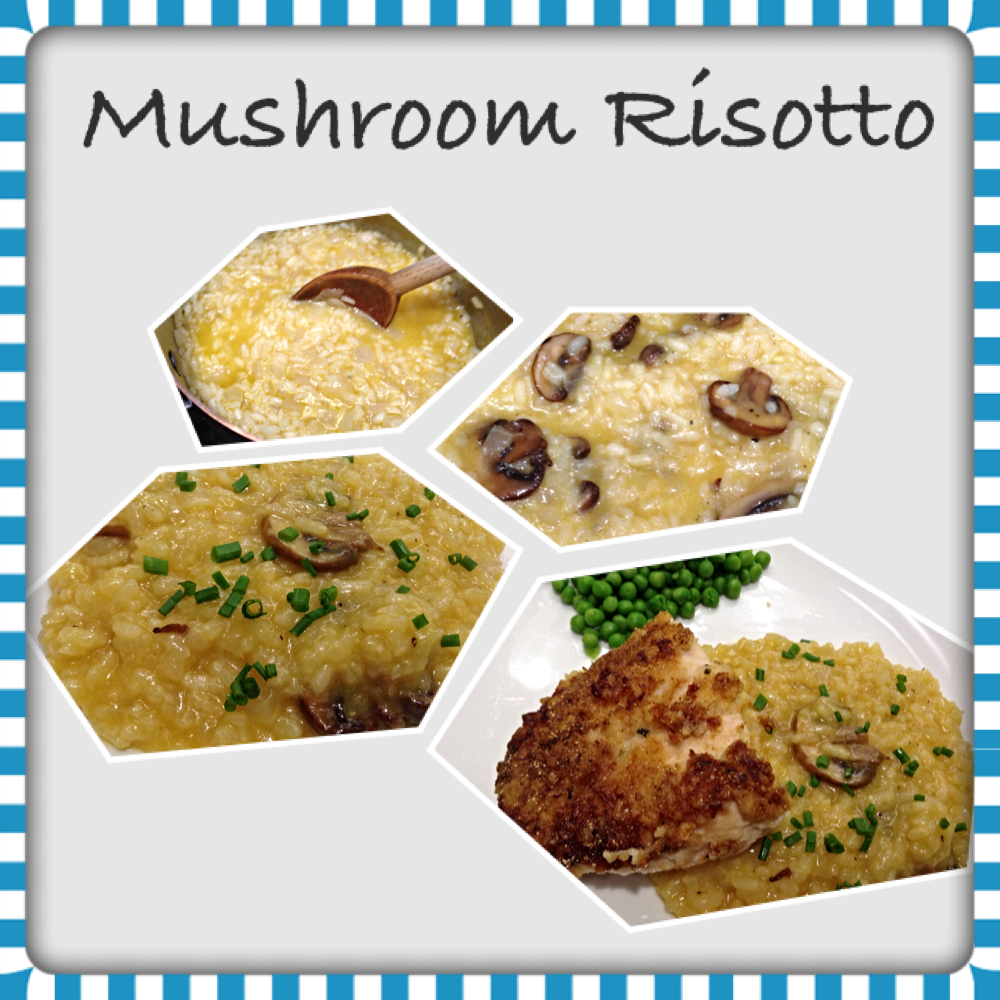
Portabella Mushroom And Sweet Onion Risotto…

The first time I ever heard the term risotto or saw it being made was on an episode of 30 Minute Meals with Rachel Ray on the Food Network. I remember distinctly her saying that many people think making risotto is difficult to master and labor intensive. I’d never tried making risotto and personally am not a big fan of rice to begin with, but it looked like a creamy style rice and I thought I could live with that. Plus my husband is a huge rice fan and I’m always looking for ways to satisfy his need for rice with something that I find palatable as well.

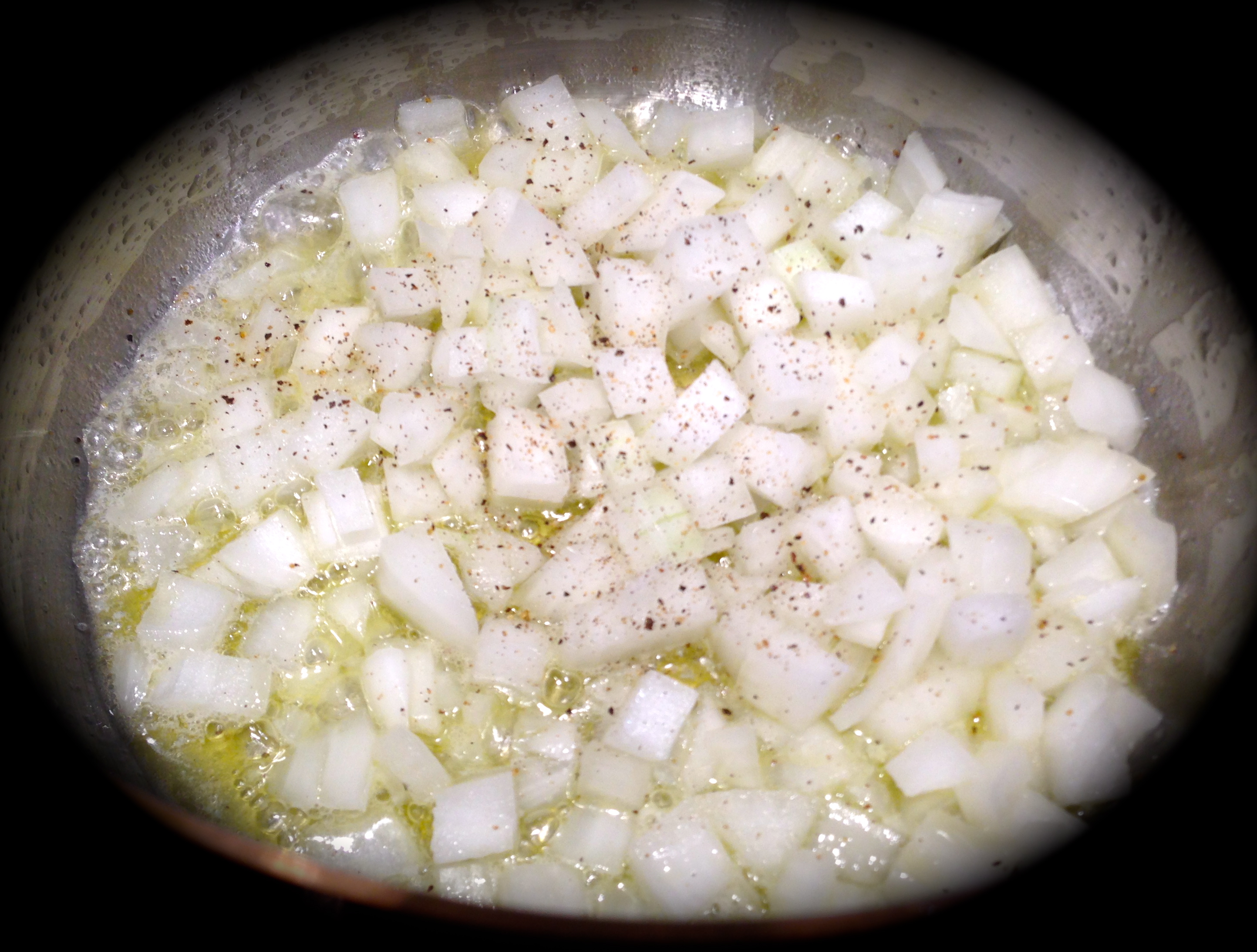
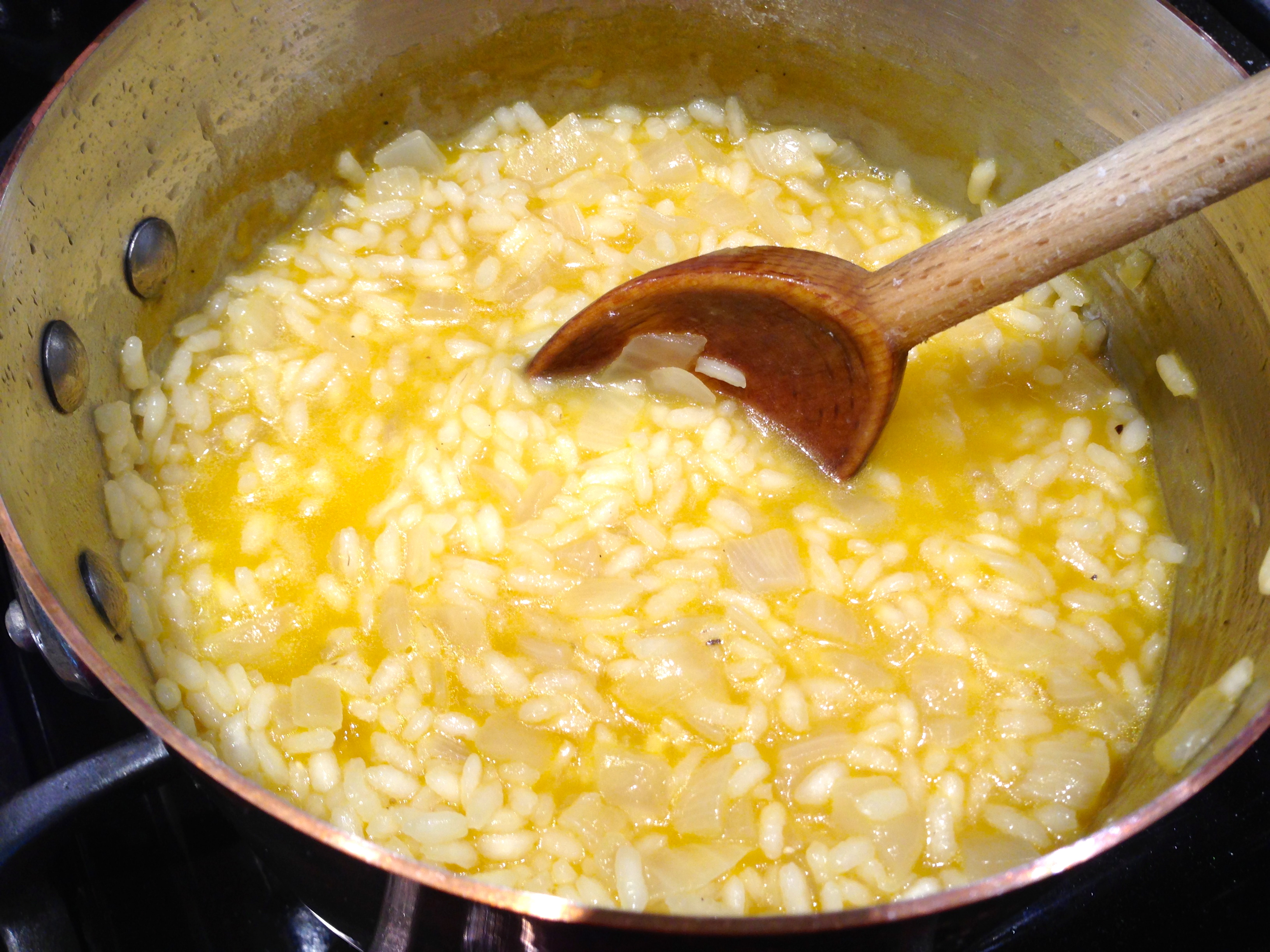
Sautee Onions In Butter And Olive Oil

Sautee Onions In Butter And Olive Oil

After watching several episodes where she made different variations of risotto I thought I might give it a go. And over the past year after having made it several times I think I have the process down pat. The base recipe that I use is my own and I’ve found with a little ingenuity (and a need to use up various types of vegetables in my refrigerator) you can make just about any kind of risotto you’d like.

At first, the thought of making risotto was daunting, especially for a non-intuitive cook like me. I found out quickly that although Rachel Ray could seemingly make it in 30 minutes it takes much longer than that for me. Maybe living in high altitude has an affect on the cooking time, but after several attempts I know that it takes me 1 hour to get creamy rice. So that’s what I plan for now and it always turns out perfectly.

Since the recipe is mine, I’m not going to take the time to rate it. What I will say is that it did take several attempts before I got the risotto to its desired consistency. So let me share with you my lessons learned regarding making basic risotto and my recipe for portabella and sweet onion mushroom risotto.

Image

Lesson Learned 1 – USE CHICKEN STOCK: Some recipes call for chicken broth, some for chicken stock, you can also use a combination of broth or stock and some wine, but my advice is always use chicken stock instead of chicken broth. Chicken stock is richer and adds more depth of flavor. There is no contest here – always use chicken stock. I find it takes me one full box of stock to make my risotto. (You can also use vegetable stock if you want to make this as a vegetarian dish).

Lesson Learned 2 – MAKE SURE THE CHICKEN STOCK IS WARM: A warm liquid helps the arborio rice (and that’s what risotto is, arborio rice) release more of its starches. Those starches are what creates the creaminess. About 5 minutes or so before I begin the process I put the stock in a pot on the stove and warm it under a very, very low flame. No need to boil or even simmer. I put my gas stove on its lowest possible setting where you can barely see a flame and keep it there the during the entire cooking process. It keeps the stock warm to the touch and that is really all you need.

Stir Regularly

Stir Regularly

Lesson Learned 3 – COOK THE RISOTTO SLOWLY UNDER A LOW FLAME: Face it, risotto takes time and there is no getting around that. The more you nurture it during the cooking process the better the end result. At any given point in time the risotto should barely bubble.

Lessons Learned 4 – SYSTEMATICALLY ADD WARM STOCK AND STIR: I think this may be the part where most people say forget it, I don’t have time for this. But it really isn’t that bad. I’ve gotten to the point where I check my risotto about every 5 minutes and if the stock has mostly cooked away I add another soup ladle full of stock, stir the risotto and then leave it for another 5 minutes. Remember stirring also helps the rice release its starches.

Lesson Learned 5 – IT MAY TAKE A FEW TRIES TO TIME IT RIGHT: As I mentioned earlier, when watching Rachel Ray cook risotto, it supposedly only took her 30 minutes. I’ve never even come close to that time. It takes me a full hour to get the risotto to its desired creaminess. Now I am not sure that high altitude has an effect on it, but I know that if I want to have risotto with a meal I need to start it an hour ahead of time. Depending upon where you live, the time may very. Unfortunately, this is something that you will need to discover on your own.  But take my word for it – IT’S WORTH IT. I am not a big fan of rice but I love risotto.

Lesson Learned 6 – ADAPTABILITY: You can add just about anything you like to risotto and serve it either as a side dish or the main course. I like to add portabello mushrooms that have been sautéed in butter and garlic. But I’ve also added roasted butternut squash or asparagus. Just remember that whatever you add should be pre-cooked and added during the last 5 minute or so. Top it off with some chopped scallions or chives and you’ve got something very special.

Lesson Learned 7 – SIZE OF POT & THE AMOUNT OF RICE: My recipe calls for one cup of arborio rice. Don’t be fooled into thinking that is not enough. One cup of rice becomes three cups of risotto so depending on how many you will be serving this could well be enough for one meal and leftovers. And make sure to use a high sided pot when making risotto as it will grow right in front of your eyes. You’ll want to have a pot that can handle the end result.

Portabella Mushroom And Sweet Onion Risotto…

  • Servings: 4-6
  • Difficulty: Medium
  • Print

INGREDIENTS:

8 ounces of Portabella Mushrooms, sliced

1/2 cup sweet onion, diced

1 clove garlic, minced

1 box (32 oz.) low sodium chicken stock

3 TBS. butter

3 TBS. olive oil

1 cup arborio rice

DIRECTIONS:

Pour stock into a pot and heat on the stove under the lowest possible flame (just enough to keep it warm). In a sauté pan, heat 1TBS. oil and butter. Add garlic and cook until fragrant (30 seconds to 1 minute). Add mushrooms and sauté until slightly softened. Set aside.

In a high-sided pot under medium heat, heat 2 TBS. of butter and olive oil. Add onions and cook until translucent. Add arborio rice and cook with the onions for 1 minute. Turn heat to low and add a soup ladle full of chicken stock. Stir to combine. After approximately five minutes (or until you see the chicken stock has almost been completely incorporated) add another ladle full of stock and stir. Repeat this process until all of the chicken stock has been used and the rice is thick and creamy (for me, that was approximately 1 hour). DO NOT LET THE RICE MIXTURE DRY OUT DURING THE COOKING PROCESS. There should always be a little moisture left when adding the next ladle full of stock.

During the last five minutes of the cooking process, add the mushrooms to the mixture. Garnish with chives or scallions and serve.

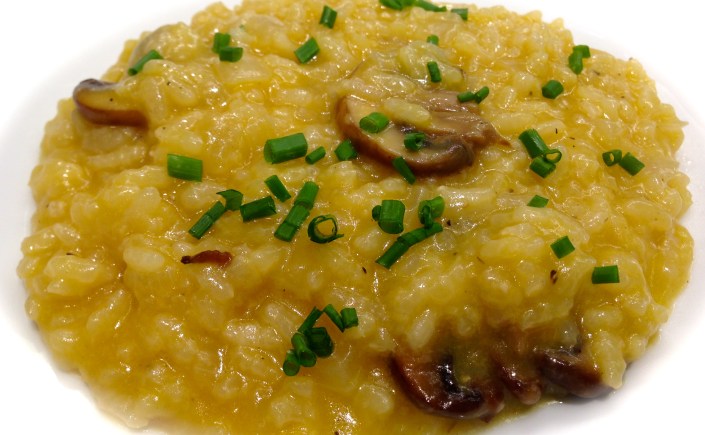
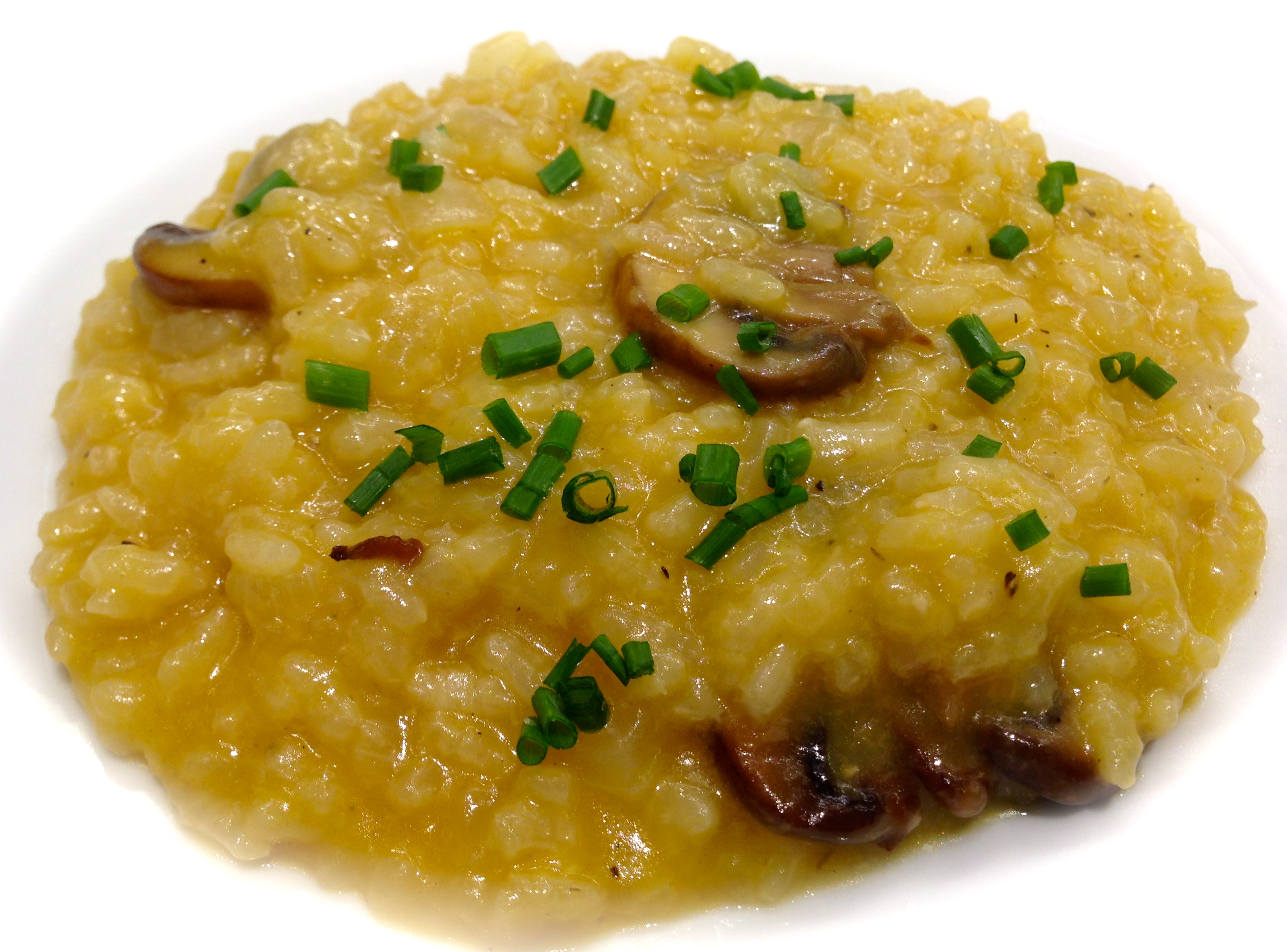
Portabella Mushroom Risotto

Portabella Mushroom And Sweet Onion Risotto

Meatloaf For Two…

Just about every family has their version of how to make meatloaf. I think meatloaf may have been with us since the dawn of time. And although my vegetarian friends may cringe at the thought, I still enjoy eating meat every now and then but now I try to balance my diet so that I am not solely relying on red meat as my main protein. But every once in a while I need some good old comfort food and I turn to things like roast chicken, pot roast or some good old meatloaf.

As I’ve mentioned before, I grew up in a meat and potatoes household. So today’s blog takes me back to my childhood where meals like these were often the family faire for dinner. And if you’re not a beef fan, you can skip this recipe as my goal is to try a wide variety of recipes and I’m sure at some point I will post something that will pique your interest.

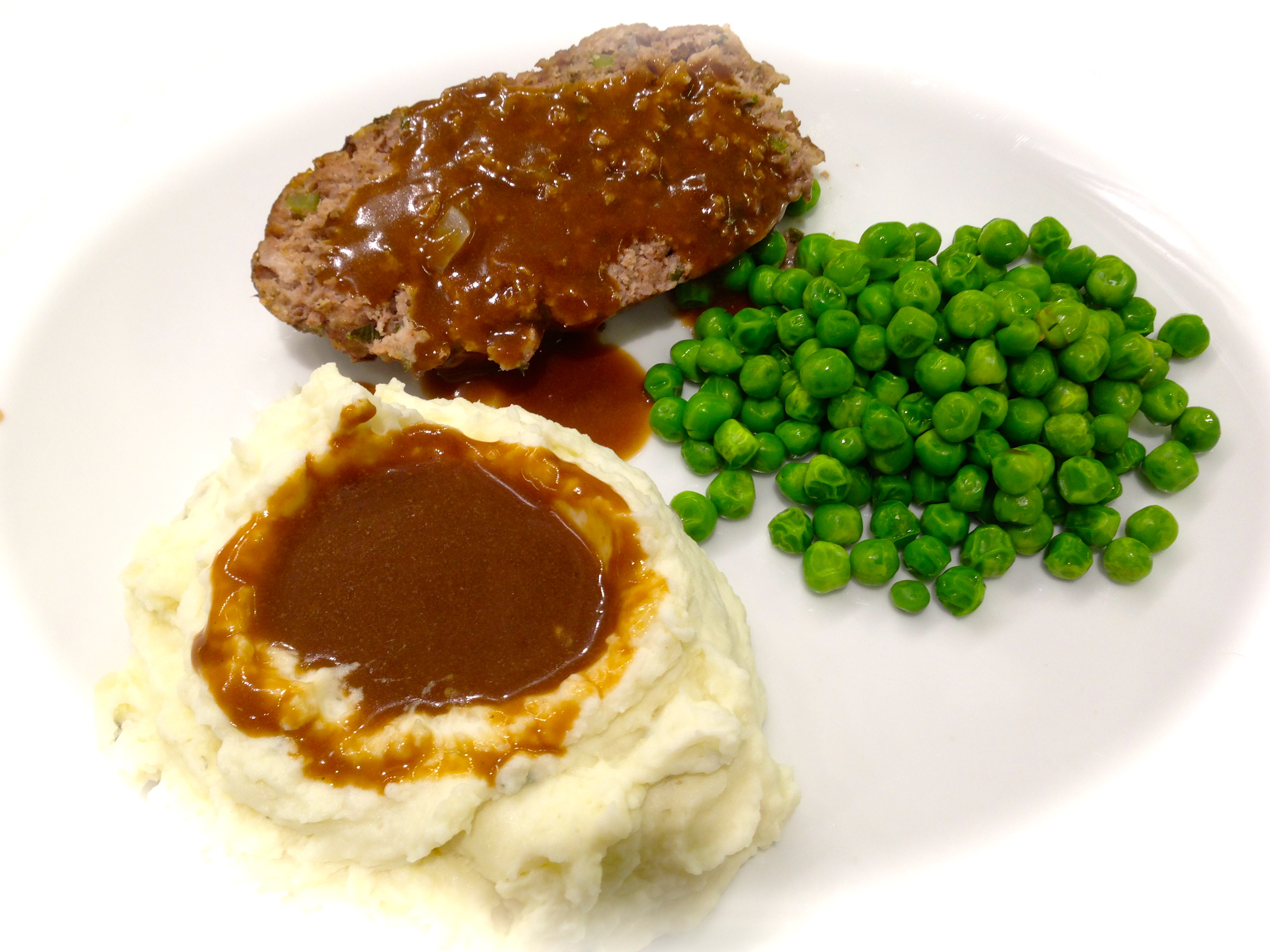
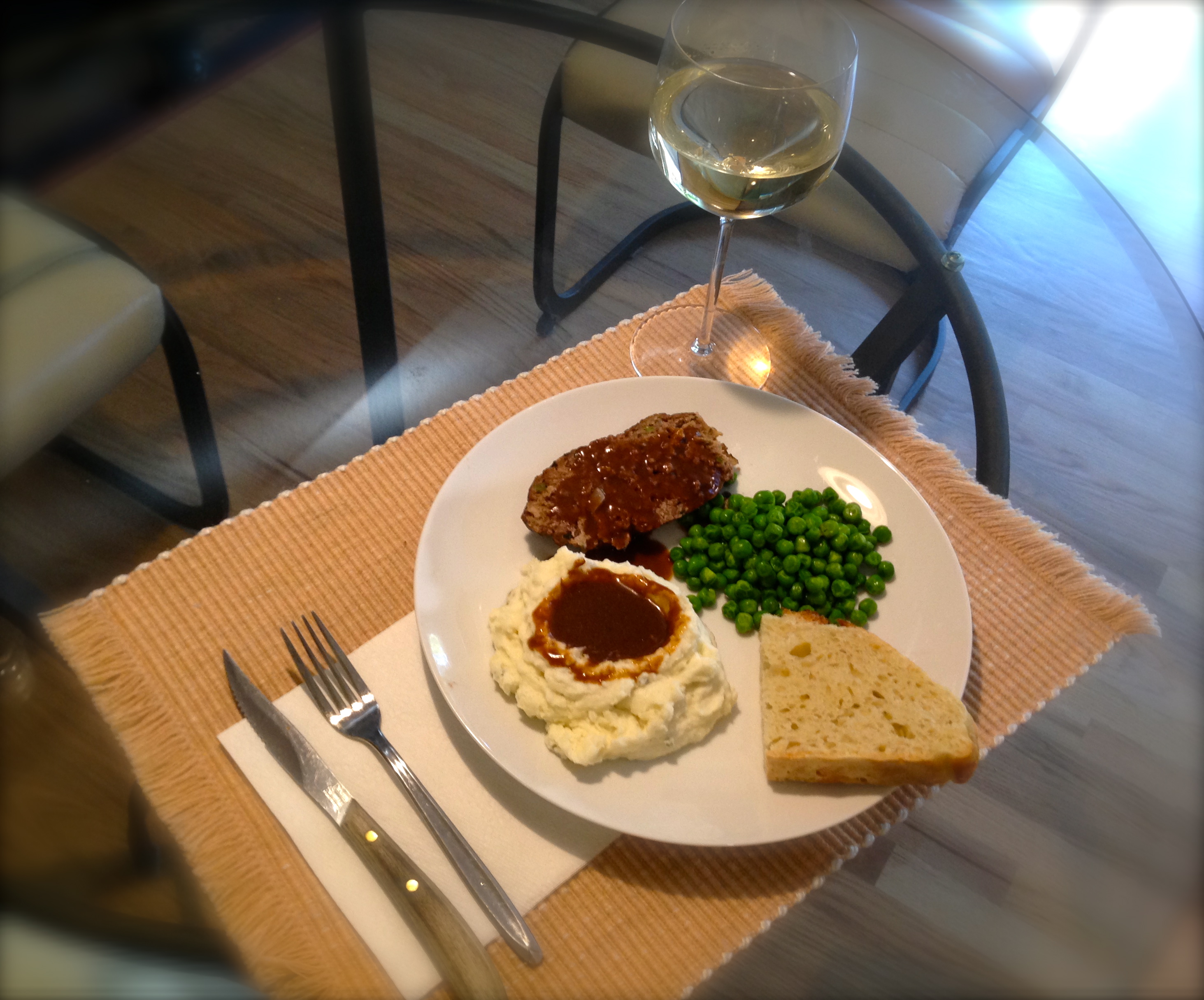
This is one of my husband’s favorite meals from when he was a child – meatloaf, mashed potatoes and peas. Meatloaf was something his mother didn’t totally annihilate in the oven and the art of scooping up a bunch of peas with a wad of mashed potatoes is a skill he has well honed over the years. As a matter of fact, no other vegetable will do for him in this meal – it has to be peas and of course there must also be mashed potatoes. My husband is one of those that does not like to combine his food and eats one thing on his plate till he’s finished with it and then moves on to something else. But for this meal the combination of meatloaf, mashed potatoes and peas compels him to break his habit and mix them all together. We all have our little idiosyncrasies don’t we?

This recipe comes from a book my husband got back in the 1970’s called The Complete Family Cook Book. It was a cook book that was offered by a chain grocery store to its customers. On your first visit to the store you got the recipe book binder and chapter 1. Every week after that, if you spent “x” amount of dollars you received an additional chapter. That continued every week until the book was complete. You could also purchase a chapter if your grocery bill was not large enough to warrant a free chapter. The book is so old now that the back of the binder is held together with duct tape, but it is an amazing book with so many recipes that we’ve used many times over the years. This one has to be our all time favorite from that book. I’ll share my rating and lessons learned over many, many years of making this recipe.

RATING: A+ what can I say, we’ve made this recipe for years and it continues to be our favorite. It’s simple, straightforward and very satisfying. You’ve simply got to try this one. And being it’s only recently that I’ve improved my cooking skills, I guarantee you this recipe can be made by even the worst cook and still turn out great. I can also tell you that from many years of experience!

Mini Loaf Pan

Mini Loaf Pan

LESSON LEARNED 1: MAKING MEATLOAF FOR TWO – The recipe as I will share it makes a very big meatloaf that serves 6. Since it is only me and my husband I wanted to figure out a way to eliminate as much waste as possible and still enjoy this meatloaf recipe. A local grocery store used to sell meatloafs in mini loaf pans (3.25 W x 2″D x 5.75L). I got the idea of trying to see how this recipe might translate into filling mini loaf pans. Well, it worked beautifully – this recipe will make 3 complete mini meatloafs. So when I want meatloaf for dinner I make the recipe, fill the mini pans, freeze two of them for a later date and cook one of them that evening. There you have it  – meatloaf for today and two others for future dinners. The mini pan gives you 3 good sized slices so you can each have one slice for dinner and if you don’t take seconds have a slice leftover to make a meatloaf sandwich the next day (remember those?).

LESSON LEARNED 2: FREEZING THE LOAFS – If you plan on having your loafs “live” in the freezer for a while I recommend first wrapping the loaf pan in plastic wrap and then wrapping them with aluminum foil. That tends to hold off freezer burn for quite some time. The mini loaf will thaw in a couple of hours so you can take it out of the freezer and put it in your refrigerator in the morning, take it out when you come home from work and just pop it in the oven. Take off the aluminum foil when you place it in the refrigerator from the freezer – the foil tends help maintain the cold and you want the loaf to thaw. I also recommend minimally letting the loaf stand on the counter at least while you preheat the oven. Any chill you can reduce will assist with the cooking time.

LESSON LEARND 3: MILK OR CANNED TOMATOES – The recipe says you can use 3/4 cup milk or 3/4 cup canned tomatoes. I’ve tried this recipe both ways and prefer making it with milk versus canned tomatoes. I think the flavor is richer and more full bodied with milk. I think the tomatoes tend to take over as the dominant flavor and I prefer the dominant flavor to be the meat itself.

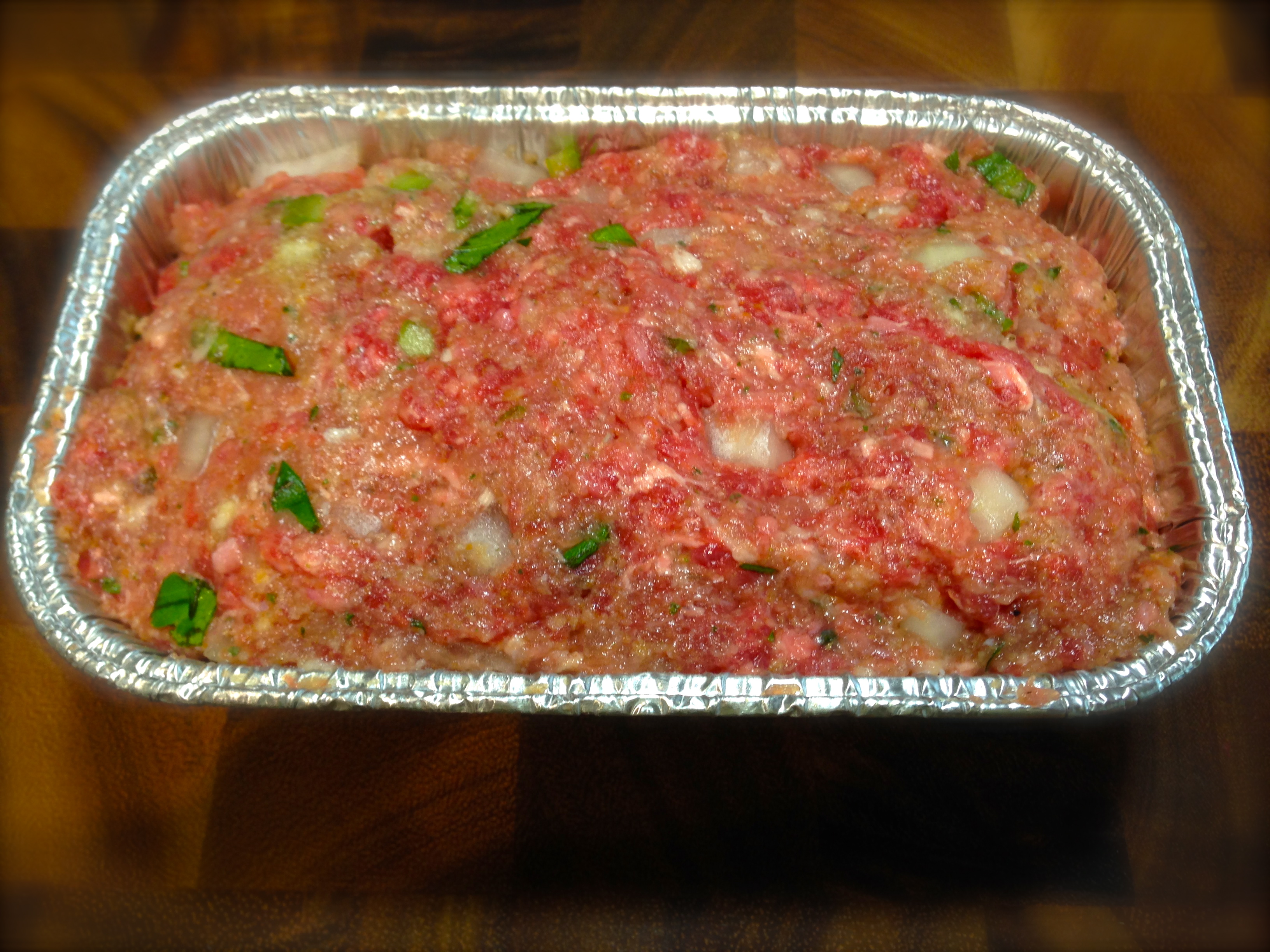
IMG_8195

LESSON LEARNED 4: PREPARING THE MEATLOAF – the recipe in itself is pretty self explanatory. The one thing I’ve learned over the years is to resist the urge to over mix. Mix all the ingredients until just combined and then STOP! Mixing a meatloaf is like mixing cake batter – the more you do it the tougher the end product. Be careful not to over mix.

LESSON LEARNED 5: BREAD CRUMBS – although the recipe calls for 3/4 cup of bread crumbs, I only add 1/2 cup to begin with and then add more if I think it’s needed. It just seems sometimes the mixture is drier than others and I would rather err on the side of caution and not add all the bread crumbs at the beginning to ensure getting a moister mixture than just dumping it in all at once and being stuck with what I’ve got. This was something learned over many years of practice.

IMG_8160LESSON LEARNED 6: DRAIN THE GREASE – Once you take the meatloaf out of the oven make sure you drain the grease before slicing and serving. I tend to use the leanest ground beef I can find and I still have grease in the pan. There’s nothing worse than serving a greasy slice of meatloaf.

LESSON LEARNED 7: MAKE IT IN YOUR TOASTER OVEN – With a mini loaf you don’t have to use your oven. Cook this in your toaster oven at 350 for 1 hour and voila, you’ll have meatloaf! And you can have meatloaf any time of year, including the summer, without heating up your house.

This is definitely not a difficult recipe to master. Give it a try and tell me what you think. This has been our go-to meatloaf recipe for a long time and I hope you will enjoy it. If you’ve got a family favorite meatloaf recipe – please share it. Would love to try it and compare the two. Enjoy this one!

Meatloaf For Two…

  • Servings: 2-6
  • Difficulty: Easy
  • Print

(This recipe, with it’s noted adjustments can be made to serve two or serve 6)

INGREDIENTS:

1 1/2 lbs. ground beef

1/2 lb. ground pork

1/3 cup finely chopped onion

3 Tbs. celery (two small stalks)

3 Tbs. italian parsley (or you can chop the leaves from the celery stalk)

1-2 cloves minced garlic (personal preference)

3/4 cup bread crumbs

3/4 cup milk or canned tomatoes

1 beaten egg

1 1/2 tsp salt

1/2 tsp pepper

1/2 tsp poultry seasoning

DIRECTIONS:

Mix all ingredients together until fully blended. If making one loaf, shape in a 9×5 inch loaf pan and bake at 350 for 1 1/2 hours. If making mini loafs, divide mixture into 3 mini loaf pans. Bake at 350 for 1 hour. Take out of the oven and remove the grease from the pan. Cover with foil and let sit for 5 minutes. Serve with mashed potatoes and peas.

IMG_8176

IMG_8182

Artisan No-Knead Bread…

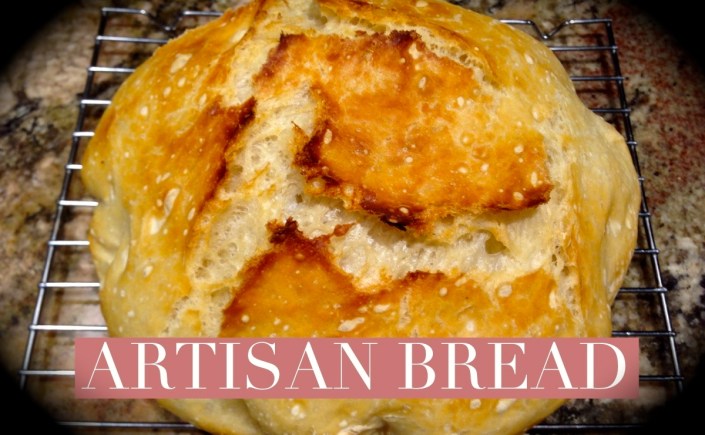
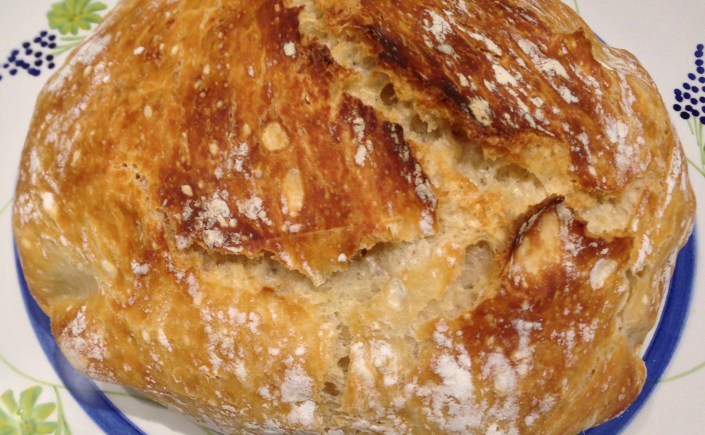
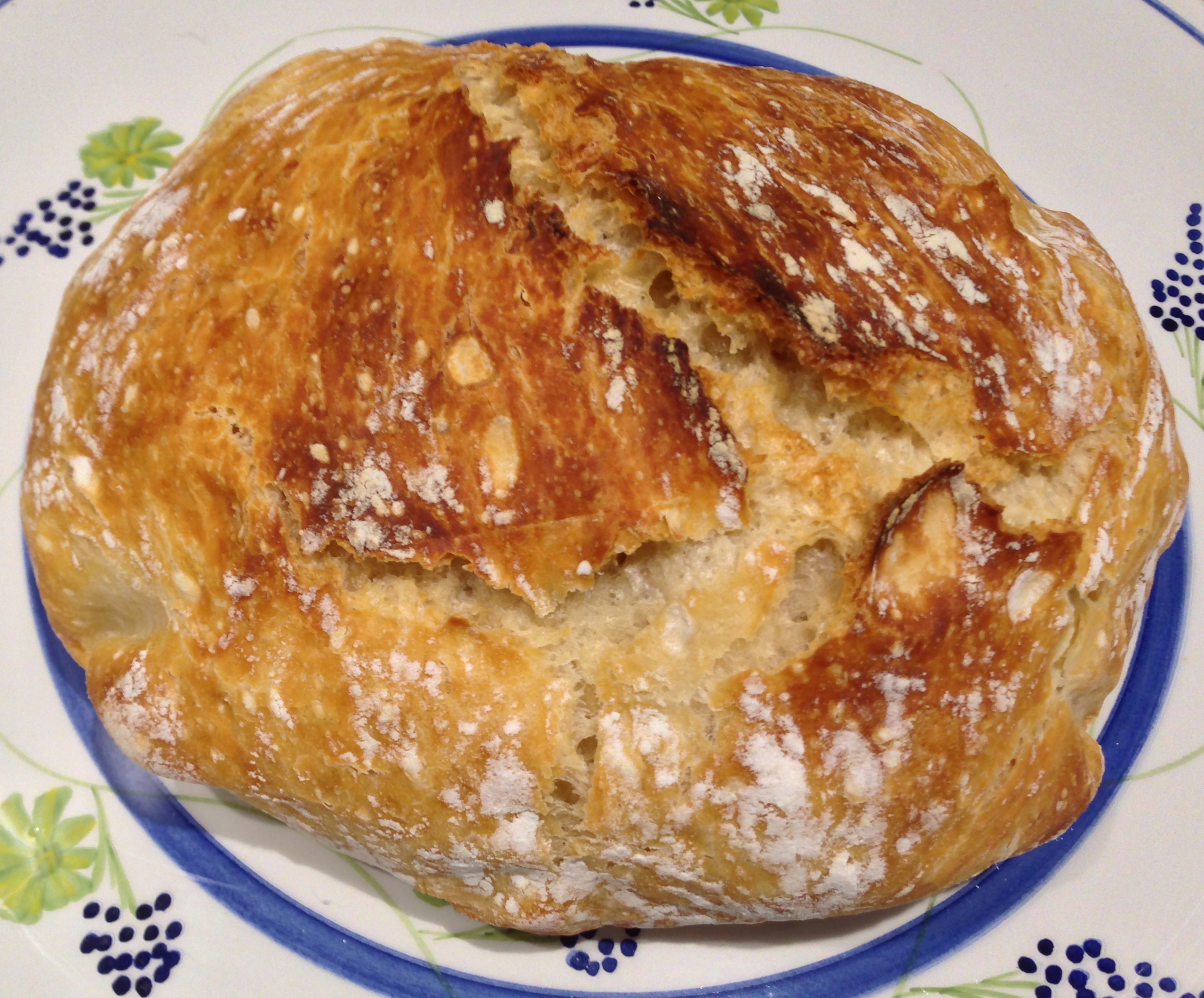
Over a year ago I wrote a blog about making no-knead bread in an enameled cast iron pot. Although it is a great blog, I felt the “knead” to rewrite it because of a significant lesson I’ve learned since I initially published the blog.

The original recipe came from a website called simplysogood.com and although I basically use that recipe there are many others out there that have slightly different variations and still produce this wonderful, easy to make bread. The key to success in this recipe is not the mixing (that is by far the easy part) but rather the handling of the dough, getting it prepped and into a screaming hot enameled cast iron pot. So I am going to revisit this recipe, rate it and give you my lessons learned. Hopefully these lessons will help you get your desired result much quicker than I did.

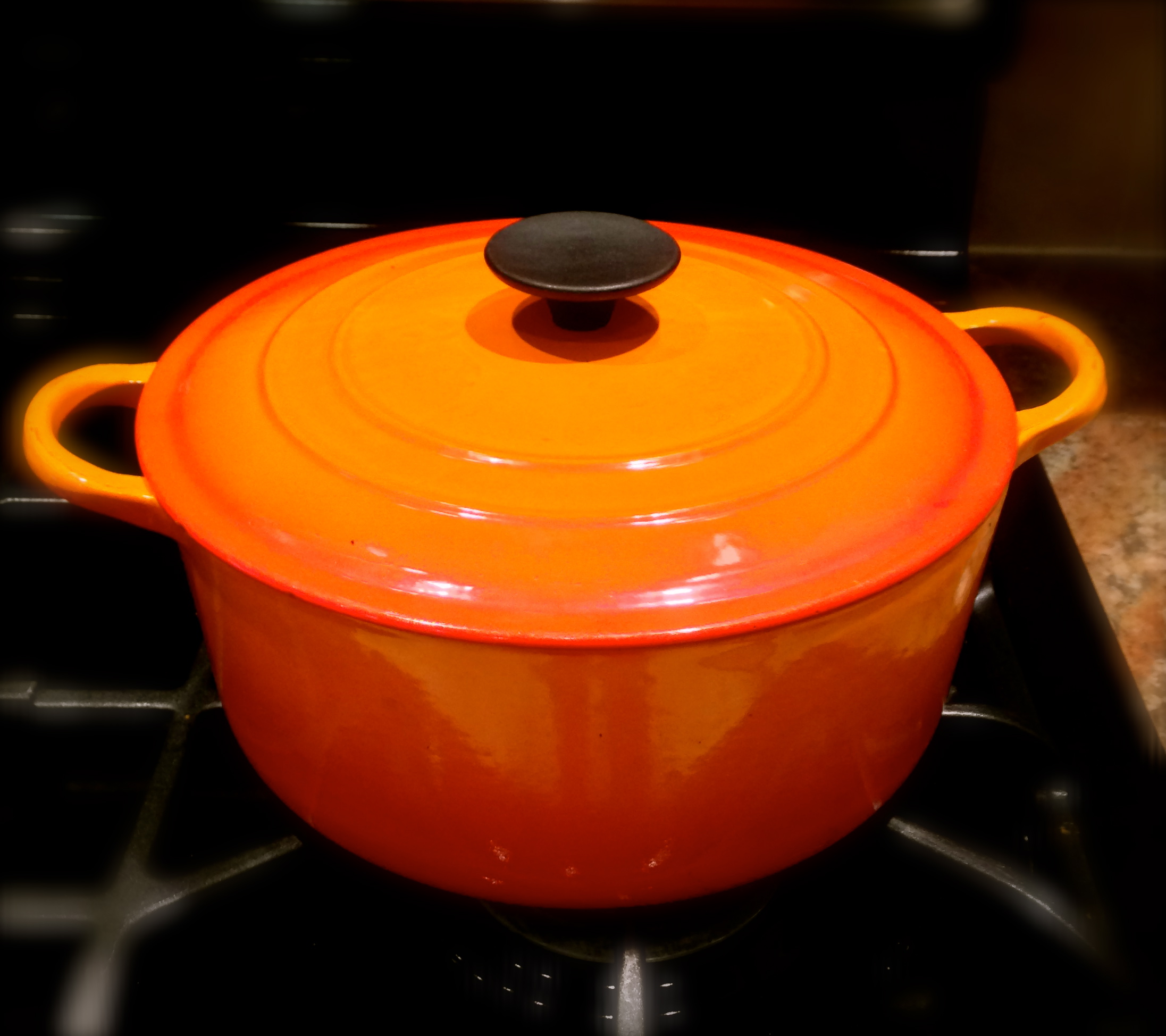
What I use to bake the bread - a LeCreuset 6 quart dutch oven...

What I use to bake the bread – a LeCreuset 6 quart dutch oven…

RECIPE RATING: A for the pictures and step-by-step instructions, C-for advice on how to prep the dough. If you go to the website and search for the recipe you will find wonderfully detailed pictures of the process for making the bread and I like that. The thing that I feel is misleading is the information on the dough prep right before putting it into the oven and I will address that in my lessons learned.

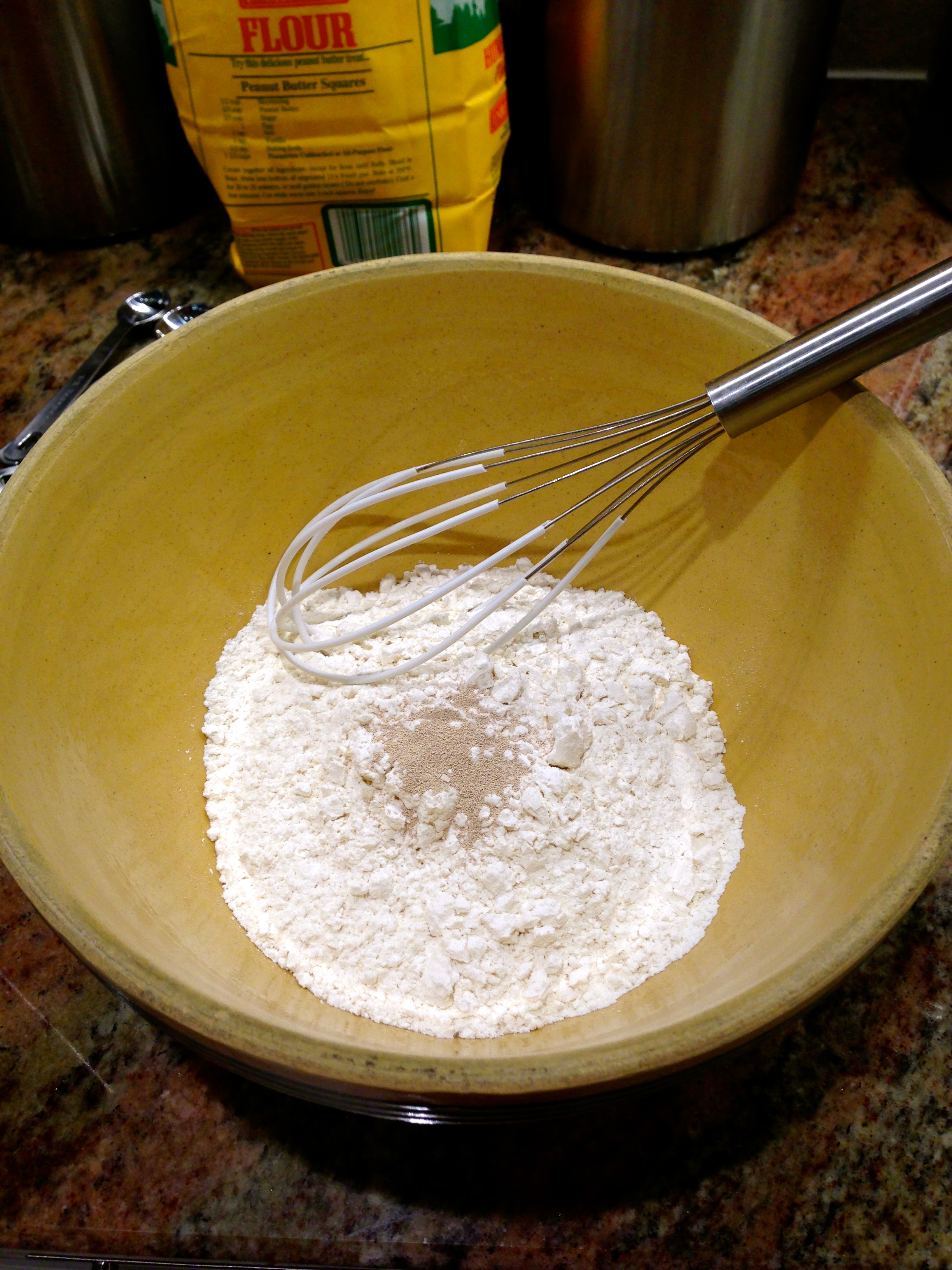
LESSON LEARNED 1 – MIXING THE DOUGH: In my mind there is nothing easier than the initial mixing of the dough in this recipe. It requires only 4 simple ingredients and time. By time I mean a minimum of 12 hours to let the dough cure and the longer the better, even up to 18 hours. As stated on the website, this recipe is very forgiving so if you make the bread after 11 hours of curing or even after 24 hours you will still get a great bread. From a mixing standpoint there is little if anything you can do to ruin the dough.

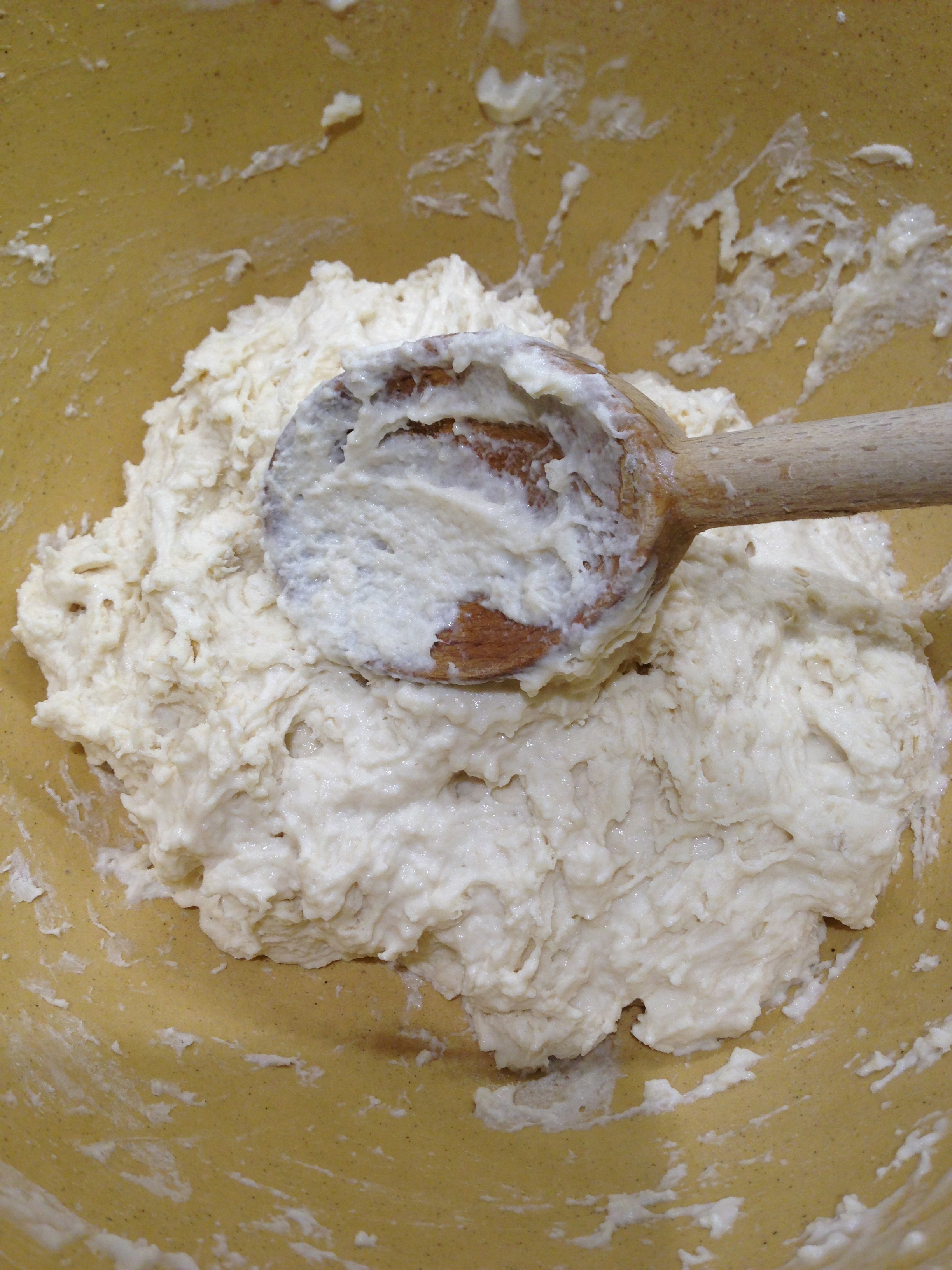
When the dough is mixed it is sticky...

When the dough is mixed it is sticky…

LESSON LEARNED 2 – TO FLOUR OR NOT TO FLOUR: This is perhaps where I disagree the most with the original recipe. In that recipe it calls for you to “flour the heck” out of the surface that you place the dough on after initially removing it from the bowl. One thing is for sure, the dough is very, very sticky and you need something to help you manage it. But in my experience the dough is also much looser than what you see in the pictures and all the flour in the world does not get it to form as round of a ball as depicted on the website. What tends to happen as you try to get some shape to the dough is it rolls back over on itself trapping small pockets of flour on the bottom of the loaf and I can tell you from much experience that they do not magically disappear when the bread is baking. Your slices wind up having pockets of flour packed into the bottom crust.  There were may times I had to cut off about a 1/4 inch off the bottom of the loaf just to remove those baked-in flour pockets.

Try as I may, whenever I tried to shape the dough on a floured surface (and I tried all amounts of flour to see what might be the right combination), it would roll over on itself and create the flour pockets. And because the dough is loose, it also is a challenge to transfer it from one surface to another without creating additional pockets. The original recipe states that after you’ve formed the loaf to let it rest covered in plastic wrap while the enameled cast iron pot is heating in the oven.  Then you can either just put the dough in the heated enamel pot or line the pot with parchment paper and put the dough on the parchment paper and into the pot. Either way, once cooked the dough will not stick to either surface and the parchment paper will not burn. That is true. But trying to move the dough from one surface to another was almost an impossible task, especially when dealing with a cast iron pot that has been in the oven for a half hour at 450 degrees. Over and over I kept trying to make this recipe work as written until I realized I was flirting with the definition of insanity, that being doing the same thing over and over again and expecting different results. I became very frustrated with the recipe and almost gave up on it but then I came up with an ingenious idea.

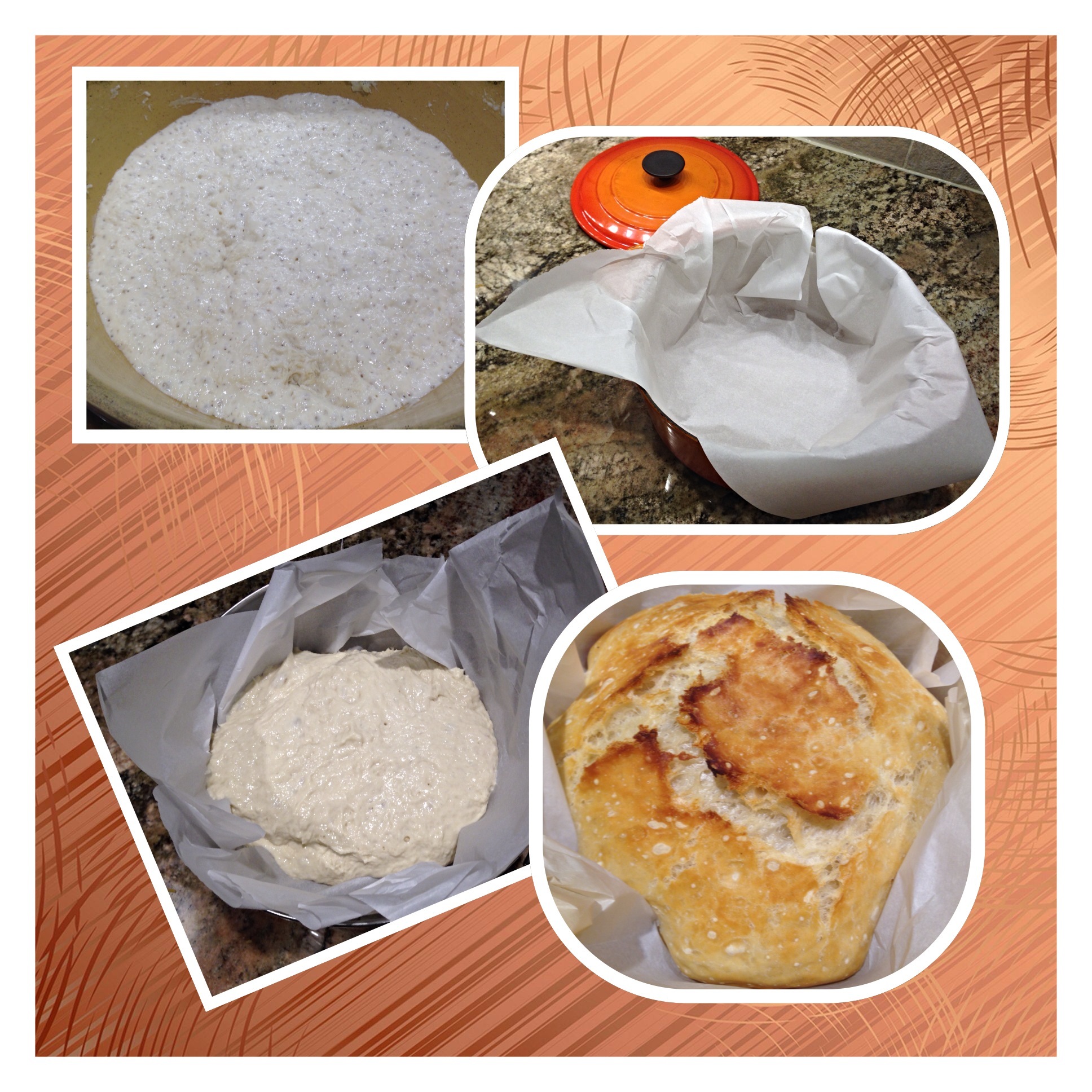
Image 1

(upper left: dough after 18 hours – upper right: laying out the parchment paper mold – lower left: – dough resting in parchment paper – lower right: dough right out of the oven before removed from the pot)

Here is how I solved the flour dilemma. Before I heat the cast iron pot I measure the amount of parchment paper I need to line the inside of the pot and cut the mold. Then I place the parchment paper mold into a high rimmed bowl. I take the other bowl with the dough, use a spatula and systematically scrape the dough into a ball and move the ball toward the rim of the bowl. Once I have it near the rim of the bowl I scrape it into the bowl with the parchment paper mold and voila I have my rounded loaf resting in parchment paper. I cover that bowl with plastic wrap and let it sit for 30 minutes while the cast iron pot is preheating in the oven.  When it comes time to put the dough into the prepared enameled cast iron pot I just pick up the dough up by the edges of the parchment paper and transfer it quickly and without drama into the cast iron pan. It couldn’t be easier and I did not have to use one bit of flour. I no longer have any flour pockets on the bottom of my baked artisan bread!
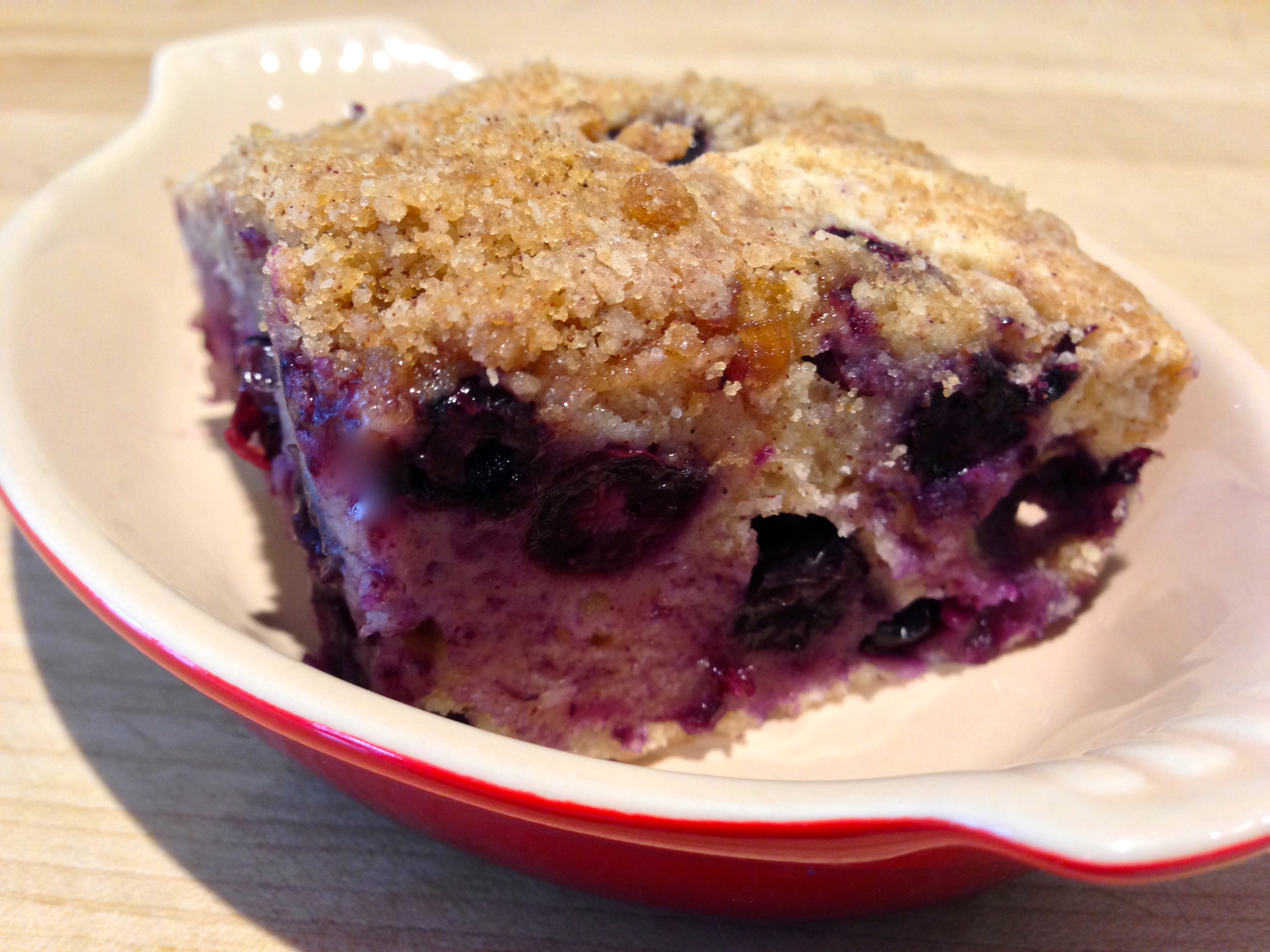
I highly encourage you to try this recipe. It really is easy and makes perfect bread every time. My challenge was simply to eliminate the flour pockets in my otherwise perfect bread. I will write the recipe with the original instructions and with my recommendations. Try it both ways and see what works for you. And if you have an answer to the flour dilemma other than mine, I’d love to hear it. Also if your dough is not as loose as mine please let me know how you achieved that. Most recipes for making artisan bread that I’ve researched do not vary greatly in the ingredients and instructions, and most say that the dough will be loose and sticky so I’m thinking the flour on the bottom of the dough will continue to be a challenge. Let me know your thoughts or suggestions – I’d love to hear them.

Artisan No-Knead Bread…

  • Servings: 8-10
  • Difficulty: Medium
  • Print

INGREDIENTS:

3 cups unbleached flour

1 3/4 tsp. kosher salt

1/2 tsp. rapid rise yeast

1 1/2 cup water

(You can add a variety of herbs and fruits to this basic recipe. See picture below of cranberry walnut artisan bread. Just add 1/3 cup dried cranberries and 1/3 cup walnuts when making the dough)

DIRECTIONS:

In a large bowl whisk together flour, salt and yeast. Add water and mix until combined. Cover the bowl with plastic wrap and set aside for 12-18 hours. (overnight is the best).

Heat oven to 450 degrees. While oven is preheating, line your enameled cast iron pot with parchment paper and press the down the center, sides and top to form a clear outline of the pot. Cut the parchment paper along the edges (so that when you eventually place it back in the pot it won’t be hanging over the sides) and place the paper mold into a bowl that has a circumference close to the desired shape of a nicely rounded loaf.  The recipe is very forgiving so don’t spend too much time worrying about the size bowl to put it in. When the oven is heated, place your enameled cast iron pot with lid into the oven and heat for 30 minutes.

Meanwhile take the dough that has been curing overnight and scrape it into a loosely formed ball inside the bowl its in and then drop it into the other bowl with the parchment paper mold. Cover the dough with plastic wrap and let it rest until the enameled cast iron pot is done heating. (The original recipe calls for you to put the dough on a heavily floured surface, shape into a ball and cover it with plastic wrap to rest while the pot is warming in the oven. You can try it this way if you want, but I found that I get pockets of flour that get baked into the bottom of the bread when I do it that way).

Once the pot is heated, quickly transfer the dough into the pot, cover and put back in the oven. (If you use the parchment paper method, just grab the paper on opposite sides and drop into the pot. Just make sure to remember that the pot is very hot. (If you don’t use the parchment paper method just drop the dough into the pot, cover and put in the oven.) You do not need to prepare the pot in any way. The dough will not stick to the surface nor will it stick to the parchment paper.

Bake for 30 minutes. Then remove the lid from the pot and bake for 10-15 minutes more. (I find that 10 minutes gives me the nice golden color you see in the picture at the beginning of this blog).  Remove the bread from the oven and place on a cooling rack to cool.


Artisan No-Knead Bread

Artisan No-Knead Bread


IMG_9215

Cranberry Walnut Artisan Bread

Easy Cheesy Stuffed Peppers…

I’d never made stuffed peppers before. I always bought them either frozen or pre-prepared at the grocery store. But in my quest to do one new recipe a week I decided to try my hand at making stuffed peppers. As you can imagine there are so many variations of stuffed pepper recipes out there but I wanted to do something that was simple but also interesting.

I came across a recipe called “Make Me Stuffed Peppers” from the website genaw.com. It was quick, easy and in my mind adaptable to what I already had in the refrigerator and so I chose it over a plethora of others.  Here is my rating and lessons learned.

Rating: B for the recipe, C for how the recipe was written. The recipe although good needed, in my estimation, a little something. It lacked depth of flavor. The next time I might try adding a little BBQ sauce or worcestershire sauce to the ground beef or maybe some red pepper flakes or smokehouse beef seasoning just for a little more kick. Don’t get me wrong, it’s not a bad recipe. It just needs a little more substance to it. And if you like things a little more mellow don’t add anything. I think the beauty of this recipe is its adaptability to one’s personal tastes.

Lesson Learned 1: CHEESE. The recipe mentioned something that I never knew.  It calls for cheese to be mixed with the ground beef and also for some cheese on the top. It specifically states not to use pre-shredded cheese as the powdery coating doesn’t allow it to melt properly. I never heard that before, but I have experience pre-shredded cheese not melting properly. Who knew? Good thing to remember for next time. The recipe called for using cheddar cheese both mixed in with the ground beef and on top. I mixed the ground beef with a cheese blend that contained three different types of cheeses mixed with cream cheese and that melted nicely. I also had some provolone slices and I used those to put on top of the stuffed pepper. That melted nicely as well. The beauty of this recipe is that you can use whatever cheese you have available – it doesn’t matter. The cheese blend gave the ground beef a nice silkiness and I liked that.

stuffed peppersLesson Learned 2: PARBOILING THE PEPPERS. It is important to cook your peppers in boiling water for 3 minutes before you cut them and fill them. Bring a pot of water to a boil, put in the peppers and cook for only 3 minutes. Take them out, let them cool slightly and then prepare them to be stuffed. If you don’t do this step they won’t cook properly. Don’t cook them any longer than 3 minutes or else you’ll have mush on your hands at the end of the process. Cooking them for 3 minutes gives them just enough of a head start to be done perfectly when they come out of the oven.

Lesson Learned 3: BROWN BUT DO NOT COOK THE GROUND BEEF. The ground beef will be in the oven for a half hour after you stuff the peppers. There is no need to cook the meat all the way through when preparing ground beef mixture. Cook it about three quarters through (so you still see a little bit of pink). The oven will take care of the rest. I also recommend using a fattier ground beef for this recipe. That way the meat will not dry out in the oven. Be sure to thoroughly drain off the grease after you brown the meat and before you stuff the peppers.

Lesson Learned 4: CUTTING THE PEPPERS. I recommend cutting the peppers in half as shown in the picture above versus hallowing out the pepper and trying to make it stand on end. If you cut the pepper lengthwise you don’t have to worry about the peppers falling over in the oven. You also are serving half a pepper per portion versus a full one. Personally I think that is a much more reasonable portion size.

My husband, my very own in-house recipe critic, liked this recipe but told me not to be afraid to jazz it up a bit. That was a very clear message that, yes it was good, but it needed just a little more umph! I’ll write the recipe as I made it and I encourage you to experiment with some additional things to add depth of flavor. This is definitely a recipe that, with your own personal tweaking, can be a staple in your recipe repertoire. I would love to hear of any adjustments you make and how it turned out. I always love to hear new ideas! 

Easy Cheesy Stuffed Peppers

  • Servings: 4
  • Difficulty: Easy
  • Print

INGREDIENTS:

2 large sweet peppers halved lengthwise

1 pound ground beef

1 TBS butter

1/4 cup of onion, chopped

2 cloves of garlic, minced

1/2 cup chopped fresh tomato

Salt and pepper to taste

4 ounces of cheese (to be mixed with the ground beef)

2 ounces of cheese for the topping

DIRECTIONS:

Preheat the oven to 350. Bring a large pot of water to a boil. Once the water is boiling put in the peppers and cook for only three minutes. Immediately remove the peppers from the water and set aside to cool slightly for easy handling.

In a saute pan, melt the butter and cook the onions until they become translucent. Salt and pepper the onions during the cooking process. When onions become translucent add the garlic and cook until fragrant (between 30 seconds and one minute). Push onions and the garlic to the side of the pan and add the ground beef. Break up the ground beef and spoon the onions and garlic on top of it. Let cook over medium heat until browned (approximately 5 minute). Turn the meat over and cook for a few more minutes. It is ok if there is some pink in the meat, it will finish cooking in the oven. Add the tomatoes and cook only until warmed (no longer than a minute). Stir in the cheese, combine until the cheese is melted and take the mixture off the heat to cool slightly.

Cut the peppers in half lengthwise and remove seeds and any white pith. Fill the hallowed out peppers with the meat mixture. Top with cheese.

Place the stuffed peppers on a greased (or you can use nonstick spray) baking sheet. Bake at 350 degrees for 30 minutes. Serve immediately.

Easy Cheesy Stuffed Pepper

Easy Cheesy Stuffed Pepper

Cinnamon Crumb Banana Bread…

Snowing on May 11, really? Just when you thought Spring had finally sprung here comes the frenetic rush to protect the rose bushes and the irises from the impending onslaught of freezing temperatures. Not much fun and I certainly hope we’ve seen the last of snow for a long while, but even so, when it snows and gets cold I’m conditioned to crank up the oven and bake something. I’m sure it comes from some childhood memories of how wonderful the house felt and smelled when the weather was cold and something was baking in the oven. So it’s ingrained in me whether it be December or May.

As the temperature dropped I decided to bake something but I wanted it to be easy while making the house smell divine. I found my answer on, you guessed it, Pinterest. Double bonus, I had all the ingredients already in the house so I didn’t even have to venture out in the cold. And once again I put my “self-proclaimed Pinterest recipe critic” hat on and started to make cinnamon crumb banana bread from a recipe I found on a website called littlebitsof.com.

Recipe Rating: A+++++ I recognize that unless stated recipes are not written to the specific needs of high altitude baking so I made some adjustments and it turned out beautifully. If I had to rate the recipe overall on how it was written I would not have given it as high of a mark and I’ll explain that in my lessons learned.

Lesson Learned 1: WRITING A RECIPE – As a non-intuitive cook I need to have things spelled out for me, at least for the first time I try a recipe. Once I get an initial “try” under my belt and am successful, then the rest is up to me. This recipe left out one very specific and important element that being the size of the pan to use. Loaf pans come in two traditional sizes, a 9 x 5 inch or an 8 x 4 inch. When using a recipe designed for a 9 x 5 inch pan in an 8 x 4 inch pan you can obviously encounter some potential differences – the two most typical being the loaf rising and spilling over the sides of the pan or the cooking time needing to be adjusted for the denser amount in the smaller pan. I will tell you up front, this recipe as written is probably for an 9 x 5 inch pan. I used an 8 x 4. I was lucky. The cake rose quite high but did not spill over but it took 15 minutes longer than what the recipe called for to bake. Please recipe writers, when writing your recipes be as specific as you can. How can you leave out the size of the pan in a recipe? I definitely was not happy about that. That being said, I thought the cake turned out pretty well, but had I been a cook just starting out I might not have been so lucky.

Also I’m not a big fan of recipes that don’t tell you how to do things systematically. For example, in my mind a recipe should indicate if an oven needs to be preheated right at the very beginning. I know it sounds picky but telling me at the very end that the loaf needs to go into a preheated 350 degree oven doesn’t cut it. If an oven needs to be ready once the batter is made, indicate that up front and not at the end.

The Crumb Topping

The Crumb Topping

Lesson Learned 2: THE CRUMB TOPPING – this is perhaps the best crumb topping I have made on loafs to date. It was easy to make, combined into crumbs well and looked as good as it tasted. This is definitely a crumb topping to use on a wide variety of sweet breads.

Lesson Learned 3: THE LOAF PAN – before I start I have to give a disclaimer that I work for Crate and Barrel. But even so, I would not sing the praises of a piece of equipment just because Crate and Barrel carries it. So I am not kidding when I say that the Pro-Line cooking and baking line carried by the store is, in my estimation, second to none. I have both the loaf pan and the baking sheet and I can tell you unequivocally that they are superior products worth the investment. These pans are commercial grade with a texture weave technology that bakes things beautifully while being totally non-stick. At first I didn’t even believe it myself, but when you can pour cake batter into a pan without pretreating it in any way and the cake comes out of the pan without any trouble and is evenly baked you know you have a good kitchen utensil. From the pictures you can see how nicely browned the loaf is and after it cooled for 15 minutes it came out of the pan with no trouble. These are great products and worth the investment, just saying. 

My Husband's Infamous Corner Cut...

My Husband’s Infamous Corner Cut…

Lesson Learned 4: NUTS – I would add nuts to this recipe, maybe a half cup chopped pecans or walnuts, whatever you have on hand. I think it would compliment this recipe well.

My husband is usually my best critic for my recipe attempts and lately he has created a unique way of sampling my baked goods. Once I tell him that I’m satisfied with the pictures I’ve taken for the blog he meticulously cuts out a corner of the cake for his taste testing. He never does a slice, just a hallowed out corner. I can tell if a recipe is really good when he goes for more. He very quickly went for more on this one so I highly recommend it to you.

The recipe below reflects elements of how it was originally written with notes about adjustments for high altitude. Enjoy this one – it’s a keeper!

Cinnamon Crumb Banana Bread…

  • Difficulty: Easy
  • Print

INGREDIENTS:

1 extra large egg

1 cup sugar (make it a “light” cup for high altitude leaving an 1/8 inch visible at the rim)

1 stick unsalted butter at room temperature

1 tsp. vanilla (2 tsp. for high altitude)

1/2 cup buttermilk

2 large overripe bananas, mashed

2 cups all purpose flour

1/2 tsp. salt

1/2 tsp baking soda (1/8 for high altitude)

1 tsp. baking powder (1/4 for high altitude)

1 heaping tsp. cinnamon

Crumb Topping:

1/2 cup powdered sugar

1/2 cup all purpose flour

4 TBS. unsalted butter melted

1/2 heaping tsp. cinnamon

pinch of salt

DIRECTIONS:

Preheat the oven to 350 degrees. Melt the 4 TBS. of butter and combine with the sugar, flour, cinnamon and salt until it forms a course crumble. Set aside.

In a stand mixer using a paddle attachment beat sugar, egg and vanilla. Add the butter and beat until smooth and the butter is completely incorporated. Add the buttermilk and bananas and beat to combine.

Put the flour, salt, baking powder, baking soda and cinnamon in a separate bowl and whisk together. Slowly add these dry ingredients into the wet ingredients until all of the flour mixture is incorporated. Spray a 9 x 5 inch loaf pan with non-stick cooking spray and pour in the batter. Crumble the crumb topping on top of the batter.

Bake for 45-50 minutes (high altitude may take as much as 65 minutes) or until a toothpick put in the center comes out clean.

Right Out Of The Oven

Right Out Of The Oven

Cinnamon Crumb Banana Bread

Cinnamon Crumb Banana Bread

Cinnamon Crumb Banana Bread

Cinnamon Crumb Banana Bread


Slow Cooker Jambalaya…

It was the very first recipe blog I wrote a couple of years ago, just something I wanted to share because I thought it was so good. I never thought it would morph into chronicling my journey about learning my way around a kitchen. I never imagined being adept in the kitchen as something that would interest me. I used to think is was too cliche. A few years later I recognize what an art cooking is and success can be tenuous. Like any well developed skill, it takes passion, time, practice and perseverance. For me, the passion came about rather quickly and my blog shares the lessons I’ve learned over time with practice and perseverance.

Jambalaya Ingredients

Jambalaya Ingredients

That being said, let me reintroduce this slow cooker jambalaya recipe since, in my estimation, it is one of the best slow cooker recipes ever! Last time I just posted a picture of the recipe. This time I will add pictures I took while making it, my rating and lessons learned as they are equally if not more important and a printable version of the recipe itself.

We’ve discussed before the benefits and challenges of cooking in a slow cooker. I guarantee you with this recipe the only challenge you’ll have will be fine tuning the cooking time for your particular slow cooker and your part of the country. More and more I realize that my high altitude challenge is not the norm for most, so I will talk about how to do this recipe from the perspective of what works for me. I don’t think altitude plays a factor in this one at all. What will play a factor is the default temperature settings of your slow cooker. That being said, this recipe holds up well to the slow cooking process, has some nice kick to it and makes great leftovers as well.
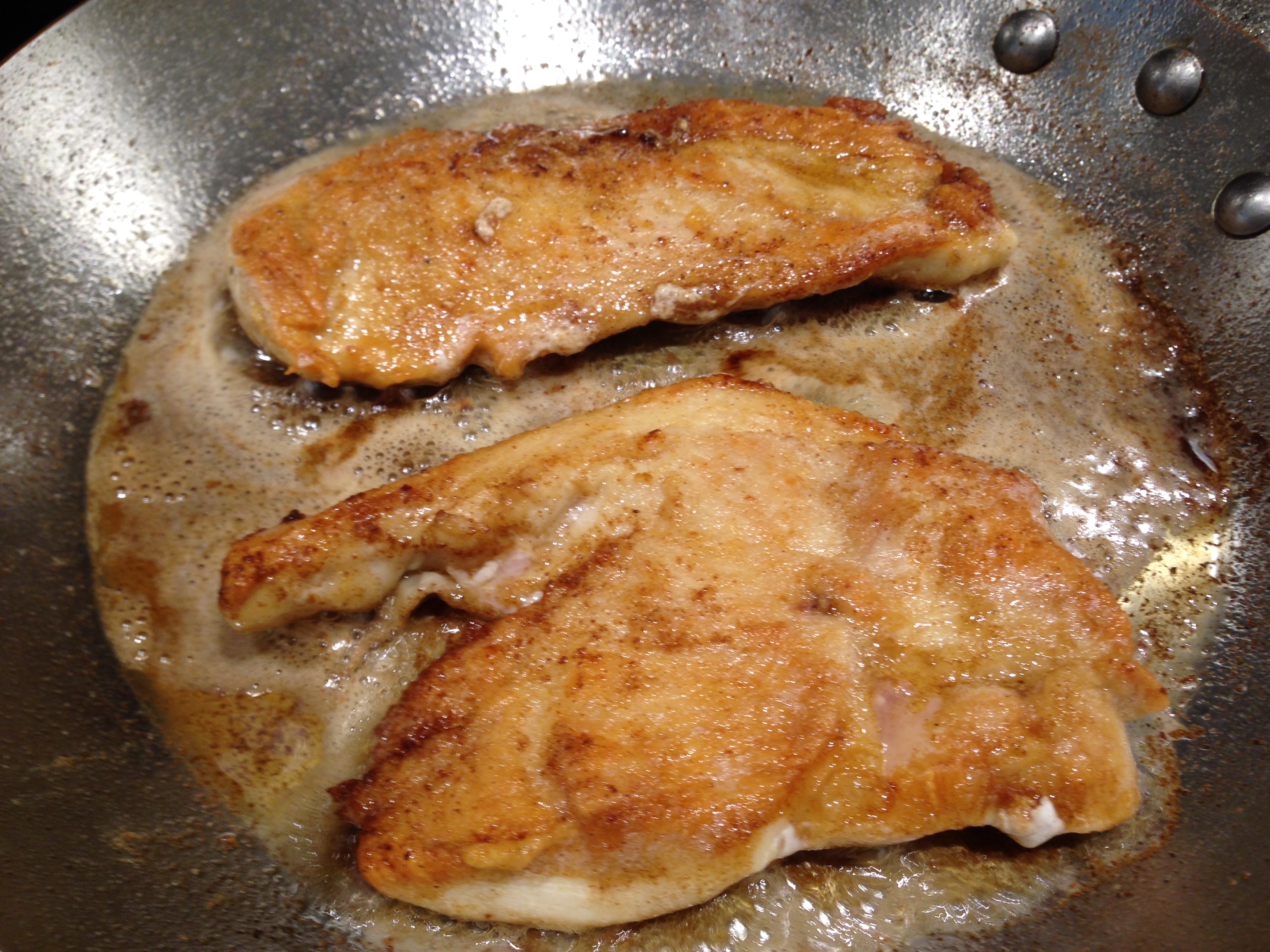
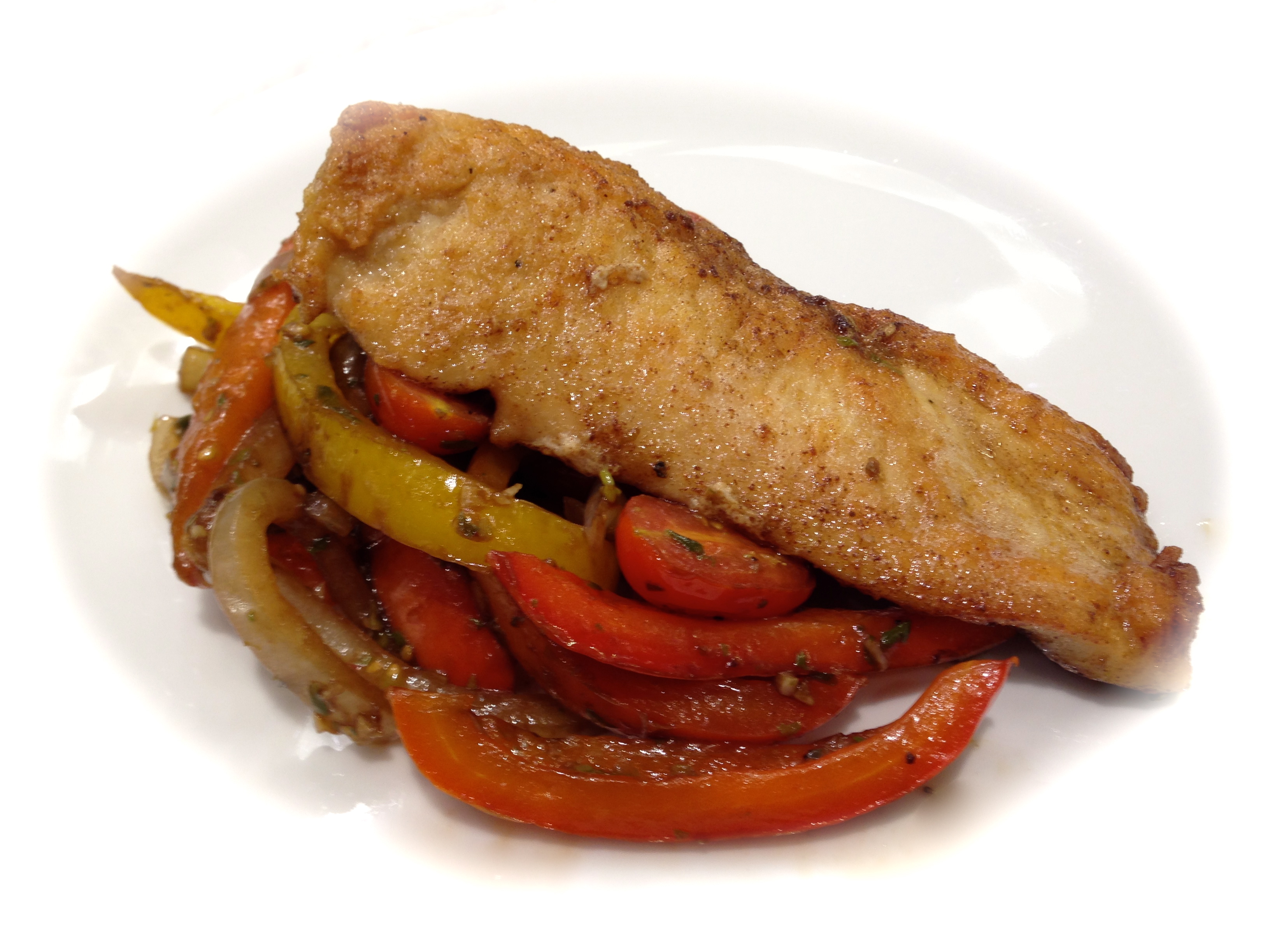
RATING: A++++++++++++ I cannot say enough about this recipe. It is so easy and really retains its flavor during the slow cooking process. Many times people complain about slow cooker recipes being bland and lacking flavor. Not this one. Try it – I just know it will become a go-to slow cooker recipe!

Cut Veggies Into Large Chunks

Cut Veggies Into Large Chunks

Lesson Learned 1: VEGETABLES IN A SLOW COOKER: You have to learn what vegetables hold up well during a lengthy cooking process and which ones should be added at a later time. I am still playing around with how do to this. When I made it I put in the onions, peppers, and celery at the very beginning. Next time I think I’ll just start off with the onions and celery. Let’s face it, the celery will not be crisp tender but I think it’s main function is to add flavor to the sauce. Onions, if you cut them large enough, will hold up and also add to the flavor during the longer cooking process. If you add peppers at the beginning, cut them in large chunks otherwise they will become mush. Next time I’m considering adding the peppers during the last hour of cooking to help them retain more body.

LESSON LEARNED 2: CUTTING THE MEAT – It’s important not to cut the meat too small or to large for this recipe. I use a German sausage in this recipe and I cut the links into two inch pieces. I use chicken thighs for this recipe (they tend not to dry out in a slow cooker) and cut them into large bite-size chunks.

Add Sausage and Chicken To The Veggies

Add Sausage and Chicken To The Veggies

LESSON LEARNED: COOKING TIME – The original recipe I used called for the traditional 6-8 hours on low and 4-6 hours on high. My advice is never ever cook this recipe for 8 hours regardless of altitude. Your vegetables will be soggy and your meat dry. Once I made that mistake I decided to change the cooking time to 6 hours on low. Even that produced dried out chicken. Now I cook it for 5 hours on low (the last half hour I raise the temperature to high) and that seems to work well. The sausage is cooked through and the chicken is not dried out. Again, this will depend on the type of slow cooker you have and its default settings for low and high.

LESSON LEARNED 4: SHRIMP – Only put in as much shrimp as you plan to serve immediately. If you save cooked shrimp in the leftovers, chances are they will get tough when you reheat them.  It is better to add fresh shrimp during the last 10 minutes of the reheating process for your leftovers. That way the shrimp stays fresh and tender.

Add Okra and Shrimp During The Last Half Hour

Add Okra and Shrimp During The Last Half Hour

LESSON LEARNED 5: ADDING THE OKRA AND SHRIMP – I add the frozen okra and shrimp during the last half hour of the cooking process and for that half hour I change the slow cooker setting to high. The okra comes out crisp tender and the shrimp is cooked perfectly.

Slow Cooker Jambalaya

  • Servings: 4-6
  • Difficulty: Easy
  • Print

INGREDIENTS:

4-5 chicken thighs (depending on size)

8 oz. uncooked sausage (I prefer a German-style sausage)

1 large sweet pepper

2-3 stalks of celery (depending on size)

1/2 of a large onion

1-  14.5 oz. can of diced tomatoes

1 – 10 oz. can of diced tomatoes with green chiles (I use the mild version)

2 TBS. quick cooking tapioca

2 TBS. dried basil

1/4 tsp. cayenne pepper (optional)

6 – 12 large shrimp (depending on many you will be serving – I usually plan on 3 per person)

2 cups of frozen cut okra

DIRECTIONS:

Prepare the vegetables cutting the onions and peppers into large chunks. The celery can be cut in thin slices. Cut the sausage into links of approximately 2 inches. Cut chicken thighs into large bite-sized chunks. Thaw shrimp if frozen. Keep cool in refrigerator once thawed.

Layer the vegetables in the bottom of the slow cooker. Add the sausage and chicken. Stir to combine.

Mix together both cans of diced tomatoes, tapioca, basil, and cayenne pepper. Pour on top of the vegetable and meat mixture.

During the last half hour of cooking time, add the okra and shrimp and stir. Change the slow cooker temperature to high and cook for additional half hour. Serve immediately.


Slow Cooker Jambalaya

Slow Cooker Jambalaya

Shepherds Pie Turkey Style…

I’ve always liked the concept of Shepherds Pie, it’s a great way to use leftover pot roast – but what about using poultry as the main protein? A grocery store near my home often features fresh half turkey breasts on the bone and I love them. Because of their smaller size, it’s a great way to have turkey more often than just during the holidays, it’s easy to cook and you still get great turkey leftovers to boot. The only difference is that now I don’t have all of the other holiday side dishes to serve with the leftover turkey, and I wanted to try something a little different than just a turkey pot pie.

Spread The Turkey Over The Bottom of the Dish

Spread The Turkey Over The Bottom of the Dish

I’m beginning to wonder what I would do without Pinterest. What great way to find recipes from sites I would probably never find otherwise. My blog now also links to my taste.com and there you can find a compilation of tons of recipes from a variety of different food blogs. I’ve just started connecting with that site and if you want to find my recipes (and there are only a few of them featured right now but there will be more to come) just type in “jan geden” in the search engine and my recipes will pop up.

But this time I found a recipe on Pinterest that I adapted and to my surprise it turned out great. I am now becoming a little more sure of myself in the kitchen with a better understanding of what will and will not work, especially in high altitude. And although this was adapted from a recipe called turkey potato casserole from all recipes.com, it is my version of it with several changes I made based on what I had in my refrigerator at the time. So, here are my lessons learned and recipe rating.

Saute the Veggies...

Saute the Veggies…

RATING: A+ – I wish I could give it a few more pluses but the only drawback was the casserole did not get as hot as I would have liked it even with the time I added on to the original recipe. Next time I will bake it longer and at a slightly higher temperature. Otherwise it was very flavorful and definitely a great way to use leftovers in a casserole.

Lesson Learned 1: COOKING TIME – and once again as I’ve stated several times before, things take longer to cook in high altitude. The original recipe called for the casserole to bake for 30-40 minutes at 350. 350 to me automatically means at least 365-375. I baked it for 50 minutes at 365 and it was warm, but this recipe needs to be served piping hot. Next time I will do 375 for an hour and I bet it will be perfect.

Layer The Veggies Over The Turkey

Layer The Veggies Over The Turkey

Lesson Learned 2: ADAPTABILITY – I love this recipe because it is easily adaptable. The original recipe called for adding only onion and frozen green beans. When I read the reviews, someone suggested that they used peas instead of the beans. I liked that idea better. I also had some mushrooms (don’t I always) and a lot of carrots in my refrigerator. I chopped the onions and carrots, sliced the mushrooms and sautéed them until the carrots were softened and added them to the mixture along with some frozen peas. The next time I might even add a little chopped celery. The vegetable medley really added to the flavor of the dish in my opinion.

Lesson Learned 3: PRE-MADE MASHED POTATOES – what a time saver they were. The pre- made mashed potatoes that you can get now in the grocery stores are really very good. I think I got a tub of Country Crock garlic mashed potatoes, but any brand will do. All I did was microwave them for about 3 minutes, stir them and spread them on top of the casserole. It worked out perfectly.

Spread Soup Mixture On Top Of Veggies

Spread Soup Mixture On Top Of Veggies

Lesson Learned 4: CHEESE – the recipe called for cheddar cheese to be mixed with the cream of mushroom soup and the mashed potatoes. I decided to get a three cheese blend and I only mixed it with the soup and not the mashed potatoes. That way you save a little on the calorie side and the cheese blend, in my opinion, melted better than just using cheddar cheese alone.

Lesson Learned 5: LEFTOVERS – this also makes great leftovers and warms up very nicely after a few minutes in the microwave.

On average I’ve found that although casseroles have the appeal of a one pot meal, they generally take some work to put them together. And although this version involves some chopping and sautéing, the finished product is well worth the time and effort. I plan on making this one often it was that good. Enjoy!

Fresh Out Of The Oven

Fresh Out Of The Oven

Shepherds Pie Turkey Style…

  • Servings: 4-6
  • Difficulty: Easy
  • Print

INGREDIENTS:

2 cups diced cooked turkey meat

1 onion chopped

1 large clove of garlic chopped

1 cup frozen peas

1 cup carrots diced small

4 ounces sliced baby bella mushrooms

1 can cream of mushroom soup

6 ounces shredded three cheese blend

3 TBS butter

1 tub (28 oz) pre-made mashed potatoes (or you can use leftover fresh mashed potatoes)

DIRECTIONS:

Preheat oven to 375. Dice turkey and put in the bottom of a 8×8 casserole dish. In a large pan, melt  the butter and sauté the onions and carrots for a few minutes before adding the mushrooms. Continue to sauté until onions are translucent and carrots have started to soften. During the last minute of cooking add the garlic until the garlic becomes fragrant. Remove from heat and set aside.

Microwave the mashed potatoes for approximately 3 minutes. While potatoes are in the microwave, mix the cheese and the soup together in a small bowl. After 3 minutes, take the potatoes out of the microwave and stir to soften.

Put the vegetable mixture over the turkey and spread the soup and cheese mixture on top of it. Spoon the softened mashed potatoes over the soup mixture and spread out evenly to cover the entire casserole.

Bake in the oven for 40-60 minutes or until heated through. Serve immediately.

Shepherds Pie Turkey Style...

Shepherds Pie Turkey Style…


Blueberry Buckle…

Just when I think I’m getting pretty knowledgeable in the culinary arts something comes along, be it a technique or a term, that makes me realize I’ve only scratched the surface of my so-called expertise. And so it was today as I was in the midst of my quest for my one new recipe per week goal. I’ve done a lot of main dishes lately and I thought I’d switch to the baking side for a couple of posts. So merrily I skipped off to Pinterest and started perusing pins. It was the title of the recipe that piqued my interest this time, a recipe for a blueberry buckle.

Wet and Dry Ingredients

Wet and Dry Ingredients

Before today I thought a buckle was a part of a belt. Now I know it is actually a term for a popular dessert that originated in New England. The premiss of a “buckle” is simple, consisting of adding berries to a single layer of cake batter. During the baking process the berries sink to the bottom and the cake emerges with a buckled appearance. Who knew you can eat a buckle as well as wear one? Will wonders never cease!

The original recipe came from a website called mybakingaddiction.com.  It seemed simple enough and this time I was smarter and adjusted the recipe for high altitude and guess what, the cake didn’t didn’t sink in! What a concept! So here are my lessons learned, recipe rating and my version of the recipe.

RECIPE RATING: A++++++  This is the best buckle I’ve ever eaten that’s for sure. The batter, the streusel topping and the blueberries all combine into one very delicious cake. Plus, you know me, I’m always a very happy camper when something turns out right the very first time you make it. I learned my lesson from not making the high altitude adjustments to my strawberry cream cheese coffee cake recipe. This time the adjustments were made and the cake turned out perfectly. I will outline the adjustments in the recipe below.

LESSON LEARNED 1: This time I made the streusel topping in a food processor versus trying to hand cut the cold butter into the other streusel ingredients. The mixture turned out much better. I simply pulsed the mixture until a greater portion of the mixture looked like very small pebbles. I will definitely make streusel that way from now on.

Ready To Go Into The Oven

Ready To Go Into The Oven

LESSON LEARNED 2: The original recipe called for two cups of blueberries. Next time I may try to cut that back a little to a cup and a half. That was a lot of blueberries and I think I might try having the cake be a tad more prominent. But use two cups if you like. I want to see if I can better balance the ratio of blueberries to cake. But then again, maybe that’s the nature of a buckle. There was certainly nothing wrong with how the cake tasted with two cups of blueberries.

LESSON LEARNED 3: As on average in high altitude, things take longer to cook. The original recipe called for baking the buckle for 25-30 minutes at 375. I would up baking it for 40 minutes.

LESSON LEARNED 4: The original recipe called for 1/4 cup shortening. I’m not a big fan of shortening so I used butter and it was fine.

LESSON LEARNED 5: I like this recipe because it is a good size for two people. I made it in an 8 x 8 pan and that is a perfect size for two people who will be munching on it over the next couple of days.

I have nothing negative to say about this recipe. The original recipe was written clearly, suggested substitutions, and turned out perfectly the first time. The only word of caution is that you use a lot of dishes to prepare the cake, but take my word for it, it’s worth it!

Fresh Out Of The Oven

Fresh Out Of The Oven


Blueberry Buckle

  • Servings: 8
  • Difficulty: Easy
  • Print

INGREDIENTS:

2 cups flour

2 tsp baking powder (high altitude adjust to 1/4 tsp)

1/2 tsp salt

1 tsp. cinnamon

3/4 cup sugar (high altitude make it a “light cup” – I left about 1/16 of an inch rim around the top)

1/4 room temperature butter, unsalted

1 large egg (high altitude use an extra large egg)

1 1/2 tsp vanilla extract (high altitude 2 tsp vanilla extract)

1/2 cup of milk (high altitude add 1 TBS water to the milk)

2 cups fresh blueberries

STREUSEL TOPPING:

1/3 cup all purpose flour

1/3 packed light brown sugar (for high altitude do a soft pack)

1/2 tsp. cinnamon

1/4 tsp salt

3 TBS cold unsalted butter cut into cubes.

DIRECTIONS:

Preheat oven to 375 degrees. In a medium bowl whisk together the flour, baking powder, salt and cinnamon and set aside. Put all of the streusel ingredients except the butter into a food processor and set aside.

In a large bowl with an electric mixer, combine butter and sugar until fluffy. Add egg and vanilla and combine thoroughly. Add the dry ingredients, alternating with a small portion of the milk. Start with the milk and end with the milk until the dry and wet ingredients are just combined. Fold in the blueberries.

Spray an 8 x 8 pan with cooking spray. Spoon batter into the pan and spread out evenly. Cut the cold butter into cubes and add to the food processor. Pulse until a greater portion of the mixture resembles small pebbles. Spoon over prepared batter.

Bake in the oven for 25-30 minutes (high altitude can take as long as 40 minutes). Let cool for 20 minutes. Serve with vanilla ice cream or fresh whipped cream.

Blueberry Buckle

Blueberry Buckle


Chicken Cutlets with Peppers, Mushrooms, Onions and Tomatoes For Two…

Recipe Ingredients...

Recipe Ingredients…

You’ve probably figured out by now that I am a chicken girl. Anyway you make it, I love chicken and I love trying out new chicken recipes. Yesterday I was looking for something different and also something quick. I just got back from a consulting job and was still on east coast time so I was still pretty tired. I wanted to fulfill my goal of one new recipe a week but did not have a lot of energy to put into it. I found just what I was looking for in the most recent “Cooking Light” magazine entitled the “fast” issue. It was labeled as a fast chicken scaloppine with peperonata (don’t you just love it when they give these fancy words for sautéed vegetables?) and it looked intriguing and quick so I decided to try it. So here is my rating and lessons learned…

Recipe rating: A – this one is quick cooking and has great flavor. I’m not so sure it holds up to it’s 25 minute meal guarantee and I will address that in my lessons learned.

Pepper Mixture...

Pepper Mixture…

Lesson Learned 1: This recipe takes longer than 25 minutes if you add the prep time. I’m not sure they factored that in, but it definitely took me a good 15 minutes or more to mince the garlic and slice the peppers, onions, tomatoes (of course I added some baby bella mushrooms so I won’t fault them for that). It also takes some time, not a lot, to halve the chicken breast and pound them to 1/3 inch thickness and dredge them in flour. When you factor all the prep time, all in all for the everyday cook like myself this recipe takes about 45 minutes from start to finish. No worries, one of my favorite parts of any recipe is the chopping, slicing and dicing – I find it cathartic – but recognize this recipe is more time consuming than the magazine would lead you to believe.

Lesson Learned 2: I halved the recipe since I was only making it for two. That worked out very well. The only thing I would change is to use even less than half the balsamic vinegar than the recipe stipulated. You only need a little to give the flavor. If you add more I think it darkens the vegetables too much, which I thought was the case with mine when I made it. Next time I make it I’ll only add a little, probably 1/8 of a teaspoon or less.

Lesson Learned 3: You will need to make this in two frying pans – one for the veggies and one for the chicken. I think it best to try to time them so they both finish together. The veggies can get cold very quickly and you don’t want that to happen. Err on the side of less time for the veggies instead of more. I started them 15 minutes before I planned to serve and I could have done 10-12. I like crisp tender veggies and 15 minutes put them on the borderline of being overcooked. Definitely cook the peppers first as they will need the full amount of time. But after sautéing them for 3 minutes, add everything else (except the tomatoes and garlic) and they will cook down nicely all together.

Lesson Learned 4: I used a basil paste in the recipe as my grocery store did not have any fresh basil on hand. You can use this, but again use only a small amount. I find the paste to be much more concentrated and a little goes a long way. Use a 1/4 teaspoon at the most.

Lesson Learned 5: The recipe called for adding the garlic when you add the onion. That would mean the garlic would be cooking for about 7 minutes. Garlic burns when cooked for a long time. I added the garlic when I added the tomatoes (and that cooked for about a minute and was done right before serving). That way the garlic cooked, was fragrant and it did not burn.

Lesson Learned 6: The original recipe calls for prepping the chicken once you’ve started the pepper mixture on the stove. I would not do that as you will probably wind up cooking your vegetable mixture for too long of a period of time. Prep the chicken first and put it aside. It can sit for a few minutes without any harmful effects and I found that slightly taking the chill out of it makes for a truer cooking time. I also added some garlic powder to the dredging mixture to give some additional depth of flavor.

Cook the chicken breasts until golden and done. Be careful not to overcook...

Cook the chicken breasts until golden and done. Be careful not to overcook…

Lesson Learned 7: It is tricky to cook a chicken cutlet and have it come out juicy. The original recipe called for it took cook for two minutes on each side or until golden and done. Boy, that gives you a lot of specifics doesn’t it. I cooked mine for 4 minutes on one side and 3 1/2 minutes on the second I could have cooked it a little less. Next time it will be 3 minutes on each side and I think that will be perfect. You get so used to cooking much thicker chicken breasts that sometimes it’s hard to imagine that the cutlets can get done so quickly. But they can and don’t be afraid of that. If you cook them too long they will dry out quickly. You don’t want that to happen.

I liked the recipe but felt I needed to make some adjustments to it based on past experience and in order to make it for two. Here is my version of the recipe.

Chicken Cutlets With Peppers, Mushrooms, Onions and Tomatoes For Two

  • Servings: 2
  • Difficulty: Easy
  • Print

INGREDIENTS:

2 TBS olive oil

1/2 red bell pepper sliced in strips

1/2 yellow bell pepper sliced in strips

1/2 large yellow onion sliced in strips

4 ounces (1/2 package) baby bella mushrooms sliced

1 large clove of garlic minced

8 grape tomatoes halved

1 TBS fresh chopped basil or 1/4 tsp. basil paste

1/8 tsp. balsamic vinegar

1 boneless skinless chicken breast cut in half horizontally and pounded to 1/3 inch thickness

1/4 tsp. garlic powder for dredging mixture

2 TBS butter

Flour for dredging (about 1/3 cup)

Salt and Pepper to taste

DIRECTIONS:

Cut the chicken breast in half horizontally. Place between two pieces of wax paper and pound until the breast is approximately 1/3 of an inch thick. Place your mallet at the center of the breast and pound outward. Take a paper towel and pat the breast halves dry. Mix flour with garlic powder and some freshly cracked black pepper. Dredge cutlets in the flour mixture and shake off any excess flour. Place on a plate to rest for a couple of minutes.

Heat a large skillet and add the olive oil. Swirl the olive oil to completely coat the bottom of the pan. Add the peppers and sauté for approximately three minutes. Add the onions and mushrooms. Salt and pepper to taste. Continue to sauté for another 5-6 minutes.

After you add the mushrooms and onions to the vegetable mixture, in another frying pan over medium high heat, melt the butter. Add the chicken breasts and cook for 3 minutes on each side.

During the last minute of overall cooking time, add the garlic and tomatoes to the pepper mixture. Cook until tomatoes begin to wilt. Add the basil and balsamic vinegar at the very end of the cooking time.

Immediately serve the chicken with pepper mixture.

Chicken Cutlets with Peppers, Mushrooms, Onions and Tomatoes

Chicken Cutlets with Peppers, Mushrooms, Onions and Tomatoes

All in all this is a simple and flavorful recipe. If you want to adhere to the 25 minutes or less time frame that the original recipe touts, I would do all of the prep work the night before. That way it actually will be a very quick and very good meal. Enjoy this one!

Chicken, Broccoli, Mushroom, Cheese and Rice Casserole…

Casserole Ingredients

Casserole Ingredients

Right out of the gate I will tell you that I had a love-hate relationship with this recipe. I loved the way it tasted and I will definitely make it again. My husband gave it a two thumbs up so I know it’s a keeper. What I hated was how the recipe was written and that is always a big sticking point with me. I try to be empathetic toward recipe authors as I understand I live in high altitude and that changes the rules somewhat. But even with that, I find it hard to believe this recipe (I amended it for you in this blog) as originally written would even work at sea level. So for my non-intuitive cooking friends out there, beware. I suggest you do the recipe the way I’ve written it and I think you will be successful on the first try.

This recipe came from the website http://www.keyingredient.com. From what I can tell, it appears that people submit recipes and they are published on this site. This particular recipe was intriguing to me as I had all of the ingredients already and I was looking to try something different. My goal is to try one new recipe a week and blog about it. So this recipe helped me on both fronts. So here is my rating and lessons learned along with my version of the recipe. You can always search for the original recipe on the key ingredients website.

RATING: A: for flavor and ease of preparation, F: for how the recipe was written. With a few simple adjustments this recipe could easily get an “A” on both counts. But in my estimation it was not well written.

Saute the Mushroom and Onions First

Saute the Mushroom and Onions First

LESSON LEARNED 1: The original recipe called for either 3 cups of cooked rice or 1 cup of uncooked rice, with no differentiation in cooking time for either one. Even I know that there has to be some sort of a difference, right? You can’t expect uncooked rice to turn out the same as cooked rice without some adjustment to the cooking time. So adjust I did, and even with that the rice still turned out slightly crunchy. The original recipe called for a cooking time of 350 for 30 minutes. So for me, in high altitude, that normally means I set my oven to 365. But I just had a feeling that 30 minutes would not cut it, so I planned on a 45 minute timeframe. After 45 minutes I looked at the casserole and it still did not seem as hot and bubbly as I would like it so I cranked the temperature up to 375 and cooked it for another 15 minutes. And even with all that time, the rice was still not fluffy and in some instances slightly crunchy. Lesson learned for me: the next time I make this I will cook it at 375 for 1 hour using cooked rice. I will cover the casserole with foil for the first 45 minutes and leave it uncovered for the last 15 to get some good browning on top of it.  If you choose to use uncooked rice remember to adjust your time. What that time might be I cannot tell you as I have no clue. All I can tell you is that after an hour it was not completely cooked through for me.

LESSON LEARNED 2: This is also a big bug-a-boo of mine. In a recipe be clear about whether a dish should be covered or uncovered in the oven. Don’t assume I know. This recipe calls for cheddar to be put in the sauce as well as sprinkled on top and did not indicate anything regarding whether the dish should be covered or not. In my experience, cheddar cheese left uncovered on casseroles for a long time tends to look burnt. I covered the casserole with foil for the first 45 minutes and then left it uncovered for the last 15. It worked out beautifully.

Blend the cheddar cheese with soup mixture until completely melted

Blend the cheddar cheese with soup mixture until completely melted

LESSON LEARNED 3: The orignal recipe calls for sautéing the onions in margarine. Why margarine instead of butter? Butter is a much purer ingredient. I used butter instead.

LESSON LEARNED 4: I was surprised how long it took for the cheddar cheese to melt in the soup mixture. It took about 5 minutes and required constant stirring. So be patient, it will melt but it does take time. (This was probably the most labor intensive part of the process).

LESSON LEARNED 5: The original recipe called for 2 cups of frozen broccoli. Although frozen vegetables are of much higher quality than they used to be, why not use fresh? I used fresh broccoli chopped into bite size pieces. The broccoli turned out perfectly, crisp tender. So use fresh broccoli if you can. I think frozen broccoli might turn out mushy in this recipe.

The first layer of rice, broccoli and 1/3 of the soup mixture.

The first layer of rice, broccoli and 1/3 of the soup mixture.

Don’t get me wrong, I really liked this recipe. It would have been tremendous if the rice was cooked properly. So give this one a try and try it the way I am writing it. I think you will be much more successful that way.

Chicken Broccoli Mushroom Cheese and Rice Casserole

  • Servings: 4-6
  • Difficulty: Easy
  • Print

INGREDIENTS:

3 cups cooked rice

3 cups cooked chicken (rotisserie chicken or any other type of precooked chicken, drained)

2 cups broccoli (fresh or frozen – no need to thaw) chopped into bite size pieces

1 can cream of chicken soup (low sodium preferred)

1 can cream of mushroom soup (low sodium preferred)

3 TBS. butter

1/2 cup chopped onion (more if desired)

1 clove garlic, minced (more if desired)

1 cup sliced portobello mushrooms

8 ounces of shredded cheddar cheese

DIRECTIONS:

Preheat the oven to 375. Cook 1 1/2 cups of rice (this should yield 3 cups of cooked rice) according to package directions. (Minute rice is not advised for this recipe). Cut chicken and broccoli into bite sized pieces. Slice mushrooms, chop the onion and mince the garlic clove. Melt butter and sauté the mushrooms for a couple of minutes. Add the onions and cook until slightly translucent. Add the garlic and sauté until fragrant, about 30 seconds. Add both cans of soup and stir until combined and hot. Add 6 ounces of the cheddar cheese and stir until melted (this could take about 5 minutes before the cheese is completely melted).

Grease or spray a 3 quart casserole dish. Spread rice evenly on the bottom. Put broccoli on top of rice. Pour about 1/3 of the soup mixture over the broccoli and rice. Add chicken and top with remaining sauce. Top with remaining two ounces of cheese.

Cover with with foil and cooked covered for the first 45 minutes. Remove foil and return to oven for an additional 15 minutes. Let stand for 5 minutes before serving.


Ready to pop in the oven...

Ready to pop in the oven…


Fresh Out Of The Oven...

Fresh Out Of The Oven…

Chicken Broccoli Mushroom Cheese and Rice Casserole

Chicken Broccoli Mushroom Cheese and Rice Casserole

Three Cheese Spinach Strata with Sundried Tomatoes and Peppers

I was raised a meat and potatoes girl so I don’t often cook meatless meals, but I do enjoy them. So when I was tasked to make something for a meeting at work, knowing that some of the associates do not eat meat, I went to my tried and true friend Pinterest to get some inspiration. And, as always, I found a wide variety of options from which to choose.

Strata Ingredients

Strata Ingredients

I was intrigued by this recipe for several reasons: 1.) I’d never made a strata, [and was always intrigued to make it especially after watching one of my favorite holiday movies “The Family Stone” with the strata being a “Morton family tradition – lovers of the film know what I mean]; 2.) I love the combination of ricotta, gruyere and parmesan and; 3.) the recipe appeared to be very adaptable even for a nonintuitive cook like me.

This recipe originated from a website called onecaketwocake.com and I can certainly understand why since the finished product is almost like an egg cake. I adapted it by adding sliced baby portobella mushrooms (one of my favorite add-on ingredients) and doubling it for a 9 x 13 pan. I also added more cheese than called for, used kosher salt instead of table salt and opted for frozen instead of fresh spinach, although fresh spinach would be very good as well.

I was a little nervous to bring something to a meeting that I never made before but I decided to take a risk and try it. So here are my lessons learned and recipe rating:

Rating: A++ I always LOVE it when you make something the first time and it turns out perfectly. This definitely did. All of the work is in the prep (and I’ll get to that in my lessons learned) but after that you just let it chill in the refrigerator overnight and bake it off in the morning. I will definitely make this for dinner sometime. You know it’s good when the whole pan disappears, which it did. It looks good and tastes good. This is definitely a keeper recipe.

Strata Filling

Strata Filling

Lesson Learned 1: This takes a long time to prep, and I mean a LONG TIME especially if you grate the cheese yourself which I did. I had a slab of parmesan in the fridge as well as a slab of gruyere so I had to process both of them. I grated the parmesan in the food processor and the gruyere with my hand grater which added a lot to the time and extra clean up. There is also a lot of chopping, mincing and dicing from the onion to the garlic and the sun dried tomatoes, peppers and bread. I never realized how time consuming cutting the crust off a loaf of french bread can be. All in all this took me about an hour to prep and that surprised me. Was it worth it – DEFINITELY. Just be aware that this recipe has a lot a prep and set the time aside to do it.

Lesson Learned 2: Make sure you take the onion, garlic, spinach and roasted red pepper mixture (and in my case I also added mushrooms) off the stove and let it cool somewhat before building the strata. This is the only area where I thought the recipe directions could be clearer. Anytime you have anything warm to add to an egg mixture you either have to temper the egg mixture (slowly warm it) or let the warm ingredients cool somewhat so you don’t wind up with scrambled eggs. I found removing the veggie mixture from the pan and letting sit on a plate for just a few minutes got it to a point where it would not adversely affect the egg mixture.

Lesson Learned 3: Saute the mushrooms first for about 3-5 minutes then add the onions until they turn slightly translucent then add the spinach, tomatoes and peppers and cook until the pan is showing no moisture. The mushrooms give off a lot of moisture so you want to begin by sautéing them.

Strata Layers

Strata Layers Before Adding The Cheeses

Lessons Learned 4: After the prep, the rest is a breeze. This dish could be a great holiday breakfast or simply a breakfast-for-dinner meal. You have to let the strata “cure” in the refrigerator overnight or at least for 8 hours so that the bread soaks up the egg mixture. Just cover it with foil once you’ve assembled it and forget about it. I love that part of it!

Lesson Learned 5: This recipe is very adaptable. I could see adding broccoli or asparagus or even zucchini to this. I think this might be a good clean out your vegetable bin recipe. Just be aware of the various cooking time of your vegetables and plan accordingly. For example, I might add asparagus uncooked or only slightly cooked into the mixture. Since the strata bakes for 50 minutes, it gives the more tender vegetables plenty of time to cook in that process. I may try that the next time and I’ll let you know whether it works or not. You could also add meat to this. I’m thinking breakfast sausage would be the best compliment. Just cook it three quarters of the way through, let it cool slightly and add it into the layers. Don’t worry, the sausage will cook through during the remaining 50 minutes in the oven. I do the same thing for my Ravioli Lasagna recipe and the meat turns out just fine.

Lesson Learned 6: If you want to make this for dinner, just prep it first thing in the morning and let it sit in the refrigerator all day. Plan to try to keep it in the refrigerator for at least 8 hours.

As you can see, I have very few lessons learned since the recipe is basically easy – it’s just the prep that’s time consuming. But what you’re left with is something that looks fancy, tastes delicious and comes out perfect the very first time you make it. Enjoy this one!

Three Cheese Strata With Mushroom, Tomatoes and Roasted Red Peppers

  • Servings: 8
  • Difficulty: Easy
  • Print

INGREDIENTS:

1/2 cup chopped sun-dried tomatoes

3 TBS butter

1 small onion, chopped

2 packages frozen spinach (6 ounces each), thawed

3/4 cup roasted red peppers (jarred or homemade), chopped

1 tsp kosher salt

I loaf french or italian bread (approximately 1 pound or 10 cups), remove the crust

10 large eggs

2 cups milk

1/2 cup heavy cream

2 TBS Dijon Mustard

Freshly ground black pepper

3/4 cup ricotta cheese

2 cups gruyere cheese

1 cup parmesan (or more if desired)

DIRECTIONS:

Thaw frozen spinach. Once spinach is thawed, place in a cloth towel and wring out several times until all excess water is removed.  Chop spinach and set aside. Make sure sundried tomatoes are soft. If not, cover them with boiling water and let them seep for 15 minutes and then chop them and set aside.

Over medium heat melt half the butter and sauté the mushrooms for about 3-5 minutes. Add the onions and cook the mixture until the onions begin to look translucent. Add garlic and stir for about 30 seconds. Add remaining butter. Stir in the spinach and pepper. Salt and pepper to taste. Stir until mixture is dry. Remove mixture from the pan and set aside to cool.

Cut bread (remove the crust first) into large cubes and place half in the bottom of a buttered 9×13 dish. Spread half of the spinach mixture on top. Take half of the ricotta and place by spoonfuls on top of the mixture followed by half of the gruyere and parmesan. Repeat the layering.

In a medium bowl whisk together the eggs, cream, mustard and a half teaspoon of salt and pepper. Pour the mixture evenly over the ingredients in the casserole dish. Cover with foil or plastic wrap and refrigerate over night.

In the morning, take the casserole dish out of the refrigerator and let it stand while you heat the oven to 350 degrees. Bake the casserole for 50 minutes or until lightly browned and cooked through.

Three Cheese Strata With Mushrooms, Tomatoes and Roasted Red Peppers

Three Cheese Strata With Mushrooms, Tomatoes and Roasted Red Peppers

Slow Cooker Country Style Pork Ribs…

I just love the slow cooker, don’t you? All the work is done up front and that allows you to be about your day knowing that you will still have a good meal for dinner with minimal work needed when you get home. But the slow cooker can also produce bland, mushy food. You need to know what adapts itself well to slow cooking and the correct cooking time for every recipe. I’ve found over the years that the biggest mistake I’ve made with a slow cooker is cooking something too long.

Layer the Vegetables On The Bottom of the Slow Cooker

Layer the Vegetables On The Bottom of the Slow Cooker

The beauty of this recipe is that it truly takes 8 hours to cook. You often see slow cooker recipes that say to set the timer on low for 8-10 hours or high for 4-6 hours. Don’t be fooled. Two extra hours can make a big difference. So I will warn you up front – be prepared to have a few slow cooker failures until you get the hang of your machine and the appropriate cooking time needed for a particular recipe. Unfortunately, it’s just a reality when using a slow cooker.

This recipe is another one of my favorite go-to slow cooker recipes. These fall off the bone ribs get their down-home flavor from vegetable juice, molasses and seasonings. It also takes very little prep to get this going and so it’s great for one of those crazy busy days. The basis of this recipe came from a Better Homes and Gardens magazine I purchased in 2005. I’ve adapted it over the years and am sharing my version of it. I’ve never had a failure with this recipe, even when I made it for the first time. So I feel pretty confident that you will have the same success I did. Enjoy!

Place the Ribs On Top of the Vegetables

Place the Ribs On Top of the Vegetables

RATING: A. This recipe is so easy and the sauce is very flavorful. You can serve this with just about anything. Quite often I will get some of the pre-made mashed potatoes, heat them in the microwave and serve them with the ribs and a steamed vegetable. The sauce makes a great gravy for the mashed potatoes. You can also serve this over rice as well.  I’ve never made this with pasta. The recipe may be too robust for pasta but give it a try if you’re a pasta lover.

Lesson Learned 1: Make sure to set aside a cup of sauce at the beginning to serve over the ribs when they are done. You can use the sauce that is in the slow cooker if you forget but the reserved sauce gets much thicker when you heat it on the stove and has less grease. I think you’ll find that extra step more than worth it.

Lesson Learned 2: I love this recipe because it uses a whole can of tomato paste. I hate it when you are asked to put in a few tablespoons of tomato paste into a recipe and wind up having a half-used can sitting in your refrigerator until you throw it out. I know you can purchase tomato paste in a tube, but sometimes I have difficulty finding it in the store or they’re out of them. This way you have no worries, you use the entire can.

Cover With The Vegetable Juice Mixture

Cover With The Vegetable Juice Mixture

Lesson Learned 3: Vegetables can always be tricky in a slow cooker as they can disintegrate or become overly mushy if you don’t prepare them correctly. Make sure to cut the onion into large rings. I usually cut the rings almost an inch thick and then cut the rings in half length-wise before separating them. Onions should always be cut rather thick if you are putting them in a slow cooker. The same applies to the carrots. Cutting them into large logs helps them stand up better to the slow cooking process.

This also applies to the mushrooms. Since you are putting them in for only one half hour you don’t need to cut them overly thick. But only put them in for a half hour. That way your mushrooms will have a perfect consistency. If you put them in at the beginning they will become way too mushy.

Lesson Learned 4: Make sure you rub the thyme and rosemary into your palm to break up the dried seasonings and release some of the natural oils before you add them to the vegetable juice mixture. That will provide greater depth of flavor to the sauce.

Lesson Learned 5: You can use just about any type of vinegar you have on hand for this recipe. I normally use red wine vinegar, but plain white vinegar or any other type will work just as well.

Lesson Learned 6: Spray a measuring cup with cooking spray before you measure out the molasses. That way when you pour the molasses it will come out easily and quickly. (This is a great tip when using an ingredient like molasses or honey)

Lesson Learned 7: Never lift the lid during the cooking process. The only time the lid can be lifted is when you add the mushrooms. If you lift the lid during any other point, you will throw off the cooking time and will be faced with adding more time to the process.

Add The Mushrooms During the Last Half Hour

Add The Mushrooms During the Last Half Hour

Slow Cooker Country Style Pork Ribs

  • Servings: 4
  • Difficulty: Easy
  • Print

INGREDIENTS:

3 pounds pork country-style ribs (don’t use baby back ribs for this recipe)

1 large onion sliced into thick rings

4 large carrots cut into one 2 inch logs

3 cups of vegetable juice

1 can of tomato paste

1/2 cup of molasses

6 TB. vinegar (I use red wine vinegar for this)

2 tsp. dried mustard

1/4 tsp. kosher salt

1/4 tsp. freshly ground black pepper

1 tsp. dried thyme

1/8 tsp. dried rosemary

8 oz. baby portobella mushrooms, sliced.

DIRECTIONS:

Slice onion into thick rings and separate. Peel and cut carrots into 2 inch logs. Place them in the slow cooker. Remove any excess fat from the ribs and place on top of the onions and carrots.

In a medium size bowl stir together vegetable juice, tomato paste, molasses, vinegar, dry mustard, salt, and pepper. Rub the seasonings in your hand to release the natural oils, add to the mixture and combine. Reserve one cup of the vegetable juice mixture for sauce, cover and refrigerate it. Pour remaining mixture over the ribs and onions covering completely.

Cover and cook on low for eight hours. During the last half hour of cooking, add the sliced mushrooms and stir mixture to combine. Meanwhile on the stove put the reserved sauce in a small saucepan and bring to a boil. Once the mixture comes to a boil, lower the heat and simmer uncovered for 10 minutes. Cover the ribs with the sauce when serving.

Serve with rice, mashed potatoes or pasta and the vegetable of your choice.

Serving suggestion: Over Rice

Serving Suggestion: Over Rice

Brandy Chicken With Mushrooms and Pearl Onions…

After my post last week that featured one of my favorite go-to recipes, chicken roll ups, I thought I would be off of the chicken bandwagon for awhile. But lo and behold the very next day I got my copy of Cooking Light in the mail and what was this months feature but “12 ways for perfect chicken!” On the cover was an enticing picture of chicken smothered in mushrooms and pearl onions and I thought, I just gotta make this one. And so I did, last night.

I am always on the look out for a good chicken recipe and this issue features an abundance of them, but I was drawn to the recipe pictured on the cover. I’d never cooked with Brandy before and was a little fearful and skeptical. I looked online to see if there was a viable substitute for brandy, as I don’t drink it and would use it only for cooking, but the information I found stated there really was no substitute. Wine was mentioned as an alternative but it would not provide the same flavor. So off to the liquor store I went. I actually found a small bottle of Korbel brandy for $10 and so I figured I could live with that. Other than fresh thyme and pearl onions, all the other ingredients I already had in the house so this seemed like a no-brainer. So here is my rating and lessons I learned making the dish for the first time.

Rating: A- for the recipe B- for the instructions. As I’ve mentioned several times I am not an intuitive cook so I need for the directions to be explicit and correct. I tend to take things literally, but more and more I am beginning to trust my instincts. I enjoyed this recipe, would definitely make it again and maybe even experiment using wine instead of brandy. I’ll explain all that in my lessons learned.

Lightly Dust With Flour and Cook In Olive Oil Until Almost Done

Lightly Dust With Flour and Cook In Olive Oil Until Almost Done

Lesson Learned 1: The time of this recipe was overestimated in my opinion. The recipe calls for halving boneless skinless chicken breasts, thus making a “cutlet”. So how do you define cutlet? I’m thinking about a quarter of an inch thick, right? When I halved a breast I wound up with 2 pieces that were a half inch thick. I decided to use that thickness instead of pounding them out based on the cooking time for the recipe, 43 minutes (how they came up with 43 versus 42 or 44 gives me a chuckle), taking into consideration I was not making as many “cutlets” as called for in the recipe so I was cooking a lesser amount of meat but at a greater thickness. My pieces of chicken were probably double the size of what I assume a cutlet should be (and that’s another thing that aggravated me, the recipe never defined the thickness of the cutlet – you just can’t assume every knows). I found that using that time as a guide for the rest of my meal wound up giving me slightly overdone chicken. I think one of the common errors most cooks make is overdone boneless skinless chicken breasts. Next time I make this I’ll reduce the cooking time by 7-10 minutes. Because I planned the rest of my meal around that 43 minute timeframe, I wound up keeping the dish on a very low simmer until everything else was ready and I think that lent to having slightly overdone chicken breasts. Mind you, they were not bad, but I do know the difference between a chicken breast that is juicy and tender and one that is overdone. (OK, I’ll get off of my soap box now).

Lesson Learned 2: Cooking with brandy did not wow me. I’m not sure what I expected the flavor to be, but it really did not supply the depth of flavor I thought it would. The recipe calls for cooking the brandy down until it’s almost evaporated (which I did) but the chicken stock that I added next seemed to overpower it. Next time I might leave a little more brandy in the pan or try this with either red or white wine. Most of the information I looked at regarding a substitute for brandy recommended using white wine, but I think red wine (like a good merlot) could also make this recipe interesting.

Lesson Learned 3: You also have to be careful cooking with brandy as it can produce a large amount of flame coming out of your pan. The recipe states that you should take the pan off the heat add the brandy and then put it back on the heat. I would highlight something like that in a recipe and even do a warning that if you don’t you could produce a large flame and injure yourself. Again, not everyone is a seasoned chef and I think a pointed warning would be helpful.

Cook Mushrooms Until Browned and Onions are Slightly Caramelized

Cook Mushrooms Until Browned and Onions are Slightly Caramelized

Lesson Learned 4: This recipe called for button mushrooms. I never use button mushrooms anymore now that baby portobello mushrooms are so easy to get. I think button mushrooms are virtually flavorless and baby bellas stand up to the cooking process better and have a much better texture. So I substituted baby portobello mushrooms for button mushrooms and I highly recommend it.

Lesson Learned 5: The original recipe cooked 8 cutlets and called for 1 teaspoon of fresh thyme leaves. One teaspoon was not enough even for my recipe for two people. I would recommend two teaspoons of fresh time for four servings. With one teaspoon I could barely see the thyme much less taste any flavor from it.

Lesson Learned 6: Adding the butter at the end gives a nice silkiness and shine to the sauce. Don’t skip that part.

Even with some of the issues, this recipe is a keeper and one I will continue to play with. What I also like about this recipe is the progressive cooking process allows you to do your clean up in stages, so by the time I served dinner the only prep dish that needed to be washed was the skillet. I liked that aspect a lot. So here is my version of that recipe:

Brandy Chicken With Mushrooms and Pearl Onions

  • Servings: 4
  • Difficulty: Medium
  • Print

INGREDIENTS:

2 boneless skinless chicken breasts halved (ideally 1/2 inch thick)

1 jar of pearl onions or 1 box of frozen pearl onions (thawed and drained)

6 – 8 ounces of baby portobello mushrooms sliced

2/3 cup of brandy

1 cup of chicken stock

2 tsps. cornstarch

1 TBS butter

2 teaspoons of fresh thyme

1/4  cup all purpose flour

Olive oil

salt and pepper

DIRECTIONS:

Halve the chicken breasts horizontally. Pat dry and season with salt and pepper. Dredge chicken breasts in flour and shake off the excess.

Heat skillet with just enough olive oil to lightly coat it. Cook chicken breast for 4 minutes on each side until almost cooked through. Remove them from the skillet and wrap them in foil to keep them warm.

Add some additional oil in the pan. Add mushrooms and cook for 2-3 minutes and then add the onions. Continue to cook until mushrooms are nicely browned and onions begin to caramelize. Remove from the pan and set aside.

TAKE THE PAN OFF THE HEAT AND ADD THE BRANDY (this is important so as not to produce a flame). Put the pan back on the heat and cook down the brandy by half. Whisk together the chicken stock and cornstarch until smooth and add it to the skillet. Continue to whisk the mixture for a couple of minutes until smooth and mixture begins to bubble.

Return chicken, mushrooms and onion to the pan, reduce heat and simmer for 3-5 minutes. Add salt, butter and thyme. Serve once the butter has melted.

Brandy Chicken with Mushrooms and Pearl Onions

Brandy Chicken with Mushrooms and Pearl Onions

Chicken Roll Ups…

Chicken Roll Ups (right out of the oven)

Chicken Roll Ups (right out of the oven)

I think I may be related to Ina Garten’s husband Jeffrey, at least in the love of chicken department. Like him, anyway you prepare it I just love chicken. Ina makes it for him every Friday. I have it at least once a week and sometimes more. Because of that fact I’m always looking for new chicken recipes and especially the ones that are easy to prepare and super delicious.

This recipe is one of my husband’s favorites. Every time I make it he always comments on how much he enjoys it. I love it for its combination of ingredients – boneless chicken breasts, genoa salami, provolone cheese, asparagus and pasta sauce. In my mind it doesn’t get much better than that.

But I have to admit there is a catch to this recipe. Like any recipe for a roll up, the challenge is rolling it up. It took me a few tries to perfect the technique but hopefully through my lessons learned it will be easier for you. There are a few recipes that I’ve posted so far on this blog that are my go-to favorites. I put this one right up there with one of my all time favorites, my ravioli lasagna recipe. Once you master the art of the roll up you will make this recipe often as it is so simple and yet very flavorful.  So here’s my rating and lessons learned:

ru1Rating A+  The only thing difficult about this recipe is mastering the roll up technique so that all of the ingredients are covered by the chicken breast. Once you’ve got that, the rest is a breeze. You’ve basically got your meat and vegetable all in one. Serve with a simple salad and some crusty bread and you’ll have a dinner that will become a staple in your household! I’ve learned a lot of lessons making this recipe and hopefully these will help you be successful the very first time you make it.

ru2Lesson Learned 1: It is so important to make sure the chicken breast is the right thickness. If it’s too thick you’ll never get it to roll up, if too thin all the provolone will ooze out.  I used to use one breast for each roll up but it seems like they are getting larger and larger and once you pound them out you are left with an enormous roll up. Now I take my boning knife and halve the chicken breast. From there I put them between two pieces of wax paper and pound each to a quarter of an inch thick. I found doing it this way makes for a much more reasonably sized portion and one breast now serves two.ru3

Lesson Learned 2: Figuring out the art of the roll up took a few tries on my part before I perfected it. What I learned is if you put the cheese, meat and asparagus closer to where you begin rolling and leave a little more just plain meat toward the end the process seems to work. As you are rolling the meat and cheese tend to move a little along with you. If you leave some “wiggle room” at the end you can get all of the insides covered with the chicken breast.

Place ingredients more toward the bottom before you roll the chicken

Place ingredients more toward the bottom before you roll the chicken

Lesson Learned 3: I have yet to find a toothpick that will hold the roll up in place without breaking off. Now I use a turkey skewer (the kind you use on your holiday turkey to keep the stuffing in place) and that seems to work well. I use the skewer to secure a flap on the bottom (opposite the asparagus tips) so that cheese does not ooze out and then weave it through the chicken flesh to hold the rest of the roll up in place. Just make sure you remember to tell people that you used a skewer. With the pasta sauce it is not always easily visible and whoever is eating it could be sawing away wondering why they can’t completely cut through the roll up. If I can I remove it before serving. If I can’t remove it, I make sure the person eating it knows it’s there.ru5

Lesson Learned 4: This is probably the biggest lesson I learned from making this – covering the asparagus tips with aluminum foil. You are baking this dish for 45-50 minutes at 350. If you don’t cover the asparagus tips they will turn to mush. If you do cover them they turn out beautifully as can be seen by the picture at the bottom of this blog.

Lesson Learned 5: Put about a quarter of a cup of sauce on the bottom of the pan before you put the roll ups in. That way the roll ups won’t stick to the bottom of the pan.

Put sauce on the bottom of the dish before adding the roll ups

Put sauce on the bottom of the dish before adding the roll ups

Lesson Learned 5: This recipe is a version that came from a Bertoli pasta sauce add I clipped from the newspaper. The beauty of this recipe is that you can basically use any red sauce that you like and top with any cheeses that you like. The original recipe called for topping the roll ups with the sauce and shredded romano cheese. I like that and so that’s what I do, but you could use a combination of parmesan and romano and you could even top it with some mozzarella for the last ten minutes of the baking process.

Ready To Go Into The Oven

Ready To Go Into The Oven

All the work in this recipe is up front. Once you get the prep work done it’s just a matter of baking and eating it. Serve this with a side salad and crusty bread and you have an easy, flavorful and fun meal.

Easy Chicken Roll Ups

  • Servings: 4
  • Difficulty: Medium
  • Print

INGREDIENTS:

2 Boneless Skinless Chicken Breasts (halved)

Genoa Salami (12 thin slices)

Provolone Cheese (4-8 slices)

12 Asparagus Spears

1 Jar Tomato-Based Pasta Sauce (15 oz. or larger)

Shredded Romano Cheese (at least 1 cup)

Italian Seasoning

DIRECTIONS:

Place your hand on the top of the chicken breast and using a boning knife start on one side and cut the breast in half (see pictures above). Place each breast between two pieces of wax paper and use a meat mallet or rolling pin and pound moving from the center out until the breast is 1/4 of an inch thick.

Beginning at the bottom of the breast, place one or two pieces of provolone cheese and three slices of salami on top of the cheese making sure to leave about an inch of just plain meat at the top of the breast (see picture above). Trim the woody bottoms off of the asparagus spears and place at the bottom of the breast. Roll the chicken breast so that the cheese, salami and asparagus (except for the tips) are all covered by the meat. Take a skewer and close off the flap a the bottom (the opposite end from the asparagus tips) and lace it through the roll up to secure it in place. Cover the asparagus tips with aluminum foil.

In a casserole dish, spread about 1/4 cup of the pasta sauce to cover the bottom. Place the roll ups in the casserole dish and cover with the remaining pasta sauce. Sprinkle with shredded romano cheese and italian seasoning.

Bake at 350 for 45-50 minutes. Remove skewer from roll ups and serve.

A Chicken Roll Up

A Chicken Roll Up

Oven Roasted Vegetables…

For a long time I’ve been trying to perfect roasting vegetables in the oven. My last foray into oven roasting was making balsamic parmesan cauliflower which sounds heavenly but had its challenges as a recipe. So I am always on the lookout for new recipes. I found this one the other day on, and this will not surprise you, Pinterest and thought I would try it. It came from a website called foodservice.com and though it looked great I could tell before making it that it had issues from the get-go. Luckily I’m finally starting to trust my instincts and not take recipes verbatim. I adapted it and it turned out beautifully, but I don’t think it would have the way it was originally written. So I will rate how I made it and then describe lessons learned based on the original recipe. For the burgeoning chef who may not have good gut instincts, like myself, I get a little perturbed when I see recipes that I know simply will not work. I’ll include my adapted recipe for you to print.

The Vegetables Used In This Recipe

The Vegetables Used In This Recipe

Rating A – the way I adapted the recipe produced tender crisp roasted vegetables, always a great accompaniment to any meal. I have to admit the original recipe provided a great trick that I will expound on in lessons learned.

Lesson Learned 1: In this recipe I used zucchini, yellow squash, thick asparagus spears, carrots cut in one inch size rounds and grape tomatoes. The original recipe also called for baby red potatoes and snow peas as well. So now I will get on my high horse for a minute. What I’ve learned over the years is the secret to successfully roasting vegetables starts out with veggies that have similar roasting times. If they don’t you will, and I guarantee it, overcook some and undercook others. Adding potatoes and snow peas to this recipe made absolutely no sense to me. Even baby red potatoes take a longer time to cook than most veggies and snow peas cook in nothing flat. And the original recipe called for roasting the veggies at 425 for 30 minutes covered and then uncovered for 15 minutes. That may well be the correct time allotment for cooking the potatoes, but I think the rest of the vegetables would have been annihilated. In defense of the recipe it does state to shorten the cooking time somewhat if you like your vegetables al dente, but 45 minutes at 425 would have, in my estimation, produced mush. I roasted the vegetables at 400 for 1/2 hour total, 20 minutes covered and ten minutes uncovered. You can see the results at the bottom of the blog. Next time I may even take 5 additional minutes off the cooking time as I like super al dente vegetables.

Vegetables Seasoned For Roasting

Vegetables Seasoned For Roasting

Lesson Learned 2: When slicing the squash, I cut them into 1 1/2 inch rounds and then cut them on the diameter both ways producing four pieces for each slice. That gave them sufficient “chunkiness” to withstand the cooking time.

Lesson Learned 3: You can see I used a thicker asparagus spear. When you buy asparagus quite often you can find it in various thicknesses. I bought the thickest one I could find so it was of sufficient “chunkiness” (I’m starting to like that word) to withstand the longer cooking time.

Lesson Learned 4: The original recipe called for baby carrots. I only had regular carrots so I took a couple that were about an inch in diameter and cut them into one inch rounds. You don’t want your carrots too big or they will remain hard.

Lessons Learned 5: I also looked for larger rather than smaller grape tomatoes for this recipe. I was most concerned about how the tomatoes would turn out but they were fine, nicely soft but not annihilated and that is ok.

Lesson Learned 6: The original recipe called for about 1/4 cup of EVOO – way too much, especially if you are adapting the recipe using smaller amounts of veggies! You want to make sure that your veggies are evenly coated but you don’t want them swimming in oil. You have to eyeball the EVOO and follow the rule of thumb that you can always add more if you need it. As long as they all have a nice shimmer of oil they will be fine and roast beautifully.

Lesson Learned 7: There is very little “exacting” to this recipe. I made this for my husband and myself and added amounts that I felt were appropriate for 2 people (and it could have probably served 3). I only cut up two rounds each of the squash, used 4 asparagus spears about 6 plum tomatoes and I think I was a little heavy handed on the carrots. There are no right or wrong amounts here. The key is to cut the veggies into sizes that will stand up nicely to the cooking time.

Lesson Learned 8: What I liked about the original recipe is the inclusion of steak seasoning. I never thought about using that on vegetables. I used Montreal Steak Seasoning and it really gave the vegetables depth of flavor. If you’ve never tried it, I recommend it. I was pleasantly surprised.

Lesson Learned 9: The recipe calls for dried rosemary, and even states that you might want to add more of it than the basil. I’m not a big fan of dried rosemary unless you really crush it. I’ve found that if you don’t you get these tasteless rosemary spears in your teeth. But you can certainly add your desired amount to the recipe below.

I would have rated the original recipe an “F” as I felt, as written, it would have been a failure. The ingredients were not well matched and the cooking time was outrageous. These types of recipes always get my goat since someone, like me, who is not an intuitive cook finds it sets you up for failure – and when you are learning in the kitchen you want easy successes to build your confidence. So, I am sharing my adaptation of the recipe. If you want to check out the original just go to the website I listed above and search for oven roasted vegetables. Good luck with that one. If you get it to work as written, let me know. I would like to hear how you accomplished that.

Oven Roasted Vegetables

  • Servings: Varied
  • Difficulty: Easy
  • Print

INGREDIENTS:

Thick Asparagus

Yellow Squash

Zucchini

Carrots cut in one inch rounds or baby carrots

Grape Tomatoes

Olive Oil

Dried Rosemary

Dried Basil

Montreal Steak Seasoning

Garlic Salt

DIRECTIONS:

Preheat the oven to 400 degrees. In this recipe you will need to use amounts based on the number of servings you want. Cut the squash into 1 1/2 rounds and then into quarters. If you don’t use baby carrots, use carrots an inch in diameter and cut into one inch rounds. Make sure to snap the bottom of the asparagus to remove the woody part. If the remaining spear is large, cut it in half. If not, keep the spear whole.

Evenly coat the veggies with olive oil and add the herbs and steak seasoning so that the veggies are evenly covered and toss. Place in a deep casserole dish and sprinkle with garlic salt. Roast covered with foil for 20 minutes. Remove the foil and roast uncovered for the remaining 10 minutes. Enjoy!

Oven Rosted Vegetables

Oven Rosted Vegetables

Tomato Potato Salad…

This recipe came about by accident – it was one of those things that my mother made for years but morphed into my mother-in-law’s recipe. Talk about inter-family competition. Not really. Both my husband and I came from modest backgrounds and our mothers were faced with learning how to really stretch a dollar while still keeping hungry children satisfied. That meant very simple meals consisting mostly of overcooked meat, canned vegetables (frozen veggies were not as prolific or as good as they are today) and recipes designed to stick to your ribs, high in fat and carbs. And guess what, we survived. Those recipes, for the most part, are what we now call comfort food and are the types of things we make sparingly, often when we feel we need a good hug.

tom and onionsThis is one of those recipes and yet it has an interesting twist, one that when I first heard about it I said yuck! My mom had a very basic potato salad recipe. My dad was not one for a lot of spices, he hated garlic (said it upset his stomach) and mostly enjoyed very bland-type meals. And considering this recipe does not have a lot of ingredients it is quite flavorful. The twist, thanks to my mother-in-law, was adding tomatoes to it. Yes, I said adding tomatoes. I’ve not seen many people, if any, add tomatoes to potato salad but if you’ve never tried it I think you might be in for a real treat. So here is my rating and lessons learned after many years of making Tomato Potato Salad.

Rating A – so easy to make, very colorful and flavorful. You will be amazed at how many people will be surprised by adding tomatoes but say it adds a wonderful flavor and consistency to potato salad.

psaladingredientsLesson Learned 1: Don’t be afraid to try it. I resisted doing it for many years and the idea of adding tomatoes was weird to me, but once I did I never looked back.

Lesson Learned 2: There is a trick to adding tomatoes. I always use roma tomatoes. I normally find that they are firmer with less seeds and more flesh and that is what you want. You need to scrape out the seeds and soft matter so that all you’re left with is the flesh. That way you get the tomato flavor but not the moisture. If you don’t do this you will wind up with watery potato salad, and you don’t want that.

Lesson Learned 3: Err on the side of more eggs than less. I usually use one large or extra large egg for every potato with 2 extra eggs to slice and add to the top. It depends on the size of the potatoes. Since there are so few ingredients in this recipe you need to make sure that you have enough eggs and green onions to provide the flavor.

Lesson Learned 4: Rinse the eggs for a long time under cold water after you boil them. I usually rinse them for 5 minutes and then I let them sit in an ice bath for about 5 minutes. If you do this the shells will easily come off. If you don’t you will struggle with removing the shells.

Proportion of Green Onions

Proportion of Green Onions

Lesson Leaned 5: Err on the side of more green onions than less, at least when you are chopping them. This is truly a recipe of sight versus exact amount. For this particular recipe I chopped 6 green onions. I did not use all of them but I used most of them. I eyeballed it. When you mix it, if the color looks proportional and not too little or too much green – then you’ve got it. I’m sure some of you are rolling your eyes right now and saying this does little to help me understand the exact amount. Hopefully the pictures will give you and idea. Just remember you can always add more onions but you can’t take them away. And green onions have a much milder flavor so even if you add a little too much I don’t think it will hurt. Also chop and use the green as well as the white parts of the onion. Personally I think the green part has a better flavor.

Potatoes

Potatoes

Lesson Learned 6: Try to, if you can, boil potatoes that are the same size. Then the boiling time becomes more consistent. In the picture to the left you can see that two of my potatoes were much larger than the others. Because of that I had to watch to make sure I took the smaller potatoes out earlier. Otherwise I would have had mushy small potatoes and evenly cooked large ones. You don’t want that. It’s also important to let the potatoes cool to room temperature before you peel them. This is perhaps the most lengthy part of the process, but I found it is so much easier to remove the skin and cut them up if the potatoes are room temperature.

The recipe is deceptively simple but I guarantee you that, especially after you’ve eaten a lot of pre-prepared store bought potato salad, you will enjoy making this for its simplicity and you will definitely love its flavor. Enjoy!

Tomato Potato Salad

  • Servings: 10-12 people
  • Difficulty: Easy
  • Print

Serving Suggestion

Serving Suggestion

INGREDIENTS:

5 medium to large red or yukon gold potatoes (if using yukon gold you don’t need to peel them)

7-8 large or extra large eggs, depending on the size of the potatoes (2 eggs are for garnish)

1 bunch of green onions (you will probably use 80% of them)

2 firm roma tomatoes

1/2 cup mayonnaise (again to taste – start with 1/2 cup and use more if you feel it is necessary, err on the side of less; reduced calorie mayo also works well)

1 TB dijon mustard (optional – I do not use it often, but it does provide some depth of flavor)

Salt and pepper – to taste

Paprika for garnish (optional)

DIRECTIONS:

Hard boil the eggs. (this usually takes me 15 minutes on my stove). Once cooked rinse thoroughly under cold water. Put the potatoes in a pot, cover with water and bring to a boil. (I usually keep the pot covered throughout most of this process). Cook until you can pierce them with a fork (this can take anywhere from 20 to 30+ minutes depending on the size of the potatoes). Be careful not to overcook, you do not want the potatoes mushy but firmly cooked. Put them in a strainer and let them cool to room temperature.

Chop up 5-6 green onions and set aside. Peel and chop all but two of the eggs. Slice the remaining two eggs and leave for garnish.

Peel the potatoes and slice into 1/4 inch square pieces. Add the chopped eggs, green onion, mayonnaise, dijon mustard and salt and pepper. Carefully mix together so as not to mash the potatoes. Add the slice eggs on top. Chill at least for 2-3 hours.

Tomato Potato Salad

Tomato Potato Salad

Tomato Potato Salad With Egg Garnish

Tomato Potato Salad With Egg Garnish

I know this sounds deceptively simple but it is amazingly flavorful. Try it and let me know what you think.

Slow Cooker Italian Chicken With A Twist…

Every once in a while, a friend will email or text me and asks about a recipe or shares one of theirs.  Such was the case  the other day when a former student messaged me on Facebook and asked if I “crock pot.” Do I crock pot? Heck yes. I love my crock pot. As a matter of fact I am probably a crock pot snob because I tend to call it a slow cooker. But call it what you will, it is a tremendous tool in the kitchen for busy families. Set it and forget it – I like that mantra.

But the slow cooker can also be a challenge. For all it’s benefits it has its downsides, mostly based in producing flavorless overcooked meals for the sake of convenience. That’s why it’s important to know your slow cooker and to understand its low and high temperatures. Not all slow cookers are created equal and it seems that over the years, at least in my experience, the temperature for the low setting has gotten higher and higher to the point that in some slow cookers it actually boils food – and that produces disaster.

IMG_5722I have an All Clad 6.5 slow cooker with a ceramic insert. Good Housekeeping reviews tend to consistently rate it as one of their top choices, especially from the standpoint of not drying out food (which tends to be the result of too high temperatures combined with too long of a cooking time). I’ll warn you now, it is an expensive piece of equipment averaging about $180 but to me it was worth the investment. Rarely do I dry out food in my slow cooker unless I cook it too long. There are other more reasonably priced top rated slow cookers out there. I would suggest doing a little research and reading reviews to determine which one fits your lifestyle and budget.

Here’s the ultimate slow cooker challenge – figuring out the correct cooking time for a specific recipe. Don’t you just love recipes that say “cook on low for 6-8 hours.” Well, what is it, six hours, seven hours, eight hours? There is a big difference between cooking something for six or eight hours. But unfortunately more often than not that is for the cook to figure out.

I’ve also found that cooking chicken is probably the biggest challenge, especially white meat chicken as it has much less fat than dark meat and can dry out faster. I’ve learned over the years that less tends to mean more when it comes to cooking white meat chicken in the slow cooker. I never cook it for eight hours, NEVER. And depending on the size and thickness of the pieces it tends to be between 5-6 that I get my best results. Normally I have to try a recipe once and from there I make an educated estimate for the next try in the slow cooker.

And so it happened with the recipe that I’m sharing today. It came from my former student Jenny who I referenced earlier in this blog. It is a traditional slow cooker recipe that uses soup as the base for its liquid but the combination of ingredients gives a sauce that is to die for. This is definitely not a low calorie recipe, but a great go-to comfort food recipe to keep in your repertoire. Jenny’s sister Shelly joined in our recipe conversation the other day and made a few suggestions that I found helpful and that added depth to the recipe. I’m calling this recipe “Slow Cooker Italian Chicken with a Twist” as it does not look or taste like a traditional Italian dish that tends to be tomato based. There are no tomatoes in this recipe but it has huge flavor. So here’s my rating and lessons learned:

Rating: A – a great comfort food recipe and the sauce is to die for!

Lesson Learned 1: I cooked boneless skin-on breasts for 5 1/2 hours. Next time I will only cook them for 5. They were just on the borderline of being a little dry, but they were not dried out.  If I had used dark meat 5 1/2 hours would have been fine.

Lesson Learned 2: Either spray or grease the crock for this recipe. The creaminess of the sauce can cause some browning especially around the edges. I used a slight brush of olive oil in my ceramic crock and it cleaned up beautifully. I’m not a big fan of cooking sprays but I am sure they work as well.

Lesson Learned 3: This is a lesson in progress as I haven’t figured it out yet. In the picture below you can see little flecks of the chive and onion cream cheese – I would have preferred it to be completely melted and am not sure why it didn’t. Maybe it was the fact that I used a reduced fat cream cheese, but I’m not sure. It certainly did not affect the flavor at all but I’m not sure why it didn’t melt completely. (we figured it out – the butter, cream cheese and soup need to be melted together in a pot over a low heat before combining with the wine and italian dressing mixture – thanks Shelly).

Lesson Learned 4: Shelly suggested serving this over rigatoni so that the creamy deliciousness of the sauce could permeate the inside and the outside of the pasta. I served it that way and I totally agree – use rigatoni.

Lesson Learned 5: I added some sliced baby portobello mushrooms during the last half hour of cooking. That way they cook but don’t disintegrate. I also served it with some sliced green onion on top for color, but you could use italian parsley as well. It needs a little color for serving.

ITALIAN CHICKEN WITH A TWIST RECIPE (courtesy of Jenny and Shelly)

Slow Cooker Italian Chicken With A Twist

  • Servings: 4-6
  • Difficulty: easy
  • Print

INGREDIENTS:

6 boneless chicken breasts

1 stick of butter at room temperature (I used a half stick and, in my opinion, it was more than enough)

2 packages of dry italian dressing mix

2 cans of GOLDEN mushroom soup

1 cup dry white wine

1 8 oz container of chive and onion cream cheese at room temperature

2 cups sliced baby portobello mushrooms

Cooked rigatoni pasta

Green onions or italian parsley for garnish

DIRECTIONS:

Mix together the wine and italian dressing mix. Combine butter, mushroom soup and cream cheese in a pot and heat slightly until melted. Add white wine and italian dressing mixture to soup mixture.  Lightly grease with olive oil or spray the crock with cooking spray before adding ingredients. Place the chicken breasts in the crock and cover with prepared sauce. Cover and cook on low for 5 hours. Add mushrooms and cook for an additional 30 minutes. Serve over rigatoni. Garnish with green onion or italian parsley.

NOTE: It’s best to cook this according to your slow cooker and its temperatures. The next time I make this recipe I will only cook it for 5 hours total. Each slow cooker can be different. And as always, resist the temptation to lift the lid. When you do that it slows down the cooking process and you need to add extra time to make up for your curiosity.

Slow Cooker Italian Chicken  With A Twist

Slow Cooker Italian Chicken With A Twist

Balsamic Parmesan Roasted Cauliflower

As I’ve mentioned may times before, I am a big fan of Pinterest especially as it comes to finding recipes. What I like about the site is one’s ability through “pins” to access websites that might not come to the top of a Google search, so you’re basically connecting with little known sites that you may never have found otherwise. And I have found these sites to be great resources for information and new ideas  for the kitchen.

So as I was browsing Pinterest the other day I came across the pin for a recipe called balsamic parmesan roasted cauliflower. It was pinned from the website http://www.kidneybuzz.com. Now doesn’t balsamic parmesan roasted cauliflower sound divine? And since I’m always looking for new ways to roast vegetables I just had to give the recipe a try.

When I evaluate recipes I look for a few simple things. First, are the directions clear – second, is it easy to prepare – third, can you be successful the very first time you make it, and fourth, did the recipe tell you everything you needed to know (as I find quite often recipes do not – especially where chefs-in-training are concerned). So here is my rating and lessons learned making this recipe:

Rating: C- with the potential for an A. I have never been so psyched to make a recipe and been so disappointed. I’m getting to the point though where I am starting to trust my own instincts versus just doing what is written. After some interesting lessons learned I would try this recipe again, as I do believe it has the potential to be an “A” rated recipe.

Balsamic Parmesan Roasted Cauliflower

Balsamic Parmesan Roasted Cauliflower

Lesson Learned 1: This recipe called for cooking the cauliflower from 20-30 minutes at 450. I will tell you right now if you do that you will have limp overcooked cauliflower. I’ve roasted cauliflower before and never over 400. But I thought, ok, I’ll compromise. I’ll roast it at 425. Big mistake!! The cauliflower came limp and overdone. I like my roasted vegetables to have some crispness to them. If you like them limp then cook them longer. In my opinion (and I roasted rather large florets) 15 – 20 minutes max at 400 is my recommendation.

Lesson Learned 2: This recipe does not tell you how to roast with balsamic vinegar, and that can be tricky. The proportions are perfectly fine, but you need to make sure that the cauliflower is primarily coated and not the pan. Otherwise you will have a sticky, gooey hard to clean mess because (unless this is different in high altitude) balsamic vinegar doesn’t evaporate as the recipe suggests, it burns especially in any concentrated amounts. That’s why I say make sure the cauliflower is covered in it and you don’t leave a puddle of it in your pan. If you do, clean up will be a nightmare (and in my opinion they should tell you these things in a recipe). I would also either spray your pan with cooking spray or line it with foil so that any balsamic that does not “evaporate” can be easily cleaned.

Lesson Learned 3: Tossing the cauliflower half-way through the cooking process is a must. That way you will get an even caramelization and the cauliflower won’t looked burnt. So, toss half-way through and don’t add the vinegar and cheese until the last five minutes.

Lesson Learned 4: Obviously this was not a recipe that turned out well the first time making it. I overcooked it and wound up with a gooey mess in my pan. That being said, it still had an interesting flavor, almost sweet. So I am definitely going to try this again as I think it has great potential.

I hope my lessons learned help you have more success the first time you try this recipe. I plan to continue to play with it until I get it right. When I do I will either update this blog or post a new one referencing this. I am a big fan of roasted vegetable but you have to get the cooking time and temperature just right, otherwise you have a limp burnt mess.

Easy Orange Chicken…

I will never forget that conversation. I was sitting at lunch with a colleague and she was telling me how she was a Food Network junkie. I laughed at her. I could not believe someone would actually enjoy watching a television program of someone cooking. So one Saturday morning, just for a lark, I decided to watch the Food Network. I’ve not been the same since.

What I liked about the Food Network, and especially the shows of a few years past, is that it educated me on various types of foods, taught me technique and challenged me to try new recipes and to experiment in the kitchen. The Food Network made me an accidental “foodie” and there’s not turning back now.

What the chicken skin looks like after the initial browning...

What the chicken skin looks like after the initial browning…

I used to really like Robin Miller’s show, but it’s no longer on the network. I’m a big fan of Ina and Giada and I also like Melissa D’Arabian. And it is my testing of one of Melissa’s recipes that is the subject of the blog today. She called the recipe “Crispy Chicken a l’Orange” and it is from her book Ten Dollar Dinners. I first saw the recipe on one of her shows, and it is listed on the Food Network website for free, so I’m pretty sure I’m not breaking any copyright laws by sharing this with you. I am always looking for different ways to make chicken and this recipe intrigued me, so I thought I’d try it. Here is my rating and lessons learned from making it.

Rating A-  the main reason I give it a minus is that the sauce is tricky. By that I mean it is a combination of frozen orange juice concentrate and honey. The tricky part is cooking this in the oven and not getting a pan that has burnt-on honey all over it, making it a nightmare to clean. I haven’t quite figured out how to avoid that. I make this recipe in a well seasoned cast iron skillet and I still have a difficult time cleaning my pan. Maybe it’s my fault. The recipe calls to brown the meat in a skillet and then transfer it to a baking dish. By using the cast iron pan I tried to do this as a one-stop shop and brown the meat and cook it all in one pot. Maybe next time I’ll try what the recipe recommends and see if that makes a difference with the clean up.

Drizzle the chicken with the orange juice and honey mixture and put into the oven

Drizzle the chicken with the orange juice and honey mixture and put into the oven

Lesson Learned 1: Brown the chicken skin side down for at least five minutes. Resist the temptation to move it around. Just let it stay in one place. After 5 minutes on medium-high heat you should have nicely browned skin and will continue to brown in the oven. (see the picture above).

Lesson Learned 2: Make sure the chicken is patted very dry before you begin to brown it. If it is moist it won’t brown.

Lesson Learned 3: It is very important to let the chicken rest for at least 10 minutes after cooking as called for in the recipe. The chicken comes out very juicy if you do it that way. Other than that there are really no other tips I can give you about this recipe. It is relatively easy to make. You get great flavor without a lot of work. The only challenge for me so far is the clean up.

When I get a thumbs up from my husband I know a recipe is a keeper. This got two thumbs up on this one. I served this with parmesan oven roasted asparagus and my pesto orzo with roasted red peppers and olives (pictured at the bottom). So try it, I’m sure you’ll find this recipe to be a keeper as well.

IMG_5517

CRISPY CHICKEN A L’ORANGE (EASY ORANGE CHICKEN)

Easy Orange Chicken

  • Difficulty: Easy
  • Print

INGREDIENTS:

Skin on chicken breast (the recipe calls for bone-in but I did mine boneless and it was delicious)

1 1/2 tsp. kosher salt

1/2 tsp. ground black pepper

1 TBS. vegetable oil

1/2 cup thawed orange juice concentrate

1/4 cup honey

DIRECTIONS:

Preheat oven to 375. Season chicken with salt and pepper. Heat oil in a skillet over medium-high heat and seat the chicken skin side down until brown and beginning to crisp – about 5 minutes.

In a small saucepan bring the orange juice concentrate honey and a dash of salt and pepper to a boil. Cook until syrupy (about 3 minutes).

Transfer chicken skin side up to a baking dish and drizzle with half of the orange juice mixture. Bake for approximately 35 minutes or until the internal temperature is between 160 and 170. After the chicken has been in the oven for about 15 minutes, drizzle the remaining orange juice mixture on it. When cooked, remove the chicken from the oven and let rest for about 10 minutes.

Serving suggestion: parmesan roasted asparagus and pesto orzo with roasted red peppers and olives

Serving suggestion: parmesan roasted asparagus and pesto orzo with roasted red peppers and olives

Don’t Chicken Out On Roast Turkey…

My husband and I went out to dinner this past Thanksgiving and I made a rib roast for Christmas so I knew eventually I would feel like I was cheated out of a traditional Thanksgiving meal. Luckily for me my local grocery store had a great manager’s special over the Christmas holiday pricing every single fresh turkey breast, regardless of weight, at $7.00. OK, I said to myself, I can’t afford to pass this up even though turkey was not on the Christmas menu. So into the freezer it went just waiting for the right time to resurrect Thanksgiving.

I used to be intimidated by cooking a turkey – I could never seem to get it right making it either over-done or, mostly in my experience, under-done. To me there is nothing worse than a dry turkey especially if you are just cooking an all-white meat turkey breast. Overcooking it means you eat sandpaper and when you spend that amount of time preparing a meal nothing can be more frustrating.

I can tell you right now, cooking a turkey is about trial-and-error, a firm resolve that it really is no big deal and a belief that you can actually be good at it. I’ve had numerous disasters over the years and only through the school of hard knocks have I become adept at roasting turkey. I very seldom cook a whole bird anymore as even a small one is way too much for me and my husband. But I find that with the right prep and know-how a turkey breast, whether half or whole, is equally as good and lends itself to being on the dinner menu more than once a year. At other times I don’t make all the traditional sides as the caloric intake is far too great, but this time I just had to opt for tradition – I mean you just gotta do it once a year, right?

Normally I critique recipes from Pinterest, Facebook or other foodie-type websites, but this is solely my recipe adapted from years of experience and variations of several recipes I’ve tried. So here are my lessons learned and rating.

7 pound turkey breast

7 pound turkey breast

Rating: Finally A+ – I say finally because this took a lot of practice on my part. For some reason the perfect roast turkey took a few years of trial and error. Thanks goodness I love turkey so much that failure did not weaken my resolve. What is great about when you master this is that you feel confident to make it any time of year. One of our local grocery stores often stocks fresh bone-in half breasts and that is plenty for my husband and me for a great meal and leftovers.

Lesson Learned 1: If the turkey is frozen, make sure it is completely thawed. This may sound rudimentary, but I can’t tell you how many times I thought the bird was thawed only to find out at the last minute that it was still frozen in the middle. The turkey breast in the picture above was a little over 7 pounds. I planned to make it on Sunday so I took it out of the freezer and put it in the fridge the Tuesday before. In my experience turkeys thaw very slowly in the fridge and I finally figured out that if I add a day on to what I think will be the right amount of time to get a perfectly thawed bird I tend to get it right. Even with putting the bird in the fridge on Tuesday I still took out frozen matter from the cavity on Sunday. But I did that very early in the day, cleaned and dried the turkey breast and put the bird back in the fridge after that so that when it was time to begin prepping it, it was completely thawed inside and out. This was perhaps the biggest difference in ensuring even cooking and determining the appropriate cooking time.

Lesson Learned 2: Prepare a butter rub and rub it under the skin as well as all over the outside of the bird. The nice brown color that you see in the picture is achieved by doing that. I normally make a mixture of butter, fresh thyme, salt and pepper. The darker pieces in the picture are not burned skin but darkened thyme. You can scrape that right off.

Lesson Learned 3: Forget about putting a bread stuffing in the cavity, instead stuff it with aromatics. With this particular bird I jammed a thyme bundle, large garlic clove, two sweet onion quarters and a half of a lemon into the cavity. You’ll be amazed at how this helps to flavor the meat. You can discard all of it before you start to carve it. It’s work is done by then.

Lesson Learned 4: Put some white wine in the bottom of the pan before you begin the roasting process. This provides a nice steam bath for the bird and enhances the juices that you can use to make homemade gravy. I never worry about having basting juices or a solid basis for my gravy anymore. This is a great trick. The gravy in the picture below was made from the wine and drippings mixture from the turkey breast.

Lesson Learned 5: Know your oven. I’ve said this in a few other recipes, but for turkey I think it is very important. I roast turkey at 350/twenty minutes per pound. Some recipes call to roast the bird at 325. I live in high altitude and so, on average, cooking times are longer and cooking temperatures need to be a little higher. After much trial and error I have found this to be the perfect roasting guideline for my circumstance. Also get a good meat thermometer and use it. That is the only way to ensure you meat is cooked to the desired doneness.

Lesson Learned 6: Let the turkey rest for at least 20 minutes to half-an-hour after roasting. The internal temperature should be 185. I normally take it out when it reaches between 175-180 as carry over cooking will occur while it is resting. Keep it covered in foil but make sure you let it rest. It will be much easier to carve that way and you will retain the natural juices in the meat.

Lesson Learned 7: Be prepared for failure, especially if you’re new to roasting turkey. It’s all part of the learning process and you can always make a turkey pot pie or turkey salad with the spoils.

So go ahead, jump into the deep end of the pool and make a roast turkey more often than just on Thanksgiving. Once you get the hang of it you’ll be surprised at exactly how easy it really is. I’m including for you my basic recipe for both a roast turkey and homemade cranberry sauce, also pictured below (forget store bought, this is sooo easy and sooo worth it).

Turkey and all the trimmings...

Turkey and all the trimmings…

Perfect Roast Turkey With HomeMade Cranberry Sauce

  • Servings: Varied
  • Difficulty: Easy
  • Print

Ingredients:

I whole turkey or a whole or half turkey breast, 7-12 pounds (you may need to adjust the cavity ingredients for a larger bird)

6 TBS. salted butter

Fresh thyme (enough to chop and mix with the butter and to put a bundle in the turkey cavity); you can also use turkey fresh herb blends sold in the grocery store that usually include sage, thyme, and rosemary.

1 sweet onion

1 large garlic clove

1-2 small lemons

2 cups dry white wine

Salt and Pepper

DIRECTIONS:

Make sure the turkey is completely thawed to ensure even cooking. Remove the turkey from its packaging, clean anything out of the cavity, rinse with cold water and pat dry. Cover with plastic wrap and refrigerate for at least an hour. Bring butter to room temperature. Mince approximately 2-3 TBS. of fresh herbs and combine with softened butter, salt and pepper. One half hour before putting the turkey in the oven take it out of the refrigerator, rinse again with cold water and dry off completely with paper towels. Use your hands to create a pocket between the turkey meat and the skin. Massage some of the butter mixture under the skin. Use the remaining butter mixture and massage the entire outside of the bird. Pour 2 cups of dry white wine into the bottom of the roasting pan and place the bird on a roasting rack inside the pan. Salt and pepper the outside of the bird. Let stand for at least 15 minutes.

Roast uncovered at 350 degrees, 20 minutes per pound, basting occasionally. Halfway through the cooking process check on the color of the skin. Once the skin reaches the desired color, tent the bird with foil to prevent the skin from getting too dark. Near the end of your estimated time, check the internal temperature of the bird at the thickest part of the thigh or breast. Poultry should be cooked to 185 degrees.  While the turkey is resting you can put the finishing touches on the other parts of your meal or make your homemade gravy.

THE BEST EVER HOMEMADE CRANBERRY SAUCE: (pictured on plate above)

Ingredients:

2/3 cup sugar

1 large or two small naval oranges (zest and 1/2 cup juice)

1/4 tsp. cinnamon

1/8 tsp. kosher salt

1 bag of fresh cranberries

DIRECTIONS:

Put the cranberries in a saucepan. Zest a large naval orange (or two small naval oranges) and juice the orange(s) – this should give you about 1/2 cup of fresh juice but if it does not just augment with bottled juice. Add sugar, zest, juice, cinnamon and salt. Stir until well mixed. Bring to a boil and then simmer for 15 minutes. Let cool and refrigerate. Make the day before serving to ensure all ingredients have sufficient time to meld. This is so easy and flavorful, you will never served canned cranberry sauce again.

Polar Vortex = Pot Roast

A friend of mine on Facebook said it pretty clearly, when was the last time, if ever, that you heard of a polar vortex? This is the first time for me but these two little words connote a nasty large band of sub zero temperatures that is currently enveloping a large portion of the country. And although our temps in Colorado today will be in the 40’s my home town, Chicago, is experiencing arctic cold the likes of which have not been seen for years.

Outside my window about 5 inches of snow rests on my deck, the sun struggling but not succeeding to show its face. It’s one of those days that a hot cup of Jo, a good book and a nice thick down comforter beckons. And when it finally comes time to think of sustenance, the only fitting thing that comes to mind is pot roast.

Just about everyone has their own pot roast recipe, so I will share mine. I’ve been making pot roast for years – on the stove, in the slow cooker, in the oven – and I think I finally found the way that bests suits us and also produces the tenderest meat. Pot roast can be tricky. There is nothing more savory and delicious than a good pot roast and there is nothing worse than a tough, dry one. My mother, bless her soul, had the theory that you cooked meat until it begged for mercy. Our special Sunday meal would be a pork and beef roast cooked together in the same roasting pan. Of course it never worked, you’re talking two very different types of meat and two very different cooking times, but we didn’t know any better and we chomped on the dried-out hunks and enjoyed them as if they were filet of beef.

Now that I am older and have a more refined pallet, I could never imagine doing something like that but can appreciate the challenge for taking a tough cut of meat and making it tender. The cooking shows would make you think the process is simple – just throw it in a slow cooker or oven and cook for hours on a low temperature. Been there, done that. With my slow cooker, and I have one of the top-rated ones, if I am not careful I can still dry out the meat, especially if there is not enough liquid in the crock and I cook it too long. So I now opt for enameled cast iron and the oven to do the trick.

I prefer enameled cast iron because of its ability to hold a consistent temperature. It does take a little longer to heat up, but once you get to the desired temperature it maintains it evenly which, I think, is the key to a tender savory pot roast. I’ve basically given up on having a tender pot roast and crusty oven browned potatoes all in one pot – to achieve the latter you tend to dry out the former. So if crusty oven browned potatoes are what you want, I suggest cooking them separately. But for me, nothing is better than having the meat, potatoes, carrots and onions slowly simmering away all in one pot. The end result is fabulous. So here is how I achieve it, my rating and lessons learned.

Rating: A – if you do it correctly. Although it may seem easy, I think achieving a perfect pot roast takes trial and error. Figuring out the perfect temperature and roasting time is important and in my experience one size does not fit all. But make this meal a mission – once your perfect it, it’s more than worth it. I also have the challenge of living in high altitude and because the air is drier cooking times tend to be longer. If you are at sea level times can be shorter. It is something you will need to determine.

Lesson Learned 1: Brown the meat. Take the time, about 4-5 minutes per side and give the roast a good sear. Searing is important in trapping natural juices which is key to any type of tender meat especially the tough cuts.

Browned Chuck Roast

Browned Chuck Roast

Lesson Learned 2: Use red wine in your braising liquid. I use a combination of both red wine and beef stock. It produces a much more flavorful gravy and creates a heavenly smell while the pot roast is cooking – and that is part of the joy of pot roast – the smells it produces in the kitchen. Make sure the liquid comes at least half way up the side of the roast for the best braising. Then pile on all the ingredients. Once that is done baste everything with the braising liquid.

Pot Roast Ingredients

Pot Roast Ingredients

Lesson Learned 3: Put the lid on and leave it alone. Resist the temptation to open the lid and constantly check on it. If you must, check on it once half way through the cooking time, but then take the roast and flip it over at that time. That way each side will have the benefit of being submerged in the braising liquid. This is not a necessary step but one I recommend if you have to take a peak at how it looks.

Lesson Learned 4: Relax and let it do its thing. The beauty of this type of meal, similar to my ravioli lasagna, is that most of the work goes into the prep. After that your oven does all of the heavy lifting.

Pot Roast and Vegetables

Pot Roast and Vegetables

Lesson Learned 5: Use the braising liquid to make homemade gravy. It will be out of this world, I promise.

Pot Roast and Gravy

Pot Roast and Gravy

My recipe is a compilation from many sources so I guess this one is my own. I also serve this with a homemade horseradish sauce and that truly complements all the flavors. Try this – I am sure you will enjoy it as much as we do!

Jan's Pot Roast With Zesty Horseradish Sauce

  • Servings: 4-6 people
  • Difficulty: Easy
  • Print

INGREDIENTS:

1  4 pound chuck roast

All purpose flour for dusting and for the roux

3 TBS. extra virgin olive oil

I large onion, peeled

2-3 garlic cloves, peeled (optional)

3-4 large carrots, peeled

3-4 medium sized potatoes (I use red potatoes, but Yukon Gold  potatoes are good as well – peeling them is optional)

1 cup dry red wine (whatever you drink is fine as long as it is a dry and not sweet wine)

1/2 – 1 cup beef broth

2 TBS worcestershire sauce

Thyme – you can use fresh twigs, bundle them and drop in braising liquid or 1/2 tsp. dried for braising liquid and 1/4 tsp. for flour mixture

2 bay leaves

DIRECTIONS:

Preheat the oven to 300. (next time I make this, I may even try 275 and add a little extra time). Trim some of the excess fat off of the roast if necessary. Mix flour with salt, pepper and dried thyme. Dredge the roast in the flour mixture. Heat olive oil in a skillet and sear the roast, 4-5 minutes on each side. (I also take my tongs and sear the edges for about 20 seconds on each edge). Peel the onion, carrots and potatoes. Cut the onion into quarters and carrots and potatoes into large chunks.

Combine wine, beef broth and worcestershire sauce. Pour into cast iron pot and add the thyme and bay leaves. (You could even drop a couple of garlic cloves into the braising liquid if you desire). Rest the roast in the braising liquid. Place the carrots and potatoes around the roast and the onions on top. Baste the vegetables with the braising liquid.

Cook in the oven for 3 hours. Mid-way through the cooking process turn the roast over. (this is optional but do it if you are one of those who just has to take a peak at it).

Using a baster, syphon braising liquid out of the pan. Put the cover back over the roast and vegetables to keep them warm. In a large skillet under medium high heat make a roux (equal parts flour and water – I use two TBS. each). Cook for a minute whisking continuously so that the “floury” taste is removed. Add the liquid and continue whisk. Initially the mixture will be very “liquidy” but it will thicken as you continue to cook.

Once the gravy has thickened, carve the meat and serve with the carrots and potatoes and a loaf of crusty bread.

HORSERADISH SAUCE:

2-3 TBS. of prepared or fresh horseradish

1 cup sour cream

1 TBS. dijon mustard

Combine all ingredients. Let chill for several hours so the flavors can meld. Serve with the pot roast.

Ravioli Lasagna…

Ravioli Lasagna

My part-time job at Crate and Barrel requires me to work longer than normal hours over the holidays. No worries, I love the hustle and bustle of the holidays and there’s no better place to experience that than working retail. The challenge for me is how to plan dinners that don’t consist of take-out, pizza or soup and sandwiches. That menu faire gets boring rather quickly. I found one solution in a Costco cookbook – that’s right a Costco cookbook!

Ingredients

Ingredients

If you are a Costco shopper you know that every year they give away a pretty substantive cookbook. The recipes in the book are designed to use the products they sell, but all in all there are some pretty decent recipes included. Over the years they’ve even featured recipes by prominent celebrity chefs such as Ina Garten, Sandra Lee, Ree Drummond and Michael Symon. What I like about the cookbook is that every recipe has a picture of the finished product. I am not a big fan of recipe books that don’t have pictures. I need something visual to help me understand what I am trying to achieve. The books provide a myriad of recipes from appetizers, main courses, celebrity chef favorites, desserts and beverages. And the fact that it is free is just icing on the cake. They usually give the books away at holiday time, so be on the look out for them. This year they started giving them away on Black Friday and continued as long as quantities lasted. I made my husband make a special trip to get ours as every year I have been able to glean a couple of family favorites from each of them.

The recipe I’m going to share comes from a book they produced three years ago. The title of the book is always the same, “Creative Cooking the Costco Way,” and this recipe is called Baked Ravioli (Lasagna Style). I like this recipe because it is simple, it can be adapted in a variety of ways, and it’s one that can be made a day ahead so it’s perfect for those nights when you want something more for dinner without a lot of thought or effort. I’ve been making a version of this for over three years now so I’ve got this one down pat. Here is my rating and lessons learned:

Rating: A – a great go to recipe, can be adapted in a variety of ways, easy to prepare and definitely something your better half can start while you’re still at work (with my husband I write the directions on a post-it and put it on the door of the microwave so it’s there in plain view for him to see).

Lesson learned 1: Don’t be afraid to play with this recipe. You can basically use any type of ravioli you like. I first started out using Bertoli four cheese ravioli and then branched off into some of the more gourmet-type blends. The ravioli used in the pictures in this blog were half-moon mushroom and cheese ravioli, but you can use any kind you want. This time I also added some additional left over mushrooms that I partially sauteed as well as some partially cooked italian sausage that I crumbled, cooked and put in the layers. No need to cook your additional ingredients completely through as the dish will bake in the oven for at least an hour. Depending on the ingredients you use, this dish can also be meatless.

Before baking...

Before baking…

Lesson Learned 2: If you are making it the day before, make sure you take it out of the refrigerator and let it sit on your counter for at least an hour and a half before baking it. If you don’t it will take much longer to bake and will not cook evenly.

Lesson Learned 3: I like to make sure that my oven is not only preheated but at the desired temperature for at least 10-15 minutes. That way I feel I have a true temperature. My oven takes about 15 minutes to get to 400 so I usually plan on a preheat time of 25 minutes.

Lesson Learned 4: Don’t forget to use a little bit of cooking oil and sauce to cover the bottom of the pan before doing the layering. If you don’t you won’t be able to get the finished product cleanly out of the pan.

Lesson Learned 5: I like to make sure that the ravioli is positioned tightly together, even with a slight overlap. That way you have a nice firm layer when it’s cooked.

Lesson Learned 6: Make sure to tent the foil over the dish for at least the first 50 minutes of the cooking process. After that, remove the foil so that the cheese can become golden brown.

You can make this recipe as simple or as intricate as you want. All of the work goes in to putting it together. Once that is done it’s simply a matter of popping it in the oven, baking it and enjoying it. Serve this with some garlic bread and a salad and you’ve got a delicious and easy meal. Try this one – I guarantee you will use this as a go-to recipe just like I do!

Ravioli Lasagna...

  • Servings: 4-6
  • Difficulty: Easy
  • Print

THE INGREDIENTS:

Cooking oil (I use olive oil) – just enough to very lightly grease the bottom of your pan

1 – 29 ounce jar of a red sauce of your choice

1 large package of ravioli (again your choice, the ingredients and shape – square or half moon – do not matter)

Italian sausage or meatballs (again the amount your choice, depending on how much you want in the recipe. I normally take two sausage links, crumble and partially cook the meat, drain it on paper towels and then put it over the ravioli when I make the layers).

Other ingredients to taste – (I often add partially sauteed mushrooms or peppers. No need to cook them through, just give them a good start).

Mozzarella, Parmesan and Romano Cheeses

Italian seasoning

DIRECTIONS:

Preheat oven to 400 degrees. Grease the bottom of your pan (for the two of us I use an 8 inch square pan) and spread a layer of sauce over the bottom. (You don’t need a lot, just enough to lightly coat it). Put down a layer of ravioli flat side up on the sauce. Position the ravioli close together, even with a slight overlap. Add any additional ingredients you have prepared (I did mushrooms and italian sausage on this one). Put another layer of sauce on top and then add a layer of mozzarella, romano and parmesan. Sprinkle with italian seasoning and pat the layer down lightly. Repeat the layering. Pat down again and cover with tented aluminum foil. (If you are making ahead, just cover with foil and put in the refrigerator. Just don’t forget to tent the foil before putting it in the oven as you don’t want all the cheese to stick to the foil).

Bake for one hour or until completely heated through. For the last 10 minutes of the baking process, remove the foil so that the cheese can brown. Let stand for five minutes before serving.

Ravioli Lasagna

Ravioli Lasagna

Salted Caramel Butter Bars…

Holiday Cookie Platter

Holiday Cookie Platter

Today I am going to a neighbor’s house for a holiday party and am bringing a platter of my holiday cookies. This year I made eight different kinds and along the way have posted updates of my baking endeavors on Facebook and Pinterest. The cookie recipe that I am going to share with you today stole the show in terms of favorable comments and requests for the recipe.

As part of my holiday baking tradition I always try at least one new recipe. This year I tried two, salted caramel butter bars and iced cinnamon chip cookies. Both turned out fabulously and will probably become future holiday staples. At some point I will have to pick and choose since eight different types are about all I can handle in one holiday season.

The salted caramel butter bars were a big hit when I posted a picture of the finished product on FB. What I like about them, besides the fabulous flavor, is that they are relatively easy to make. My husband gave them two thumbs up which is a real vote of confidence for a new holiday cookie and although the iced cinnamon chip cookies topped my list of the new recipes (that recipe to be posted in the near future) these certainly will wind up a keeper. So here is my rating and lessons learned making this recipe.

Rating: A – hard to top a cookie that not only looks bone chilling delicious but is easy to make and tastes as good as it looks!

Lesson Learned 1: The recipe calls for one bag of caramel candies or 50 individual pieces. The bag I bought was 11 ounces and had 40 pieces in it. I bought two bags. In my estimation you need the 50 pieces to have enough caramel filling to spread so buy either a 14 ounce bag or two 11 ounce bags.

Lesson Learned 2: The most labor intensive part of this recipe is unwrapping the individually wrapped pieces of caramel. It took me about 7 minutes just to do that. If you can buy a slab of caramel that would definitely be easier, just make sure you have a sufficient amount to spread over a 9×13 pan.

Lesson Learned 3: The ingredients to make the crust call for a whole pound of butter. Although I used that, I am wondering if that couldn’t be cut down just a little bit. When I cut the bars the bottoms appeared to be a little greasy. Next time I make these I may experiment with using a little less butter. But beware, you have to be careful when experimenting with cookie recipes as the amounts need to be more exact than they do when you are just cooking something.

Lesson Learned 4: This recipe makes a lot of dough. The instructions call for using 1/3 of the dough for the base. I used more than that and still had a lot of dough to dot the top with a lot left over. Next time I make this I may reduce the portions by twenty-five percent. That still should provide plenty of dough for the crust and the top.

Lesson Learned 5: I had to make these a little earlier in the month and put refrigerate them to keep them fresh. If you do that, pull them out of the refrigerator and let them get to room temperature before serving. They are very hard when taken immediately from the fridge and you don’t want anyone cracking a tooth on them.

Lesson Learned 6: I made this recipe without the sea salt but next time I am going to try it with the salt. Either way the bars were still delicious.

I cannot take credit for this recipe. I found it posted on Facebook and discovered it comes from the website http://www.cleverhousewife.com. I will still post the recipe here so you don’t have to link to the site but I want to give credit where credit is due. Enjoy this recipe. I am sure it will become a holiday staple for you as well!

Salted Caramel Butter Bars

Salted Caramel Butter Bars

Salted Caramel Butter Bars

  • Servings: 2 dozen
  • Difficulty: Easy
  • Print

INGREDIENTS:

Crust:

1 lb. salted butter at room temperature

1 cup sugar

1 1/2 cups powdered sugar

2 TBS. vanilla

4 cups flour

Filling:

1 bag caramel candies (you will need a 14 ounce bag) or about 50 pieces

1/4 cup milk or cream

1/2 tsp. vanilla

1 TBS. sea salt (optional)

DIRECTIONS:

Preheat the oven to 325 and grease a 9×13 pan (or use cooking spray).

In a large bowl combine the butter and sugars and beat until creamy. Add the vanilla and beat until combined. Add the flour and mix until a smooth dough forms.

Press one third of the dough evenly into the pan. Wrap the remaining dough in plastic wrap and refrigerate. Bake the crust approximately 20 minutes or until firm and the edges are lightly browned. Transfer the dish to a wire rack and cool for 15 minutes.

While the crust is baking make the caramel filling. Place the unwrapped caramels and cream in a microwave safe bowl and cook on high for 1 minutes. Stir and continue to cook for 30 second intervals until the mixture is combined and smooth. Once the caramel is melted add the vanilla and stir until combined. Pour and smooth the caramel filling over the somewhat cooled crust. If you are going to use sea salt, now is the time to add it on top of the caramel. Take the remaining chilled dough and crumble it over the entire top.

Return the pan to the oven and bake until the filling is bubbly and the crumbled topping is firm and lightly golden, about 25 – 30 minutes.  Let cool before cutting into squares.

Triple Chocolate Brownie Cookies…

The second favorite cookie in my recent posts on Facebook was the Triple Chocolate Brownie Cookie. I’ve been making this cookie for the past six years and it has risen to the list of the big three must-bake every year holiday cookies (the other two being chocolate chip cookies and the chocolate dipped sugar cookies, soon to be featured in future blogs). I like this particular cookie for several reasons: one it is easy to make, two it has three kinds of chocolate in it and three it has a great consistency that leaves you asking the question am I eating a cookie or a brownie.

Triple Chocolate Brownie Cookies

Triple Chocolate Brownie Cookies

The recipe comes from a magazine I purchased in 2008 called “Taste of Home Best Loved Cookies & Bars.” This magazine was definitely worth the money because it also provided the recipe for another one of my holiday staples, the cranberry oatmeal cookie (also to be featured in a later blog). I like this recipe because not only does the finished product look and taste so darn good but it keeps well in the freezer so it is a great make-ahead cookie. That being said, let’s move on to my rating and lessons learned.

RATING: A++++++++++++ This cookie is one of my big three holiday must-bake recipes so I will give you a clue and tell you that all three will have the same rating. Easy to make, great visual appeal and leaves you wondering whether you’ve just had a cookie or a brownie. Top that off with three different types of chocolate used in the recipe and tell me, how can you go wrong?

Lesson Learned 1: Make sure you cool the melted butter and unsweetened chocolate before beating it with the sugar and eggs. If you don’t you will wind up with scrambled eggs.

Lesson Learned 2: Use a cookie scoop (a small ice-cream scoop) to portion out the cookie dough. That way you have the same amount and don’t have to worry about having some cookies baking faster than others. Spray the inside of the scoop with some non-stick spray when you first start out and then wash it out after every completed baking sheet. That way you won’t struggle as much with getting the batter out of the scoop. It will stick somewhat, but having even amounts of batter on the cookie sheet is worth it.

Lesson Learned 3: Don’t over-bake the cookies. The cookies will be robust in the center and they are supposed to be that way. The cookies are done when the edges are set and the tops are slightly cracked. They are designed to have a doughy consistency.

Lesson Learned 4: You don’t need any special utensil to drizzle the chocolate over the cookies. Use an ordinary quart-sized plastic bag, insert it into a tall drinking glass, pour the melted chocolate and shortening mixture into the bag and squeeze it down to one of the tips of the bag. Twist the top portion of the bag and snip a very, very small portion of the tip. Then just drizzle what comes out free-armed over the cookies. As you can see from the pictures, the back and forth pattern really gives a professional finishing touch to the cookies.

Just like the Raspberry Walnut Bars from my previous blog, this recipe is so easy to make and produces a professional looking end product. I like this recipe because of the consistency of the finished product that often has people asking if they are eating a cookie or a brownie. Plus it really appeals to the chocolate lovers out there and tell me, how many non-chocolate lovers do you know? Try making these cookies during this holiday season and see if it doesn’t quickly becoming one of your holiday must-bake traditions.

Triple Chocolate Brownie Cookies

  • Servings: 3 dozen
  • Difficulty: Easy
  • Print

INGREDIENTS:

3/4 cup butter cubed

4 squares (1 ounce each) unsweetened chocolate

2 cups sugar

4 eggs

1 1/2 cups all-purpose flour

1/2 cup baking cocoa

2 tsp. baking powder

1/2 teaspoon salt

2 cups (12 ounces) semisweet chocolate chips, divided

2 teaspoons shortening

DIRECTIONS:

Preheat your oven to 350. In a small saucepan over low heat melt the butter and unsweetened chocolate; cool. Transfer to a large mixing bowl; add sugar and eggs. Beat until smooth. Combine the flour, cocoa, baking powder and salt; gradually add to the chocolate mixture. Stir in 1 1/2 cups of chocolate chips. Cover and refrigerate for 2 hours or until the dough is easy to handle.

Drop by tablespoonfuls 2 inches apart onto greased baking sheets (or you can line your baking sheets with parchment paper). Bake for 7-9 minutes or until the edges are set and tops are slightly cracked. Cool for 2 minutes before removing from pans to wire racks to cool completely.

In a microwave-safe bowl, heat shortening and remaining chocolate chips on high for 1 minute or until chips are melted; stir until smooth. Drizzle over cookies. Let stand for 30 minutes (or pop them in the freezer for about 5 minutes) until the chocolate is set. Store in an airtight container. These cookies freeze well so they are a great make-ahead cookie.

Triple Chocolate Brownie Cookies

Triple Chocolate Brownie Cookies

Raspberry Walnut Bars…

I made three holiday cookies recipes yesterday and posted pictures of the final results on Facebook. Without a doubt two of the three were big hits with my friends. (The third, chocolate chip cookies, are such a traditional favorite that they did not get much attention). The biggest hit as determined by the number of recipe requests I received were the Raspberry Walnut Bars followed by the Triple Chocolate Brownie Cookies. The latter will be the subject of an ensuing blog, but today we’re focusing on the media favorite.

Raspberry Walnut Bars

Raspberry Walnut Bars

There’s a lot of reasons for this recipe being so popular. First, and probably foremost, it looks so darn delicious. Second, and not known by those requesting the recipe, it is sinfully easy to make. And third, the recipe turns out perfect first time, every time. I can’t take credit for the recipe, it was one I found a few years ago, I simply can’t remember where I found it. So up front I apologize to whomever I am not giving credit to for the actual recipe. And, as with all the recipes I make these days, I will give it may rating and share my lessons learned making it.

Recipe Rating: A++++++++++ (get the message)? I just can’t say enough about this recipe. I remember the first time I saw a picture of it. It looked so good but I thought it would be hard to make. Was I ever wrong. This recipe couldn’t be simpler and it has turned out perfectly every time I’ve made it, including the first time. And it’s not all that often that a recipe turns out picture perfect the first time you make it. So you definitely have to try this one. You will love it.

Lesson Learned 1: Perhaps the hardest thing about this recipe is preparing the pan. The recipe calls for lining a 8 inch square pan with parchment paper allowing some overhang on both sides. Trying to keep parchment paper from popping back out of the pan when you allow for overhang can be tricky. I found the easiest way to make the parchment paper behave is to take two heavy cans of anything and weigh down the paper in the pan while making the dough. That way when it’s time to spread the dough out on the bottom the paper has been somewhat trained and doesn’t jump around as much.

Lesson Learned 2: It is important to follow the directions of using the parchment paper, having the overhang and spraying the parchment paper with cooking spray. I can’t image what you would wind up with if you didn’t. But if you take the time to do it, it comes out of the pan easily and absolutely nothing sticks to the parchment paper.

Lesson Learned 3: This recipe gives you plenty of dough so don’t worry about using it to fill up the bottom. It says to use two thirds of the dough for the crust and one third to dot the top. I found that gave me way too much dough for the top. You need a lot less dough to dot the top then you think, so don’t be afraid to use more than two thirds of the dough for the crust.

Lesson Learned 4: Avoid the temptation to use too much raspberry jam. A nice even thin coat is all you need. Stick to the amount called for in the recipe.

Lesson Learned 5: Depending on how many bars you want to give out, you may have to make this recipe a couple of times. You can make the bars big or small, but the most you’ll probably get out of this recipe is 24 small bars.

I guarantee these bars will be a hit with your family and friends. You simply must try them!

Raspberry Walnut Bars

  • Servings: 2 dozen
  • Difficulty: Easy
  • Print

INGREDIENTS:

Non stick baking spray

1 3/4 cups flour

1/2 tsp. kosher salt

1/2 tsp. ground cinnamon

1/8 tsp. nutmeg

3/4 cup unsalted butter, room temperature

1 cup sugar

2 large egg yolks

1 tsp. vanilla

2/3 cup raspberry jam

1 cup chopped walnuts

DIRECTIONS:

Preheat oven to 350. Line an 8 inch square baking pan with parchment paper leaving an overhang on both sides. Spray the parchment paper with cooking spray. (I do this right before I am ready to put the dough into the pan).

In a medium bowl whisk the flour, salt, cinnamon and nutmeg. Set aside. Beat the butter and sugar until fluffy. (This does take a little time, most people do not do this thoroughly enough so make sure to take the time to make the mixture fluffy). Beat in the egg yolks and vanilla. Gradually add the flour mixture until combined. Do not over mix. Transfer two thirds of the dough into the prepared pan and press down evenly. Spread the jam on top. Crumble the remaining dough and dot it over the jam. Sprinkle the top with the walnuts. Bake until golden 35-45 minutes. Cool completely in the pan. (this is very important).

Holding both sides of the parchment paper, lift out of the pan, transfer to a cutting board and cut into rectangles. Store in an airtight container at room temperature for up to 5 days.

Raspberry Walnut Bars

Raspberry Walnut Bars

Get Your Holiday Crab On…

SINCE ORIGINALLY POSTING THIS RECIPE I’VE BEEN ASKED TO INCLUDE THE RECIPE IN THE BLOG AND I’VE TWEAKED IT SLIGHTLY FROM THE ORIGINAL. SO I WILL REPOST THE BLOG, WITH THE LINK TO THE ORIGINAL RECIPE AS WELL AS A PRINTABLE RECIPE ON THIS BLOG:

I stumbled on this one quite by accident. I was looking for a make-ahead appetizer recipe to bring to a friend’s house. All I could seem to find on Pinterest were appetizers best served hot and I wanted something I could make on Friday to bring to an event on Sunday. Somehow I stumbled on this recipe from justapinch.com called crab dip to make ahead. It sounded like it would fit the bill, so I decided to try it.

The challenge for me was finding some good crab meat. The last time I bought lump crab meat was from Costco and it was full of shells and very salty, even after I rinsed it thoroughly. This time I went to a local grocery store called Sprouts and found an 16 oz.can of crabmeat. When I opened it up, much to my surprise, it was a can of crab claw meat. The meat was tender, there were no shells and a slight rinse was all the meat needed. The dip took about 20 minutes to prepare and the recipe says it serves ten but I think it will serve more than that.

My rating of the recipe: A++++. This recipe is fabulous, easy to make and definitely one that tastes better once the flavors have had a chance to meld, so definitely make it ahead of time. This recipe would be a great addition to any holiday gathering.

Lessons Learned:

1. The recipe calls for 1/2 pound or 6 ounces of crab meat. I put in approximately 16 ounces. The more crab the better. There’s nothing worse than a crab dip where you can barely see or taste the crab.

Make Ahead Crab Dip

Make Ahead Crab Dip

2. The recipe includes adding unflavored gelatin to the mixture, the purpose being to keep the dip from getting too runny once it sits out for a while. I added it and would recommend it. The dip stayed nice and firm and you never taste the gelatin.

3. The original recipe also calls for either cream of shrimp or cream of mushroom soup. If anyone can tell me where to find cream of shrimp soup I would certainly like to know. I went to four different grocery stores and no on carried it. The cream of mushroom soup worked very well, but I would like to try it with cream of shrimp soup.

4. Everyone who tasted it loved it. You will be asked to share this recipe, I guarantee it.

Quite a few times I talked about the joy of trying a recipe and having it turn out perfectly the first time. This is one of those recipes. I was so excited to bring it with me to my friend’s house. Unfortunately the evening got canceled. My co-workers wound up being the recipients of my culinary success. Already four of them have asked for the recipe.

Holiday Crab Dip

  • Servings: 25-30
  • Difficulty: Easy
  • Print
INGREDIENTS:

1/2 – 1pound crab meat (I used a 16 ounce can)

1 8 oz package cream cheese

1 can cream of mushroom soup (I used the brand with roasted garlic)

1 packet unflavored gelatin

1/2 cup mayonnaise

1/2 cup (4 stalks) green onion, chopped fine

1/2 cup (1 1/2 large stalks) celery, chopped fine

1/8 tsp. salt

1 package cocktail pumpernickel bread and/or party crackers

Old Bay for garnish.

DIRECTIONS:

Open the can of crab meat and drain. By hand, clean the crab meat and remove any remaining shells or cartilage. Set aside.

Cut the cream cheese into smaller chunks. In a medium saucepan combine soup and cream cheese. Stir occasionally until cream cheese has melted. Add gelatin and stir to combine. Stir in the mayonnaise until combined. At no time let the mixture come to a boil.

Once combined, take the mixture off the heat and stir in the onions and celery. Add the crab meat and fold in gently until combined.

But crab mixture into a bowl and refrigerate for at least 6 hours (overnight is best). Put in a serving bowl and garnish with a sprinkle of Old Bay and a lemon slice. Serve with cocktail pumpernickel slices or cracker.

Holiday Crab Dip

Baking on Facebook (Apple Cinnamon Loaf) …

If you are in forced recuperation like I am (not sure why I’m making it sound like a death sentence) you are constantly looking for things to occupy and enrich your mind while your body heals. And if you’re outside adventures, such a trips to the grocery store, are also limited until you get clearance from the doctor, you need to rely on what you already have at home. And although I love my computer, one can only surf so much before you seek stimulation elsewhere.

Apple Cinnamon Loaf Ingredients

Apple Cinnamon Loaf Ingredients

I found an outlet on, of all places, Facebook. Scrolling through the news feed the other day I came across a recipe for an apple cinnamon loaf. Now I’ve looked at dozens of recipes that people post and generally gloss over most of them but this one intrigued me because not only did is sound very “Fall-ish” and wonderful but also because I already had all of the ingredients in my pantry. So today, instead of being the self-proclaimed Pinterest recipe critic, I am switching my critique to what I found on Facebook.

In a previous blog when I reviewed a Pinterest recipe for Lemon Blueberry Yogurt Loaf, I talked about the technique of mixing fruit with flour so that it disburses throughout the loaf and doesn’t all sink to the bottom. Unfortunately that technique did not work for me when I made it (I attribute it to the use of frozen instead of fresh blueberries). Upon seeing the loaf my husband dubbed it my “sunken berry” cake and although delicious not as pleasing to the eye as I would have wanted. This time I wanted to avoid the dreaded sunken berry (almost sounds like a breakfast cereal, doesn’t it?).

This particular loaf uses a different technique, one that is used frequently in boxed loaf mixes, that of putting half the batter in the pan, adding the spices or fruit and topping and then adding the remaining batter with another layer of topping. This recipe calls for adding a layer of spices and fruit onto half the batter, patting it down, repeating the process and then finally before putting it into the oven using your finger or a spoon and swirling the mixture all around. That sounded interesting. And what technique do you think I used?  Of course, nix the spoon, the finger is so much more fun! Nothing like getting your hands dirty while in the kitchen I always say.

Needless to say, a very simple and full proof recipe. My Rating: A-. What I like about this recipe is that it’s very easy to make and uses staples most of us have in the pantry. Believe it or not I did not have enough vanilla extract for the recipe (who ever runs out of vanilla extract, I mean really?) so I substituted the cinnamon extract I had on hand and it seemed to work fine. And, as always when I make something, there are some lessons learned.

Lesson Learned 1.) I think the recipe needs a couple of boosts to get rid of the minus on the rating.  First, I would specify using a green apple (which I did in the directions below). I had a gala apple on hand and although it worked well I think green apples are your best bet when a recipe calls for using apples.

Lesson Learned 2.) The next time I make this I will try coating the apple chunks with some nutmeg and cinnamon sugar and letting them absorb them before I layer them on the batter. I think that will enhance the flavor of the apple.

Lesson Learned 3.) The recipe calls for 1/3 cup brown sugar not packed. I would recommend packing the brown sugar as I think the cake needed a little more of that sweetness. You may need to add a little more cinnamon to the brown sugar but that is no big deal.

Lesson Learned 4.) The recipe called for the loaf to bake for 30-40 minutes. It took my loaf 45 minutes to render a clean toothpick when inserted in the center.

Lesson Learned 5.) As mentioned in previous critiques, as soon as I am able I am getting a new loaf pan. Hopefully that will help to get a loaf that is evenly baked and not crunchy on the ends.

All in all I was very pleased with the outcome, especially when it turns out well the very first time you make it. This is an easy recipe, one I would recommend to keep in your recipe box.

APPLE CINNAMON LOAF

inside

Apple Cinnamon Loaf

  • Servings: 1 loaf
  • Difficulty: Easy
  • Print

INGREDIENTS:

1/3 cup brown sugar packed

1-1 1/2 tsp. ground cinnamon

2/3 cup sugar

1/2 softened butter

2 eggs

1 1/2 tsp. vanilla extract

1 1/2 cups flour

1 3/4 tsp. baking powder

1/2 cup milk

2 apples peeled and chopped, honey crisp or granny smith

Cinnamon, sugar and nutmeg to coat the chopped apple (mixture to taste)

DIRECTIONS:

1. Preheat oven to 350 degrees. Grease and flour a 9 x 5 loaf pan (or use baking spray).

2. Mix together brown sugar and cinnamon and set aside. Chop the apple and lightly coat with a mixture of cinnamon, sugar and nutmeg and set aside.

3. Beat sugar and butter until smooth and creamy. Beat in eggs one at a time until incorporated. Add vanilla extract.

4. In a separate bowl, sift together flour and baking powder. Make a well in the center and stir in butter mixture. Once combined, stir in milk until batter is smooth.

5. Pour half the batter into the prepared pan. Top with half the chopped apples. Sprinkle brown sugar mixture on top. Pat apples and brown sugar into the batter. Pour the remaining batter over the apple layer, top with remaining apples and brown sugar and cinnamon mixture. Lightly pat. Swirl batter with your finger or your spoon.

6. Bake in preheated oven for 30-40 minutes or until a toothpick inserted in the center of the loaf comes out clean.

Apple Cinnamon Loaf

Apple Cinnamon Loaf

IMG_7095

Bread and Enameled Cast Iron, Who Knew…

Last Sunday when I met with my “foodie” group, one of the members brought a fabulous loaf of homemade bread. Not only did it look spectacular but it tasted divine. You would have thought it was made by a professional baker. When I asked her how she made it she told me she baked the bread in an enameled cast iron pot. She said it was so easy that I just had to try it. It sounded way too good to be true but even though that was my initial impression I began to research how to bake bread this way online.

5-6 quart enameled cast iron pot

5-6 quart enameled cast iron pot

Everything I read about making this type of artisan bread seemed to support what she said. Everyone wrote that the basic recipe was easy, forgiving, and produces the most fabulous loaf of bread. The recipe I chose was from a site called SimplySoGood.com. I liked the site for several reasons: 1.) It was written in a very folksy easy to understand way. 2.) The blog took the mystery out of making bread in this particular way and made you feel like you could really do it and do it well. 3.) I like sites that give you step by step pictures of the process and what the recipe should look like at all stages. This site may have overdone it a little with the pictures but better more than less I always say, especially where pictures are concerned.

And so, with my new found courage I ventured into the world of baking bread in an enameled cast iron vessel. The bread recipe was extremely, and I mean extremely simple – only 4 ingredients. If you use rapid rise yeast you don’t even have to fuss with determining the correct water temperature. You simply mix together the ingredients, cover the bowl, let it sit overnight on the counter, form it into a ball and bake it in a pre-warmed pot. It doesn’t get much easier than that.

3 Simple Dry Ingredients: Flour, Yeast and Salt

3 Simple Dry Ingredients: Flour, Yeast and Salt

So what lessons did I learn from making it. Lesson Learned #1: The blogger says this recipe is full proof and it is. I live in high altitude and absolutely no adjustments had to be made to the recipe. Lesson Learned #2: The dough is very sticky when you start to form it into a ball. The recipe calls for an over abundance of flour on the surface you use when forming the dough and for your hands. I actually think I put down too much flour on my counter because the bottom of my bread was loaded with it to the point I had to brush some off after it was baked. Just be careful and don’t go overboard like I did. But you will need a good amount of flour.

What the dough looks like when initially mixed

What the dough looks like when initially mixed

LessonLearned 3#: This is probably the absolute easiest way to make bread and be successful every time. The outside is crusty, the inside is moist and flavorful. I am looking forward to experimenting with different versions of this recipe, maybe using whole wheat flour or adding cranberries and nuts. When I do I will post the results.

I was so amazed to see the finished product and I was so surprised that I actually made this. So I guarantee that you will be equally successful when you try it. You would be foolish not too, this bread it just two darn easy to make. Click on this link: artisanbread for the recipe. Enjoy!

The finished produce: Artisan No-Knead Bread

The finished product: Artisan No-Knead Bread

How Do You Solve A Problem Like Zucchini…

(Please check out my more recent post regarding this recipe and the lessons I’ve learned after a year of making it several times – just click here and enjoy!)

I love to grow vegetables in my garden. It’s not only fun it’s very satisfying. And I’ve learned over the years, just like anything else, that less is more. So I’ve finally come to terms with having blank space in my garden knowing that as the summer progresses the vegetable plants will fill them in. They’re also much happier because now they have the room to grow and don’t have to compete with other plants for space and water. What a concept. I wish I had figured that out a lot sooner.

A zucchini from my garden...

A zucchini from my garden…

And for some reason my gardening prowess seems to be growing zucchini. Once the onslaught begins it never seems to end. I love grilled zucchini and I have a great recipe for zucchini gratin (thanks to Ina Garten) but I’ve struggled with using zucchini to make zucchini bread. The usual recipes seemed too dry and too bland to me. I was searching for the perfect recipe and happened to stumble upon it last year thanks to Pinterest and my friend Kelly Brown who posted it. It is a recipe for double chocolate zucchini bread and I am not kidding when I say it is to die for! I can’t take credit for the recipe, it is from King Arthur’s Flour, but I love it for several reasons. First, there is no white sugar in the recipe – honey is the substitute for that. Second it uses a good quantity of zucchini, two cups patted down that translates into about two 8-9 inch long zucchinis. Third it uses coffee as a flavor enhancer  (technically the recipe calls for espresso powder but I have been challenged in finding that so I just substitute plain ole’ brewed coffee) and it is amazing how much more robust coffee makes the chocolate flavor. Fourth, it is so simple to make and it so killer delicious you won’t believe what you are tasting.

So enough is enough – here is the recipe. I will write the recipe as originally printed and note adjustments I made to it that work for me in high altitude. I guarantee you will enjoy this one!

Double Chocolate Zucchini Bread

  • Servings: 1 loaf
  • Difficulty: easy
  • Print

INGREDIENTS:

2 large eggs

1/3 cup honey

1/2 cup vegetable oil

1/2 cup brown sugar

1 tsp. vanilla extract

1 tsp. salt

1/2 tsp. baking powder

1/2 teaspoon baking soda

1/2 tsp. espresso powder (I used a Tbs. of brewed coffee and got the same effect)

1/3 cup baking cocoa

1 2/3 cup flour

2 cups shredded unpeeled zucchini, gently pressed

1 cup chocolate chips (I used dark chocolate chips)

DIRECTIONS:

1. Preheat oven to 350 degrees, lightly grease an 8 1/2 x 4 1/2 inch loaf pan (I used the 9 inch loaf pan and struggle to think that the amount of batter you get in this recipe would fit in an 8 inch pan. It doesn’t rise all that much, but there is a lot of batter).

2. In a large mixing bowl, beat the eggs, honey, oil, sugar and vanilla until smooth. (I added the brewed coffee to this mixture).

3. Add the salt, baking soda, baking powder, espresso powder, cocoa and flour mixing until well combined.

4. Stir in the zucchini and chocolate chips.

5. Pour the batter into the prepared pan.

6. Bake the bread for 65-75 minutes. (the first time I did this I way overcooked the bread. I think because I was using a bigger pan and it takes less time. So now I only bake mine for 45 minutes and it turns out perfectly. If you use the smaller pan you may have to bake it longer because the batter will be less spread out. You may have to play with the cooking times the first few times you make this recipe. Don’t get frustrated if it is not perfect the first time. I guarantee it is worth figuring out how it will work for you and your oven). Test for doneness (a toothpick or cake tester inserted into the center will come out clean save for perhaps a light smear of chocolate from the melted chips).

7. Remove the bread from the oven and let it cool for 15 minutes before taking it out of the pan.

8. Cool completely before slicing (although slightly warm is delectable as well). Store well wrapped at room temperature.

One more thing to note: I am always on the lookout for zucchini recipes so feel free to share. Enjoy making this one – it is divine!

Double Chocolate Zucchini Bread

Double Chocolate Zucchini Bread

Snow Day, Crank Up The Oven…

It’s March, it’s Spring and it’s snowing, tons… I decided not to go to work today, something that is very hard for me to do but given the conditions outside I think it’s best. So now I have a whole day of unplanned time. What’s a girl to do? I decided to go treasure hunting in my pantry to see if there was anything I could whip up. After all it’s cold and snowy outside and that only means one thing, time to crank up the oven!

I belong to a recipe share group on Facebook. One of my former students is a closet foodie as well and she invited me to join. The group shares a lot of good ideas and yesterday I came across a recipe for “Red Lobster’s Cheese Biscuits” done as a loaf. A member of the group posted a picture of it and I was intrigued, plus I happened to have all of the ingredients to make it. I think I may have eaten at Red Lobster only once in my lifetime so I was not familiar with their cheese biscuits but the snow on the ground and the chill in the air compelled me to give it the old college try.

Needless to say I was pleasantly surprised, the bread turned out beautifully. The ingredients almost make it cake-like and the sour cream gives it a nice little tang. There is only one thing I would change about it when I make it again. The recipe calls for 4 ounces of cheddar cheese cut into 1/4 inch cubes. For some reason even with a 350 degree oven the cheese did not melt. Next time I’ll used shredded cheddar instead of cubes and see if I like it better that way. The best reviews come from my husband and he gave this one a thumbs up (he agrees about the cheese) so I suggest you try it. It’s easy and it is delicious.

cheese bread

Red Lobster Cheese Biscuit Bread

  • Servings: 1 Loaf
  • Difficulty: Easy
  • Print

INGREDIENTS:

3 Cups Flour

1 Tbs. baking powder

1 tsp. salt

1/4 tsp. cayenne pepper

1/8 teaspoon black pepper

4 ounces cheddar cheese, cut into 1/4 inch cubes

1 1/4 cups milk

3/4 cup sour cream

3 Tbs. butter, melted

1 egg, slightly beaten

DIRECTIONS:

Preheat oven to 350 degrees. Grease a 9×5 loaf pan with oil. In a bowl, whisk together the first 5 ingredients. Carefully stir in the cheese cubes until covered in the flour mixture. (this will prevent the cheese from sinking to the bottom of the loaf). In a separate bowl whisk together the remaining ingredients. Fold the wet mixture into the flour and cheese mixture and stir until just combined. (do not over mix). Spread the mixture into the loaf pan. Bake for 45-50 minutes. Let cool 10 minutes and then remove from the pan. Allow to cool for one hour before slicing and serving.

The Saving Banana Bread…

More and more you read about the perils of eating too much white sugar. And if you read the ingredients on food items at the grocery store, you’ll be amazed at the number of grams of sugar in most things you eat. I don’t know about you, but white sugar has been a staple in my diet for most of my life. And I will be the first to admit that I was never a nutritional expert. But the more I learn about cooking, the more I’ve become aware of things that were never part of my consciousness before.  So, why all of a sudden, is white sugar so bad for you (or at least it seems all of a sudden)? This got me thinking and so I did a little research. Is white sugar really bad? I looked at various articles and over and over saw the same message as the one below:

“Most foods containing sugar, especially refined white sugar, have very little nutritional value and are often referred to as “empty” calories. Beyond this, insulin is also secreted in proportion to the amount of sugar consumed. Since insulin is the hormone that instructs the body to store energy as fat, it’s a nemesis if it becomes too high. Repeatedly eating sugar throughout the day eventually leads to chronically high insulin and ultimately to insulin resistance.”

And that is why so many Americans develop Type II Diabetes as they get older. White sugar is probably not the only cause, but after pounding it for years and years I’m certain it makes a substantial contribution. And yet white sugar, or granulated sugar as it is widely known, has its purpose. Apart from being used as a sweetening agent, white sugar has other essential functions:

  • It delays the coagulation of the proteins in eggs
  • Promotes aeration and colour in baked products
  • Lowers the freezing point in ice cream preparation
  • Increases the shelf life of cakes

Plus, let’s face it, sugar just makes things taste so darn good. What would sugar cookies be without white sugar? What would chocolate cake be without white sugar? What would ice-cream be without white sugar? Sounds like a no-win situation here. But maybe, not.

Now I am not a proponent of getting rid of white sugar altogether. It would be interesting to see what my Christmas cookie baking tradition would be without it. And there’s nothing that tops having something sweet with your morning coffee. But I’ve learned over time that moderation in all things is the best way to maximize good health. So, with that in mind, how do you manage to be more moderate with your intake of white sugar and still feel like you’re eating something enjoyable? Are there sensible ways of diminishing the amount of white sugar you eat so that you don’t become insulin resistant?

I went on a mission and forayed onto Pinterest in search of a recipe for something that I usually make that can be made with no white sugar and still be as good as if it were. I stumbled on a recipe for banana bread that uses sugar free applesauce and honey instead of white sugar. Ah yes, banana bread, so good with a cup of coffee in the morning. I decided to begin my journey into baking without white sugar by making banana bread.

To my surprise it actually turned out quite good. Here in high altitude most food cooked in the oven takes longer than what is prescribed in the recipe. But for some reason baking is different. I alway have to be careful when I’m baking and baking times seem to vary from recipe to recipe. What I usually do now is to start looking at a baked items, specifically cakes and breads, about 5-10 minutes before the time written in the recipe. Cookies generally take the allotted time although sometimes that changes too. Needless to say, cooking or baking at high altitude is always an adventure and usually requires two to three tries before a new recipe is perfected. The recipe below is as was printed online. I baked my bread for only 55 minutes and it came out ok, but I think even baking it for 50 minutes would work and make the bread a little moister. That being said, the taste was great. I learned a lesson today. You can make things that taste good without the demon white sugar. Enjoy the recipe! (from 8 weeks to a better you recipes) 

Healthy Banana Bread

  • Servings: 1 Loaf
  • Difficulty: Easy
  • Print

Banana Bread

Ingredients:

  • 2 cups whole wheat flour
  • 1 teaspoon baking soda
  • 1/4 teaspoon salt
  • 1/2 sugar free apple sauce
  • 3/4 cup honey
  • 2 eggs beaten
  • 3 mashed overripe bananas

Directions:

  1. Preheat oven to 350 degrees. Lightly grease a 9 x 5 inch loaf pan.
  2. In a large bowl, combine flour, baking soda, and salt. In a separate bowl, mix together applesauce and honey. Stir in eggs and mashed bananas until well blended. Stir banana mixture into flour just to moisten. Pour batter into prepared loaf pan.
  3. Bake in preheated over for 60-65 minutes (use your judgment here) until a toothpick inserted into the center of the loaf comes out clean. Let bread cool in pan for 10 minutes, then turn out onto a wire rack.  
  • Banana Bread and Fresh Strawberries

    Banana Bread and Fresh Strawberries

  • My First Venture into French Cooking (Easy Chicken Marsala)…

    I don’t know about you but I just love Pinterest. I find it a great place to find recipes and to find recipe sites that I may never have found otherwise. Repinning has become one of my favorite pastimes. Last week as I was in the midst of doing some massive repinning, I came across a recipe for easy Chicken Marsala. Now I don’t know about you but I am always on the lookout for something different to do with chicken. Chicken is such a great staple, but after a while the same old tried and true recipes just don’t seem to cut it. So this one had me intrigued. The recipe came from the website savorysweetlife.com, a site I had never come across before. The picture on the pin looked pretty good so I thought, what the heck, give it the old college try.

    Needless to say it was easy. The hardest part was making the sauce and that came together in about 10 minutes. One thing I’ve learned about cooking in Colorado is that when it comes to cooking everything takes longer. Maybe it’s the altitude, but after having lived here for 10 years I always add time to my recipe preparation plans because it always needs it. I will share the recipe as it is, but depending where you live, your stove and cooking utensils, be prepared to add an additional 10 minutes on to this. The only things I changed were that I added some flour to the sauce to thicken it, without it the sauce just looked too runny, and some dried thyme to the flour dredging mixture. Otherwise, I followed the recipe as is and it turned out great. This particular recipe is for 4 people so adjust accordingly.  I got a thumbs up from my husband on this one and he always has a little bit of trepidation when I tell him I am trying something new. So this one is definitely a keeper. Enjoy easy Chicken Marsala!

    Easy Chicken Marsala

    • Servings: 2
    • Difficulty: Easy
    • Print

    INGREDIENTS:

    • 2 boneless skinless chicken breasts
    • salt and freshly ground pepper
    • 1/2 cup of all purpose flour or corn starch for gluten free
    • up to 1/2 cup olive oil or vegetable oil (I used olive oil and needed close to the whole amount)
    • 8 ounce container of mushrooms cleaned and sliced (I used baby bellas)
    • 1/2 cup marsala wine
    • 1/4 cup chicken stock (I only had vegetable stock on hand and it worked just fine)
    • 1/4 sherry or dry white wine (I used white wine)
    • Optional: 2 tablespoons of heavy cream (I used this)
    • Garnish with fresh parsley or oregano

    DIRECTIONS:

    1. Split each chicken breast through the middle to make 2 pieces. Place plastic wrap over them and pound them flat using a meat mallet until they are about 1/4 inch thick. Season with a good amount of salt and pepper on both sides. Place some flour on a plate and dredge each piece of chicken in it. (I added some dried thyme to the flour)
    2. Heat the oil over medium-high heat and when the oil is hot fry each piece of chicken for 3-4 minutes on each side until they are golden brown (this may require you do this in two batches). Remove chicken and place them on your serving platter covering them with foil. (I put my toaster oven on a low heat setting and kept them warm in there). Carefully soak up any remaining oil in the pan with a paper towel and discard.
    3. Reduce the heat to medium and add the butter and mushrooms. Saute the mushrooms for 4-5 minutes making sure to season them with lightly with salt and pepper. Add the marsala wine, white wine, cream and chicken stock allowing the liquid to reduce slightly, approx. 3 minutes. (This is where I added approx. a teaspoon of flour to thicken the sauce). Pour mushrooms and sauce over the chicken and serve.

    Chicken Marsala

    Chicken Marsala

    Stir Fry Beef with Vegetables and Pea Pods…

    I loved my my mother dearly, but let’s face it she was right up there when the world’s worst cook award was being passed out. I guess it simply was the fact that she did not have time, especially when she went back to work full time. My father was runner up for the award as he hardly cooked a day in his life, that was woman’s work you know. So I grew up with a bland palate consisting of meat (always overcooked), peas, corn and potatoes. Yep, that was about it.

    During my career I too never had time to cook. Thank goodness my husband was adept in the kitchen. And boy did he have trouble moving me away from the staples I grew up with. And eating any type of ethnic food, well that was just not acceptable. So how did it all change.

    Well, the Food Network for one – once I started watching it I was hooked. I learned so much watching those shows that no on ever taught me. Then once I retired, I finally had the time to explore cooking. I took cooking lessons, I experimented with various dishes, I started working at Crate and Barrel where a lot of their mainstay merchandising relates to dining and entertaining. And I became a student of the art.

    Now I am not saying I am a master chef by any means, but I really enjoy the process. I enjoy learning about different foods, learning new techniques, experimenting with recipes. Who would ever believe that. It’s fun when you can accomplish something new and interesting in the kitchen. At least for me…

    So, every once in a while in my blog I will be posting recipes. I hope that you try them and give me feedback about them. And if you have some you want to share, join the party – the more the merrier.

    Today I posting my stir fry beef and pea pods recipe. It cooks up in 15 minutes or less and it is fabulous. Most of the work involved in the recipe is the chopping and dicing (which I like to do, I find it therapuetic).  Enjoy, and please let me know what you think.

    Stir Fry Beef and Pea Pods

    • Servings: 4
    • Difficulty: Easy
    • Print

    INGREDIENTS:

    • Flank steak or beef tenderloin
    • Beef broth
    • Soy Sauce
    • Vermouth
    • Baby Bella Mushrooms
    • Pepper (red or green)
    • Roma Tomatoes
    • Pea Pods (fresh or frozen, I prefer fresh)
    • Garlic (I-2 cloves)
    • Cornstarch, 3 TBS total
    • Olive Oil or Vegetable Oil

    BEEF MARINADE:

    Flank Steak or Beef Tenderloin (if beef tenderloin, marinate for only ½ hour, if flank steak the longer the better, I found 4 hrs. minimum to be the best)

    • 1TB cornstarch
    • 2 TB soy sauce
    • 4TB vermouth

    DIRECTIONS:

    Chop vegetables and garlic– a bigger chop for vegetables stands up better to stir frying (this can be done well in advance)

    Heat wok. Add enough oil to lightly coat the bottom. (I use an electric wok so it heats up very quickly)

    Add beef and stir fry until almost at desired doneness. (We most often use beef tenderloin so I like to have a little pink in the meat – with flank steak I would cook longer)

    Remove beef and set aside, cover with foil to keep warm

    Mix together:

    • 1 cup beef broth
    • 2TB soy sauce
    • 2TB cornstarch (make sure cornstarch is completely absorbed by the liquid)

    Add mixture to wok and let simmer for a short time (1/2 minute to 1 minute)

    Add peppers and mushrooms

    Cook until almost crisp tender, 3-5 minutes

    Add tomatoes and pea pods, cook for about 1 minute

    Add garlic and cook until fragrant (30 seconds to minute)

    Add beef back into the mixture and cook for an additional 30 seconds.

    Serve over rice

    Image

    SaveSave